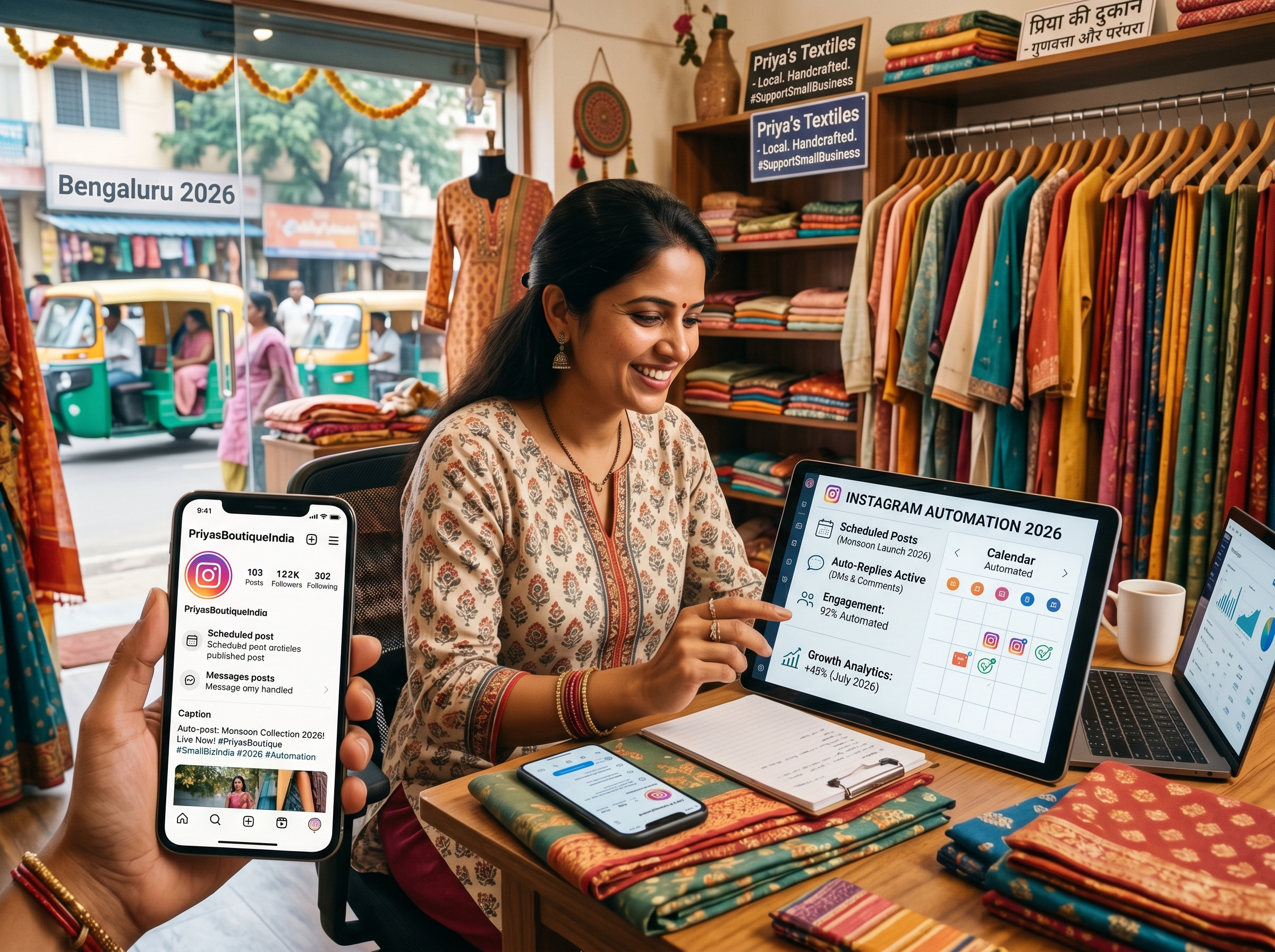
Why Instagram Automation Matters for Indian Small Businesses in 2026
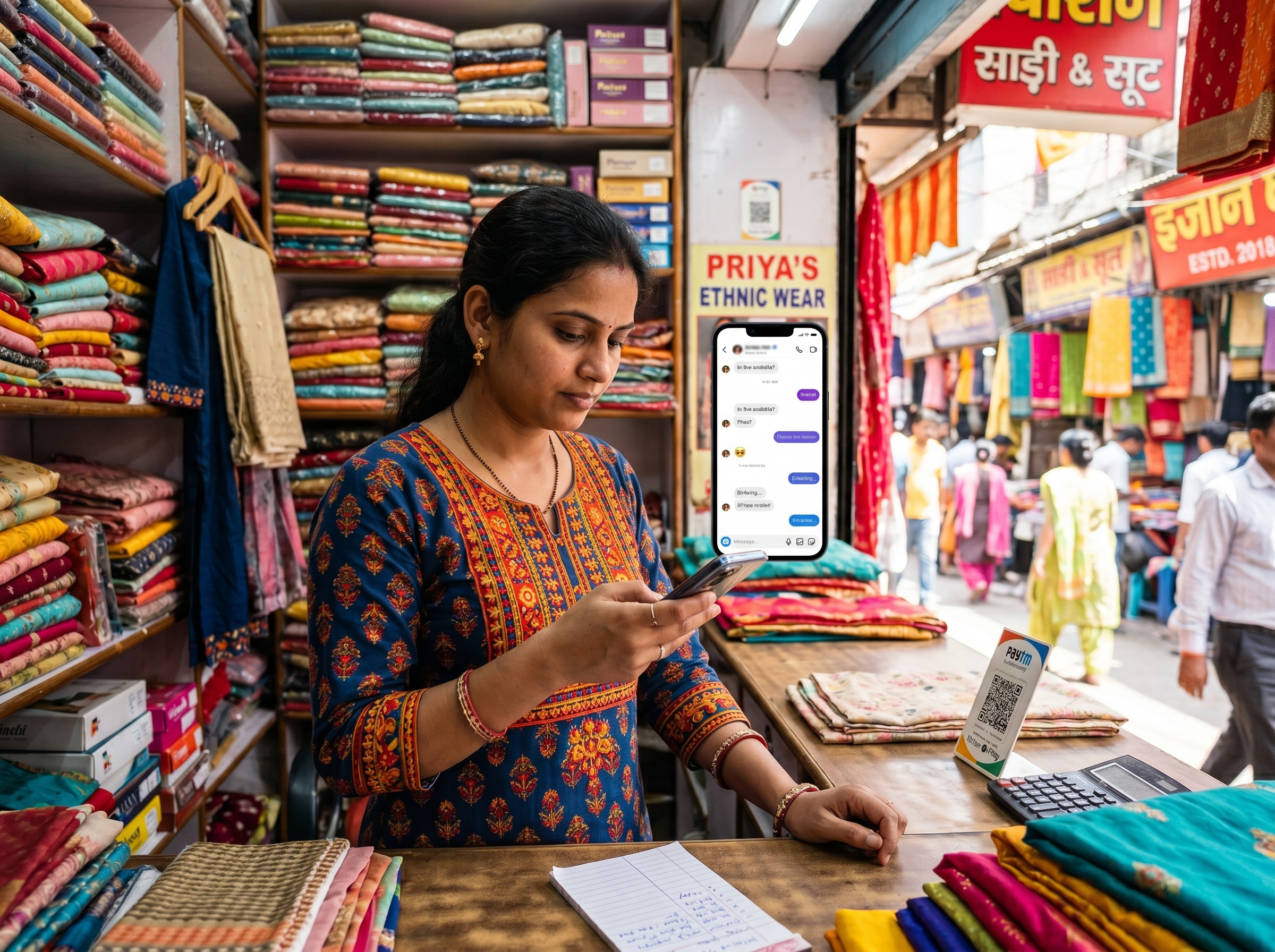
Instagram has evolved from a photo-sharing app into India's most intimate business communication channel. For small business owners running boutiques in Colaba, coaching institutes in Lajpat Nagar, and bakeries in Indiranagar, the direct message inbox is where sales actually happen. But that same inbox has become a source of chaos — hundreds of repetitive questions, missed leads at 2 AM, and viral posts that flood your DMs faster than any human team can respond. This is precisely why small business India automation has moved from a nice-to-have luxury to an operational necessity in 2026. The brands that automate intelligently are capturing leads while their competitors sleep. The brands that don't are burning out their founders and hemorrhaging warm prospects into the void of unread messages.
Key takeaways:
Prices verified June 2026. FX calculated at ₹89/USD, ₹92/EUR with 3.5% transaction fee and 18% GST credit loss applied to non-Indian vendors.
The DM Chaos Problem for Indian SMBs
Every Indian small business owner on Instagram knows the pattern. You post a Reel showcasing your new product collection at 8 PM. By 10 PM, forty-seven people have commented "PRICE" or "HOW" or simply dropped a heart emoji. By morning, twelve of them have moved on to a competitor who responded faster. Another eight sent follow-up messages asking if you received their first DM. Three are angry that you never replied. This is the DM chaos problem — and it scales brutally. A boutique in Bandra with 15,000 followers receives an average of 80-120 DMs per day during festival seasons. A solo coach running a webinar promotion can see 300+ DMs in 48 hours. Manual management means either hiring dedicated staff (₹15,000-25,000/month in metro India) or accepting that you will miss a significant percentage of warm leads. Neither option is viable for a business operating on thin margins. The real cost isn't just the missed replies — it's the mental load of constantly checking your phone, the sleep disruption, and the inability to focus on product development or service delivery because you're trapped in your inbox.
India's 400M Instagram User Opportunity
India is now Instagram's largest market by active users, with over 400 million monthly active users as of early 2026. This isn't just a vanity metric — it represents the deepest penetration of visual commerce anywhere in the world. Indian consumers don't just browse Instagram; they discover products, compare prices, read comments for social proof, and make purchase decisions entirely within the app. For small businesses, this means your Instagram profile is often your storefront, your catalog, your customer service desk, and your checkout page all rolled into one. The opportunity is particularly acute for D2C brands, local service providers, and creators who monetize through courses or consulting. Unlike saturated Western markets, India's Instagram commerce ecosystem is still in a growth phase where early automation adopters can capture disproportionate market share. A Mumbai-based skincare brand that automates its comment-to-DM funnel can reach 50,000 engaged users monthly without increasing headcount. A Delhi fitness coach using creator-focused automation can scale from 20 to 200 consultations booked per month. The 400 million user base isn't just an audience — it's a pipeline waiting to be systematically tapped.
Why 2026 Is the Year to Automate
Three converging factors make 2026 the inflection point for Instagram automation in India. First, Meta has significantly expanded its Instagram Messaging API capabilities, making official automation more powerful and reliable than ever before. Features that previously required risky browser bots — like automated story replies, multi-step DM flows, and seamless handoff to human agents — are now available through compliant API pathways. Second, Indian small businesses have matured in their digital literacy. The post-pandemic wave of forced digitization means that business owners who once feared "robotic" customer interactions now understand that intelligent automation actually delivers faster, more consistent service than overwhelmed human operators. Third, and most critically, the competitive landscape has intensified. With global tools like ManyChat pricing themselves out of the Indian market at $14-65/month (approximately ₹1,250-5,800 after FX) [Source: manychat.com/pricing, verified June 2026], and new India-first tools like QuickDM emerging at ₹399/month, automation has become affordable at exactly the moment it became essential. Businesses that delay adoption in 2026 won't just be inefficient — they'll be competitively disadvantaged.
The Hidden Cost of Manual DM Management
The true cost of managing Instagram DMs manually extends far beyond the obvious time sink. Consider the economics: an Indian small business owner earning ₹50,000/month who spends 3 hours daily on DMs is effectively allocating ₹6,250 worth of their time to a task that generates zero new value. That's ₹75,000 annually — enough to hire a junior employee or invest in significant inventory. But the financial cost is only half the story. Manual DM management creates what psychologists call "continuous partial attention" — a state of constant distraction that degrades decision-making quality across all business functions. The boutique owner checking DMs during a supplier negotiation makes worse purchasing decisions. The coach replying to comments during a client call delivers poorer service. Furthermore, manual processes are inconsistent. A tired founder at 11 PM sends shorter, less enthusiastic replies than they do at 9 AM. Important leads slip through because the notification got buried under twenty others. Indian SMB automation tools eliminate this variability, ensuring every prospect receives an optimal response regardless of when they message or how busy the founder happens to be.
Types of Instagram Automation Tools (and Which One You Actually Need)

Not all Instagram automation tools are built for the same purpose. The market has fragmented into distinct categories, each solving different problems for different user profiles. Understanding these categories is essential because choosing the wrong type of tool — a heavyweight multi-channel CRM when you only need comment auto-replies, or a simple bot when you need sophisticated lead qualification — leads to wasted money and poor results. Before diving into specific tool comparisons, let's map the landscape so you can identify exactly which category matches your business model, technical comfort level, and growth ambitions. Free and paid DM tools span all these categories, and knowing your type will help you navigate that comparison effectively.
DM Flow Builders vs Comment Triggers
DM flow builders are the Swiss Army knives of Instagram automation. They allow you to construct multi-step conversation sequences — when a user comments "INFO," they receive an immediate DM, then a follow-up after 2 hours if they haven't responded, then a final message 24 hours later with a special offer. These tools excel at lead nurturing, qualification, and conversion. Comment triggers are simpler but equally powerful: they monitor your posts and Reels for specific keywords (like "PRICE," "LINK," or "BOOK") and automatically send predefined DMs to commenters. For Indian small businesses, the choice depends on your sales cycle. A coaching institute offering a free trial class needs a flow builder to qualify leads over multiple touchpoints. A boutique launching a flash sale only needs comment triggers to distribute coupon codes. Many modern tools, including QuickDM, offer both capabilities in a single platform. The critical question isn't which technology to choose — it's whether your customer journey requires sustained conversation or single-touch response. Most Indian D2C brands eventually need both, which is why standalone comment-trigger tools often become limiting as businesses scale.
Post Schedulers vs Growth Hacks
Post schedulers like Later, Buffer, and Hootsuite solve a fundamentally different problem than DM automation tools. They optimize the content publishing workflow — allowing you to batch-create posts, schedule them for optimal engagement times, and maintain a consistent content calendar. While valuable, they don't automate the conversations that happen after someone sees your content. Growth hack tools take a more aggressive approach, promising follower growth through automated engagement pods, mass following/unfollowing, or automated liking. These tools often violate Instagram's terms of service and carry significant ban risk. For Indian small businesses, the distinction matters enormously. A post scheduler might help you publish consistently, but it won't convert a viral Reel's comment section into a lead database. A growth hack tool might inflate your follower count, but those followers rarely convert to customers and the account risk isn't worth the vanity metric. The most successful Indian Instagram businesses in 2026 combine consistent content scheduling with intelligent DM automation — capturing and converting the engagement that content generates, rather than chasing hollow growth numbers.
CRM-Integrated vs Standalone Tools
CRM-integrated automation tools connect your Instagram DMs to broader customer relationship management systems like HubSpot, Salesforce, or Zoho. When someone messages your Instagram account, their conversation history, purchase records, and website behavior all become visible to the automation logic and any human agent who takes over. This integration is powerful for businesses with complex sales cycles or existing CRM investments. However, it comes at a cost — both financial (CRM licenses plus automation tool fees) and operational (setup complexity, training requirements). Standalone tools like QuickDM operate entirely within the Instagram ecosystem. They're faster to set up, more affordable for small businesses, and require no technical integration work. For a Mumbai salon or a Bangalore boutique, a standalone tool that captures emails and phone numbers is usually sufficient. The CRM integration only becomes necessary when you're managing thousands of leads across multiple channels with a dedicated sales team. Most Indian SMBs should start standalone and only consider CRM integration after they've proven their Instagram funnel's unit economics. DM automation comparison resources can help you evaluate which architecture fits your current stage.
Browser Bots vs Official API Tools
This is the most critical technical distinction in Instagram automation, and the one that determines whether your automation strategy sustains your business or destroys it. Browser bots — also called scrapers or unofficial automation tools — work by simulating a real user browsing Instagram through a web browser. They log into your account, navigate the interface, click buttons, and type messages exactly as a human would. This approach has two fatal flaws. First, it's explicitly against Instagram's Terms of Service, and Meta actively detects and bans accounts using browser automation. Second, browser bots are unreliable — Instagram's interface changes break them constantly, and they're slow because they must literally load web pages for every action. Official API tools like QuickDM, ManyChat, and CreatorFlow communicate directly with Meta's servers through approved programming interfaces. They're faster, more reliable, fully compliant with Instagram's rules, and can handle vastly higher message volumes. The difference is like the difference between forging a key to sneak into a building and having a legitimate access card. For Indian small businesses that can't afford to lose their primary customer acquisition channel to a ban, official API tools are the only responsible choice.
Which Type Is Right for Your Use Case
Choosing the right automation type requires honest assessment of four variables: your primary channel (Instagram-only vs. multi-channel), your DM volume, your budget in INR, and your risk tolerance. If you're an Instagram-first D2C brand in India with moderate DM volume and a tight budget, a standalone API tool with flow builder and comment trigger capabilities is optimal. If you're a multi-channel agency managing Facebook, WhatsApp, SMS, and Instagram for clients, you need a CRM-integrated platform like ManyChat despite the higher cost. If you're a solo creator focused purely on comment-to-DM conversion for course sales, a lightweight tool like CreatorFlow or QuickDM's free tier may be sufficient. If you're considering a browser bot because it's cheaper — stop. The account ban risk alone outweighs any savings, and rebuilding a banned Instagram account's follower base from scratch costs far more than any official tool's subscription fee. DM automation guide resources provide detailed use-case matching to help you decide.
Quick Answer: The Best Instagram Automation Tools for India (2026)

If you don't have time to read this entire guide, here's the executive summary. We tested and ranked seven Instagram automation tools based on their India fit, pricing in INR, Meta API compliance, feature depth, and real user reviews. The rankings below reflect specifically the needs of Indian small businesses — D2C brands, local services, coaches, and creators — not generic global agency requirements. For the best Instagram automation tools from a global perspective, see our broader comparison.
Best Overall for Indian SMBs
Winner: QuickDM — QuickDM is the only Instagram automation tool built specifically for the Indian market. Its free-forever plan includes unlimited automations, 20 DMs/hour, follow-gating for up to 100 followers, and email collection for up to 100 emails — no credit card required. The Pro plan at ₹399/month (approximately $10 globally) delivers 185 DMs/hour, which sits comfortably within Meta's safety green zone while being nearly 10× faster than the free tier. No other tool in our comparison offers native INR billing, GST invoicing, UPI payment support, and Mumbai-based customer service. For Indian small businesses that need reliable, compliant, affordable automation without FX markup surprises, QuickDM is the clear category leader. The platform's visual flow builder makes it accessible to non-technical founders, while its DM cap transparency ensures you always know exactly where you stand relative to Meta's limits. Whether you're a boutique in Jaipur, a salon in Pune, or a coaching institute in Chennai, QuickDM's combination of India-first pricing and global-grade compliance makes it the most rational choice in 2026.
[CTA: Start automating your Instagram DMs for free with QuickDM's forever-free plan → https://quickdm.app/signup]Best Free Plan
Winner: QuickDM — In a market where "free" usually means a 14-day trial or a severely crippled plan, QuickDM's free tier is genuinely operationally viable. Twenty DMs per hour translates to approximately 4,800 DMs per month if used consistently — enough for a small boutique's entire customer service volume. The inclusion of 100 email captures means you can build a meaningful retargeting list for Mailchimp or WhatsApp marketing without spending a rupee. One hundred follow-gated followers helps you grow a warm audience organically. By comparison, ManyChat's free plan limits you to 25 active contacts [Source: manychat.com/pricing, verified June 2026], which a single viral Reel can exhaust in hours. CreatorFlow offers 500 DMs/month on its free tier [Source: creatorflow.so/pricing, verified June 2026] — better than ManyChat but still a fraction of QuickDM's capacity. Inrō's free plan caps at 100 active contacts/month [Source: inro.social/pricing, verified June 2026]. LinkDM provides 1,000 DMs/month [Source: linkdm.com/pricing, verified June 2026], which is respectable but lacks the unlimited automation depth of QuickDM's free tier. For Indian small businesses testing automation for the first time, QuickDM's free plan removes every barrier — no credit card, no time limit, no feature lockout that forces an upgrade before you've proven ROI.
Best for Multi-Channel Agencies
Winner: ManyChat — ManyChat remains the gold standard for agencies that manage Instagram, Facebook Messenger, WhatsApp, SMS, and email automation from a single dashboard. Its visual flow builder is mature and intuitive, with extensive template libraries and powerful AI-driven conversation branching. The platform supports advanced features like user segmentation, A/B testing of message sequences, and deep integrations with e-commerce platforms. However, this multi-channel power comes at a significant cost for Indian users. The Essential plan starts at $14/month for 250 contacts [Source: manychat.com/pricing, verified June 2026], but contact-based billing means your costs scale unpredictably with viral content. At 1,000 active contacts, you're on the Pro plan at $65/month — approximately ₹5,800 after FX markup and bank fees. ManyChat bills exclusively in USD with no INR option, no GST invoicing, and no India-specific support. For global agencies with USD revenue streams, this is manageable. For Indian SMBs operating purely in rupees, it's prohibitively expensive. If you need multi-channel automation and can absorb the USD pricing, ManyChat is technically excellent. If Instagram is your primary channel, you're paying for capabilities you'll never use.
Best for AI-First Workflows
Winner: Inrō — Inrō has built the most sophisticated AI-driven DM automation experience in the market. Rather than rigid keyword-based flows, Inrō uses natural language understanding to interpret user intent and generate contextual responses. A user asking "Do you have this in blue?" receives a fundamentally different response than one asking "How do I return this?" — without requiring explicit programming for every possible question variant. The platform boasts a 4.9★ rating on Product Hunt and strong reviews from tech-forward creators. However, Inrō prices in EUR (€12.99/month for Pro) [Source: inro.social/pricing, verified June 2026], which creates FX complexity for Indian users. Its free tier is limited to just 100 active contacts monthly — barely enough for a week of moderate activity. The AI sophistication is genuinely impressive, but for Indian small businesses that primarily need reliable comment-to-DM triggers and follow-up sequences, Inrō's AI capabilities may be over-engineered. The integration ecosystem is also narrower than ManyChat's, meaning you may struggle to connect with India-specific tools. Consider Inrō if your use case genuinely requires intelligent conversation handling beyond simple automation — otherwise, the EUR pricing and limited free tier make it a poor India fit despite the technical excellence.
Best for Comment-to-DM Funnels
Winner: LinkDM — LinkDM has optimized specifically for the comment-to-DM use case, and its execution is polished. When someone comments a trigger word on your post or Reel, LinkDM sends a personalized DM faster than most competitors. The setup process is streamlined — you can configure a basic comment trigger in under three minutes. The free plan offers 1,000 DMs/month [Source: linkdm.com/pricing, verified June 2026], which is generous for light users. However, LinkDM's paid plans start at $19/month (approximately ₹1,580 after FX) [Source: linkdm.com/pricing, verified June 2026], making it one of the more expensive entry points in our comparison. The tool is also Instagram-only, so if you later expand to WhatsApp or Facebook, you'll need a second platform. For Indian small businesses that exclusively need comment triggers and don't mind the USD pricing, LinkDM is reliable and well-built. But when compared to QuickDM's ₹399 Pro plan — which includes comment triggers plus flow builders, follow-gating, email collection, and India support — LinkDM's value proposition weakens significantly. It's a solid tool for a narrow use case at a premium global price.
How We Tested and Ranked These Tools
Our ranking methodology goes beyond feature checklists and marketing claims. We subjected each tool to a rigorous evaluation process designed specifically around the operational realities of Indian small businesses. This isn't a theoretical comparison — it's a practical stress test based on real workflows, real pricing pain points, and real safety concerns. For the full global comparison and how these same tools perform outside India, see our dedicated global ranking article.
Ranking Criteria Explained
We evaluated each tool across seven weighted dimensions, with India-specific factors receiving higher priority than they would in a generic global review. First, India Pricing & Billing (25% weight): we looked for native INR pricing, GST invoicing capability, UPI support, and overall cost after FX for tools billing in USD/EUR. A tool scoring well here eliminates the hidden 18-25% cost inflation that Indian SMBs suffer when subscribing to USD-priced SaaS. Second, Meta API Compliance & Safety (20% weight): we verified whether each tool uses official Meta APIs, publishes transparent DM rate limits, and maintains safety margins below Meta's thresholds. Tools making "unlimited" claims without mapping to Meta's actual limits received severe penalties. Third, Free Tier Viability (15% weight): we assessed whether the free plan is genuinely usable for a real small business, or merely a marketing teaser designed to force an upgrade after a week. Fourth, DM Workflow Depth (15% weight): flow builders, conditional branching, delay timers, and multi-step sequences. Fifth, Lead Qualification Features (10% weight): follow-gating, email collection, phone capture, and tagging. Sixth, Ease of Setup (10% weight): time to first automation running, template quality, and UI intuitiveness for non-technical users. Seventh, Support & Documentation (5% weight): India time zone support, regional language resources, and response speed. These ranked automation tools were scored against each criterion on a 1-10 scale, with weighted averages determining final rankings.
DM Workflow Depth
Workflow depth measures how sophisticated your automated conversations can become. A basic tool lets you send a single message when someone comments. An advanced tool lets you build branching logic: if the user responds positively, send them a catalog link; if they don't respond for 24 hours, send a reminder; if they've already purchased, skip the pitch and ask for a review. We tested each tool's flow builder by attempting to recreate a standard Indian D2C funnel: comment trigger → welcome DM → product question → email capture → follow-up offer → purchase link. QuickDM completed this sequence with its visual flow builder and conditional logic. ManyChat handled it with advanced branching and A/B testing. CreatorFlow managed the basic sequence but lacked deep conditional branching. LinkDM struggled with multi-step flows beyond the initial comment trigger. InstantDM's workflow builder was functional but the "unlimited" claims raised safety concerns that affected its trust score. Inrō excelled at AI-powered branching but required more setup time. The workflow depth score directly correlates with conversion optimization potential — deeper workflows mean more personalized customer journeys and higher revenue per conversation.
Lead Qualification Features
Not every DM conversation is equally valuable. A user asking "What's your address?" is closer to purchase than one asking "Do you ship to Trivandrum?" Lead qualification features help you identify, tag, and prioritize your hottest prospects automatically. We evaluated four specific capabilities: follow-gating (requiring users to follow your account before receiving certain DMs), email collection (capturing email addresses during DM conversations), phone number capture, and user tagging/segmentation. QuickDM scored highest here with robust follow-gating (up to 100 followers on free, unlimited on Pro), email collection (100 on free, unlimited on Pro), and visual tagging. ManyChat offers sophisticated user fields and segmentation but buries advanced features behind higher pricing tiers. CreatorFlow provides basic tagging but no native follow-gating. LinkDM focuses narrowly on DM delivery rather than qualification. InstantDM includes email capture but the reliability concerns undermine trust in data handling. Inrō's AI naturally qualifies leads through conversation but lacks explicit gating mechanisms. For Indian small businesses, follow-gating is particularly valuable — it converts DM engagement into follower growth, which improves organic reach and creates a retargetable audience for future campaigns.
Follow-Up Automation
The money in DM automation isn't in the first message — it's in the follow-up. Statistics consistently show that 80% of sales require five or more touchpoints, yet most manual Instagram operators give up after one unreplied message. We tested each tool's ability to schedule delayed follow-ups, create drip sequences, and handle user responses intelligently. QuickDM offers delay timers, conditional follow-ups based on user actions, and unlimited automation sequences on both free and paid plans. ManyChat provides the most sophisticated follow-up engine with time-zone-aware delivery, A/B testing, and engagement-based triggers. CreatorFlow offers basic delayed messages but lacks conditional branching on follow-ups. LinkDM's strength is immediate comment response, not sustained conversation management. InstantDM includes follow-up capabilities but again, the safety concerns limit recommendation confidence. Inrō's AI generates contextual follow-ups that feel remarkably human, though the EUR pricing remains a barrier. For a coaching institute in Delhi following up with trial class inquiries, or a boutique nurturing festival sale leads over two weeks, follow-up automation is where revenue is actually generated. The first DM opens the door; the follow-up sequence walks the prospect through it.
Multi-Channel Fit
While this article focuses on Instagram automation, we recognize that many Indian businesses operate across multiple channels. A customer might discover you on Instagram, prefer to communicate on WhatsApp, and ultimately purchase through your website. We evaluated how easily each tool integrates with Facebook Messenger, WhatsApp Business API, SMS, and email marketing platforms. ManyChat dominates this category — it's genuinely multi-channel with native support for Instagram, Facebook, WhatsApp, SMS, and email. QuickDM is currently Instagram-focused (though WhatsApp integration is on the roadmap), which is sufficient for the 80% of Indian SMBs whose primary customer interaction channel is Instagram. CreatorFlow offers limited multi-channel support. LinkDM and InstantDM are Instagram-only. Inrō supports Instagram and limited web chat. For businesses that need unified multi-channel automation today, ManyChat remains the technical leader despite its India pricing challenges. For Instagram-first businesses, QuickDM's focused approach delivers better value without charging for unused channels. Our tested Instagram tools evaluation includes detailed multi-channel scoring for each platform.
Revenue Impact & ROI
Ultimately, automation tools are investments, not expenses. We modeled ROI for a typical Indian small business — a boutique with 10,000 Instagram followers, converting 2% of engaged users into customers with an average order value of ₹1,500. Manual DM management at 50 DMs/day consumes 2.5 hours daily. At ₹300/hour opportunity cost, that's ₹22,500/month in founder time. Automation at ₹399/month (QuickDM Pro) saves 90% of that time while improving response speed and consistency. The break-even point is instantaneous. But the real ROI comes from capture rate improvement: automation responds to 100% of comments within seconds, while manual management misses 30-40% of after-hours inquiries. For a boutique generating 100 DM inquiries weekly, automation captures 30-40 additional leads that would otherwise be lost. At 10% conversion and ₹1,500 AOV, that's ₹45,000-60,000 in additional monthly revenue — a 100×+ return on the ₹399 tool investment. We applied similar ROI models across all tool categories, factoring in their respective pricing, DM caps, and conversion capabilities. Every tool in our comparison delivered positive ROI for active Instagram businesses, but QuickDM's India pricing created the most dramatic return multiples.
Tool Deep Dive: QuickDM

QuickDM is a Mumbai-based Instagram automation platform built specifically for Indian small businesses, D2C brands, coaches, and creators. Unlike global tools that treat India as an afterthought, QuickDM was designed from the ground up with INR pricing, GST compliance, UPI payments, and regional language support. The platform operates exclusively through Meta's official Instagram APIs, ensuring full compliance and zero ban risk. QuickDM free plan and Pro options make it accessible to businesses at every stage, from pre-revenue startups to scaling agencies.
[CTA: Automate your Instagram DMs with India's own automation tool — start free → https://quickdm.app/signup]Best For: Indian D2C Brands & Local Services
QuickDM's architecture aligns precisely with how Indian small businesses actually use Instagram. A Mumbai skincare boutique can set up a comment-to-DM flow where anyone commenting "ROUTINE" on a Reel automatically receives a personalized DM with a skincare quiz link. A Bangalore fitness coach can configure follow-gating that requires new users to follow the account before receiving a free workout PDF. A Delhi home bakery can automate order confirmations, address collection, and delivery slot selection entirely through DMs. The platform's visual flow builder requires no coding knowledge — founders with zero technical background can build sophisticated automation sequences in under 20 minutes. The India-specific use cases extend beyond generic e-commerce: QuickDM supports festival sale campaigns (Diwali, Eid, Christmas), flash drops for boutique fashion, appointment booking for salons and clinics, and course enrollment for coaches. The creator DM automation capabilities are particularly strong for Indian influencers monetizing through courses, consulting, or brand collaborations. Because the platform is built by a Mumbai team, the template library includes India-relevant scenarios rather than generic Western business models.
QuickDM Pricing: Free Forever vs Pro at ₹399
QuickDM operates on a simple two-tier pricing model that eliminates the complexity and surprise charges common in the automation industry. The Free plan costs ₹0 forever — no 14-day trial, no credit card requirement, no hidden upgrade pressure. It includes unlimited automations (you can create as many flow sequences as you want), 20 DMs per hour, follow-gating for up to 100 followers, and email collection for up to 100 emails. For a small Indian business just starting with automation, this free tier is genuinely operationally viable — not a teaser designed to frustrate you into upgrading. The Pro plan costs ₹399 per month for Indian users ($10/month for global users). This represents a fraction of what Indian SMBs pay for competing tools after FX markups. Pro increases the DM cap to 185 per hour (well within Meta's green zone), removes all collection limits (unlimited emails, unlimited followers), and unlocks priority support from the Mumbai team. There are no per-contact charges, no overage fees, and no feature tiers within Pro — everything is included at one flat price. This pricing transparency is revolutionary in an industry where competitors bury critical features behind multiple pricing tiers and bill in currencies that cost Indian users an additional 20-30% after bank fees.
Free Plan Reality: 20 DMs/Hour, 100 Emails, 100 Followers
Let's quantify what QuickDM's free plan actually delivers in practice. At 20 DMs per hour, assuming you operate actively 8 hours per day, 30 days per month, your theoretical monthly capacity is 4,800 DMs. Even at a more realistic 4 hours of active engagement daily, that's 2,400 DMs monthly — enough for a boutique processing 80 customer inquiries per day. The 100-email collection limit means you can build a substantial retargeting list: at industry-average 15% email capture rates from DM conversations, you'd need approximately 667 engaged DM interactions to fill this quota. For a pre-revenue startup or a side-hustle business, this free capacity often sustains full operations for 3-6 months before an upgrade becomes necessary. The 100 follow-gated followers represent warm, engaged audience growth — these aren't random followers from a follow-back loop; they're people who actively engaged with your content and chose to follow you in exchange for value. Compare this to ManyChat's free tier, which limits you to 25 active contacts [Source: manychat.com/pricing, verified June 2026] — a single viral Reel can exhaust this in hours. Or Inrō's 100 active contacts [Source: inro.social/pricing, verified June 2026], which sounds comparable but represents individual people rather than DM interactions. QuickDM's free plan is unique in offering unlimited automations alongside meaningful volume caps — you can build complex, multi-step workflows without artificial feature restrictions.
Pro Plan: 185 DMs/Hour & Unlimited Automations
QuickDM Pro at ₹399/month represents one of the best price-to-performance ratios in the global Instagram automation market. The 185 DMs per hour cap is strategically engineered: Meta's official private reply limit for posts and reels is 750/hour [Source: developers.facebook.com/docs/graph-api/overview/rate-limiting, verified June 2026], meaning QuickDM Pro operates at roughly 25% of the theoretical maximum. This massive safety margin protects your account even during viral spikes, while still delivering enough throughput for aggressive growth strategies. To put 185 DMs/hour in context: if you're running a festival sale campaign and receive 500 comment triggers in an hour, QuickDM Pro handles 185 immediately and queues the rest — rather than either dropping them (like some tools do) or blasting all 500 and risking a rate limit violation (like unsafe tools do). The unlimited automations mean you can create separate flows for every product category, every campaign, every customer segment — there's no artificial constraint forcing you to consolidate. Unlimited email collection lets you build massive retargeting lists for platforms like Mailchimp, Klaviyo, or Indian email marketing tools. Unlimited follow-gating means your follower growth accelerates in direct proportion to your content's viral performance. At ₹399/month, this is approximately the cost of two Domino's pizzas — an almost trivial investment for any business serious about Instagram growth.
DM Caps vs Meta Limits: Green Zone Safety
Understanding DM caps requires understanding Meta's actual rate limits, which most automation vendors deliberately obscure. Meta's Instagram Messaging API specifies several limits: 750 private replies per hour to comments on posts and reels, 100 API calls per second for text messages, 10 calls per second for audio/video, and a platform-level limit of 4,800 times impressions per 24 hours [Source: developers.facebook.com/docs/graph-api/overview/rate-limiting, verified June 2026]. QuickDM has engineered its caps as a three-zone safety system. The Green Zone — 20 DMs/hour on Free, 185 DMs/hour on Pro — represents comfortable operation with massive headroom below Meta's thresholds. Even if you hit your QuickDM cap continuously for 24 hours, you'd send at most 4,440 DMs — well under the platform limit. The Yellow Zone — 200-750 DMs/hour — is where technically possible but risky. Some competitors operate here, pushing close to Meta's limits to maximize throughput. This works until it doesn't — a sudden algorithm change or account review can trigger restrictions. The Red Zone — anything above 750/hour or using browser automation instead of APIs — is where bans happen. Tools claiming "truly unlimited" DMs are either operating in the Red Zone or being dishonest about their actual throughput. QuickDM's conservative cap approach prioritizes account safety over vanity metrics, which is exactly what small businesses need.
India-First Features: INR Billing, GST, UPI
QuickDM is the only tool in our comparison cohort that offers native Indian financial infrastructure. INR billing means you pay exactly ₹399 — not a fluctuating USD conversion that changes monthly based on exchange rate movements. When ManyChat charges $14, that becomes approximately ₹1,250 at today's rate, but ₹1,350 next month if the rupee weakens. QuickDM's pricing is fixed in rupees, giving you predictable monthly expenses for budgeting. GST invoicing is critical for Indian registered businesses: QuickDM provides GST-compliant invoices with your GSTIN, allowing you to claim input tax credit. USD tools cannot provide GST invoices, meaning the effective cost is 18% higher than the sticker price and non-deductible for tax purposes. UPI support means you can pay via Google Pay, PhonePe, Paytm, or any UPI app — no credit card required, no international transaction fees, no bank FX markup. For Indian small businesses operating on tight cash flows, UPI's instant settlement and zero transaction cost (compared to 2-3% on cards) matters significantly. These aren't minor conveniences — they're structural advantages that reduce QuickDM's total cost of ownership by 30-40% compared to USD-priced alternatives.
Mumbai HQ & Local Support
QuickDM operates from Mumbai, which provides tangible advantages for Indian users beyond patriotic preference. India time zone support (IST, UTC+5:30) means when you have a question at 11 AM about why a DM flow isn't triggering during your lunch-hour campaign, you're talking to someone who is also at 11 AM — not submitting a ticket that gets answered at 2 AM your time by someone who doesn't understand Indian business contexts. The Mumbai team understands festival marketing calendars (knowing that Diwali campaigns start in September, not November), regional language requirements, and the specific pain points of Indian SMBs like cash-on-delivery coordination, WhatsApp handoffs, and address collection for tier-2 city deliveries. Local support also means faster resolution for India-specific issues: UPI payment failures, GST invoice corrections, or compliance questions about Meta's policies as they apply to Indian accounts. For global tools, India support is typically handled by offshore teams working from playbooks. For QuickDM, India is the primary market — not an afterthought.
Pros: No Per-Contact Surprises
QuickDM's single most valuable feature for Indian small businesses isn't technical — it's financial predictability. Unlike ManyChat, where a viral Reel can spike your monthly bill from $14 to $65 because you exceeded your contact tier [Source: manychat.com/pricing, verified June 2026], QuickDM charges a flat ₹399 regardless of how many people message you. This means you can plan marketing campaigns without fearing surprise bills. A Diwali flash sale that generates 5,000 DM conversations won't cost you a rupee extra beyond your fixed Pro subscription. This predictability extends to the free plan too — unlimited automations means you can experiment, test, and optimize without counting credits or worrying about hitting artificial feature walls. The visual flow builder is genuinely intuitive, with drag-and-drop interfaces that non-technical founders master in a single session. The follow-gating and email collection features work reliably, with captured data exportable via CSV for import into Mailchimp, Klaviyo, or Indian marketing platforms. For SMB-focused automation, QuickDM's combination of predictable pricing, India-specific features, and compliant operation creates a value proposition that no global competitor can match at anywhere near the same price point.
Cons: Instagram-Only Focus
QuickDM's primary limitation is its Instagram-only focus. If your business operates across Facebook Messenger, WhatsApp Business API, SMS, and Instagram simultaneously, you'll need separate tools for each channel or a more expensive multi-platform solution like ManyChat. For the majority of Indian small businesses — boutiques, salons, coaches, local services — Instagram is the dominant customer acquisition channel, making this limitation more theoretical than practical. However, agencies managing multiple client channels, or D2C brands with significant WhatsApp commerce operations, may find QuickDM's single-channel approach constraining. The company has indicated WhatsApp integration is on the roadmap but hasn't published a specific timeline. Another consideration is that QuickDM's AI capabilities, while functional, don't match the natural language sophistication of Inrō's AI-first platform. For businesses that genuinely need intelligent conversation handling beyond keyword-based triggers, this may be a limiting factor. Finally, as a newer platform compared to ManyChat's decade-long market presence, QuickDM's third-party integration ecosystem is smaller — though it covers the essential connections (email platforms, analytics, scheduling tools) that Indian SMBs actually use.
Verdict: Best Value for Indian SMBs
QuickDM is not just the best Instagram automation tool for Indian small businesses — it's the only tool that treats India as a primary market rather than a geographic afterthought. The combination of free-forever entry, ₹399 Pro pricing with GST and UPI, Mumbai-based support, and Meta-compliant safety engineering creates a value proposition that global competitors cannot touch without fundamentally restructuring their business models. For Indian D2C brands, local services, coaches, and creators, QuickDM eliminates every barrier to sophisticated Instagram automation: cost barrier (free entry), currency barrier (INR billing), compliance barrier (API-only operation), and support barrier (local team). While power users needing multi-channel agency management may still prefer ManyChat despite its pricing, the 90% of Indian small businesses that primarily need reliable Instagram DM automation will find everything they need in QuickDM. India business automation has found its definitive platform.
Tool Deep Dive: ManyChat
ManyChat is the dominant player in the global chatbot automation market, with over one million businesses using its platform across Instagram, Facebook Messenger, WhatsApp, SMS, and email. Founded in 2015, it has a decade of iteration behind its product, resulting in a polished, feature-rich platform with extensive integrations and a massive template library. However, for Indian small businesses, that maturity comes with a significant cost structure that deserves careful scrutiny. ManyChat vs QuickDM comparison reveals substantial India-fit differences.
Best For: Multi-Channel Agencies
ManyChat's core strength is genuine multi-channel automation from a single dashboard. An agency managing fifteen client accounts can orchestrate Instagram comment-to-DM flows, Facebook Messenger sequences, WhatsApp broadcast campaigns, SMS promotions, and email drip campaigns without switching platforms. The unified inbox aggregates conversations from all channels, showing a complete customer communication history regardless of where messages originated. This is genuinely valuable for agencies and businesses with sophisticated omni-channel strategies. The flow builder supports advanced logic: A/B testing of message variants, time-zone-aware delivery scheduling, user scoring based on engagement patterns, and conditional branching based on custom fields. For Indian agencies serving enterprise clients or businesses with significant WhatsApp commerce operations, ManyChat's channel breadth is unmatched. However, for the typical Indian small business that generates 90% of its social engagement through Instagram alone, ManyChat's multi-channel capabilities are overkill — you're paying for WhatsApp, SMS, and Facebook infrastructure you'll rarely use, while struggling with USD pricing that makes budget management unpredictable.
ManyChat Pricing: $14/mo Essential (250 contacts)
ManyChat's pricing structure is the primary barrier for Indian users. The Essential plan starts at $14 per month for up to 250 active contacts [Source: manychat.com/pricing, verified June 2026]. "Active contacts" means anyone who has interacted with your bot in the past 30 days — so if 300 people comment on your Diwali sale Reel, you're automatically bumped to a higher tier. The Pro plan at $65/month covers up to 1,000 contacts [Source: manychat.com/pricing, verified June 2026], and pricing continues scaling from there. For a growing Indian business, this contact-based model creates a perverse incentive: viral success directly increases your costs. A boutique that goes from 200 to 800 active contacts because one Reel hit the algorithm doesn't just get more sales — it gets a 4× higher automation bill. ManyChat bills exclusively in USD with no INR option, meaning Indian users pay additional foreign transaction fees (typically 3-5%), lose 18% GST input credit, and face monthly exchange rate fluctuations. The real monthly cost for an Indian business on ManyChat Pro isn't $65 — it's approximately ₹5,800-6,500 after all hidden costs. For context, that's more than most Indian small businesses spend on their entire software stack combined.
Free Plan Reality: Only 25 Active Contacts
ManyChat's free plan is among the most restrictive in the industry. You get unlimited flows but can only engage with 25 active contacts per month [Source: manychat.com/pricing, verified June 2026]. This isn't 25 DMs — it's 25 unique people. A single moderately successful post can exhaust this allocation in hours. The free plan also lacks critical features like email collection, custom branding, and advanced analytics. ManyChat's free tier is essentially a extended demo — designed to show you the platform's capabilities while forcing an upgrade before you can achieve meaningful business results. For an Indian small business testing automation for the first time, 25 contacts provides maybe 2-3 days of real usage before hitting the wall. In comparison, QuickDM's free plan offers 20 DMs per hour with no contact limit — you could engage thousands of unique users without upgrading. This difference in free tier philosophy reflects the companies' different target markets: ManyChat optimizes for rapid conversion to paid tiers among businesses with USD budgets, while QuickDM optimizes for long-term trust building with Indian SMBs who need to prove ROI before spending.
Per-Contact Billing: The Viral Week Trap
The per-contact billing model deserves its own warning section because it's the most common source of pricing shock for ManyChat users. Here's how the viral week trap works: you post a Reel on Tuesday that unexpectedly goes viral. By Wednesday, 1,200 people have commented and received DMs. Your active contact count for the month jumps from 180 to 1,200. ManyChat automatically upgrades your plan to the 5,000-contact tier at approximately $125/month [Source: manychat.com/pricing, verified June 2026]. You had budgeted ₹1,200 for automation; you're now billed ₹11,000+. This isn't hypothetical — Reddit forums and Trustpilot reviews are filled with complaints about unexpected ManyChat bills after viral content. [Source: reddit.com/r/socialmedia, verified June 2026] The contact-based model fundamentally misaligns the vendor's incentives with your business success: ManyChat profits when your content performs well, even if that virality doesn't convert to equivalent revenue. QuickDM's flat DM-cap pricing eliminates this misalignment — your costs remain ₹399 whether you send 100 DMs or 4,000. For Indian small businesses with unpredictable cash flows, this predictability isn't just convenient — it's essential for survival.
DM Caps & Meta Compliance
ManyChat operates through Meta's official APIs and maintains strong compliance standards. The platform respects Meta's rate limits and has established relationships with Meta's platform team, meaning they're typically early aware of policy changes. DM throughput is managed through contact-based allocation rather than explicit hourly caps — your effective DM rate depends on your plan tier and contact volume. ManyChat doesn't publish specific hourly DM limits, which creates some opacity compared to QuickDM's transparent 20/185 caps. However, ManyChat's scale and API compliance history mean account safety is generally strong. The platform has sophisticated queue management that paces message delivery to avoid triggering rate limits. For Indian agencies managing high-volume clients, ManyChat's compliance infrastructure provides peace of mind — though at a price point that puts it out of reach for most independent SMBs. The ManyChat alternative question for Indian users ultimately comes down to whether multi-channel capabilities justify the 5-10× price premium over QuickDM.
India Pricing: ~₹1,250+/mo with FX
Let's do the actual math for Indian users. ManyChat Essential at $14/month: at ₹89/USD (a common bank rate), that's ₹1,246. Add 3.5% foreign transaction fee (₹43): ₹1,289. Lose 18% GST credit you could have claimed with a GST-compliant invoice: ₹232 in additional effective cost. Total effective monthly cost: approximately ₹1,521. And that's for the entry plan with 250 contacts — barely enough for an active small business. If you need Pro features or grow beyond 250 contacts, the effective cost quickly reaches ₹5,000-7,000/month. For Indian small businesses operating on margins of 15-25%, spending ₹5,000/month on a single automation tool is a significant commitment. ManyChat's India pricing isn't malicious — it's simply a global USD product that hasn't been localized for the Indian market. But that lack of localization makes it economically unviable for the vast majority of Indian SMBs, which is precisely why QuickDM's ₹399 Pro plan represents such a disruptive market entry.
Pros: Ease of Use & Multi-Channel
ManyChat deserves credit for genuinely excellent product design. The flow builder is the most intuitive in the industry — anyone can create a basic automation sequence within 10 minutes of signing up. The template library is extensive, covering e-commerce, coaching, restaurants, real estate, and dozens of other industries. The multi-channel dashboard truly works — switching between Instagram DMs, WhatsApp conversations, and SMS threads is seamless. Integrations with Shopify, Zapier, HubSpot, Google Sheets, and hundreds of other tools mean you can connect ManyChat to virtually any business system. The analytics are comprehensive, showing flow performance, revenue attribution, and user engagement metrics. For agencies and businesses with dedicated marketing teams, ManyChat's sophistication enables automation strategies that smaller platforms can't match. The community is massive — thousands of tutorials, Facebook groups, and YouTube channels provide learning resources. If budget isn't a constraint and you need multi-channel automation, ManyChat's product quality justifies its market leadership. The question for Indian users is whether that quality is worth 5-10× the price of a locally-built alternative.
Cons: Contact Pricing Spikes & No INR
ManyChat's two fatal flaws for the Indian market are pricing unpredictability and currency incompatibility. The per-contact billing model means your costs grow with your success, creating cash flow stress during your best marketing moments. The lack of INR billing means every transaction involves FX markup, foreign transaction fees, and lost GST credit — an effective 25-35% price inflation over the sticker price. There's no India-specific support team, no understanding of Indian business contexts, no festival marketing templates, and no UPI payment option. For a Mumbai boutique preparing for Diwali sales or a Chennai coach launching a New Year fitness program, ManyChat is a foreign tool charging foreign prices for a foreign business model. The QuickDM compared to ManyChat analysis consistently shows that Indian businesses switching from ManyChat to QuickDM save 60-80% on automation costs while maintaining equivalent Instagram functionality. ManyChat remains a powerful platform — but power that you can't afford to use is theoretical, not practical.
Verdict: Powerful but Expensive for India
ManyChat is the Mercedes-Benz of chatbot automation — engineered to perfection, loaded with features, and priced accordingly. For Indian agencies with USD revenue, enterprise clients, and multi-channel requirements, it remains the technical benchmark. For Indian small businesses operating in rupees, serving Instagram-first customers, and needing predictable monthly costs, ManyChat is simply too expensive. The $14 entry point becomes ₹1,500+ after hidden costs, and the contact-based billing creates pricing trauma during viral growth moments. Unless you genuinely need WhatsApp, SMS, and Facebook automation alongside Instagram, the price premium over QuickDM is impossible to justify. ManyChat is a global tool for global businesses. QuickDM is an Indian tool for Indian businesses. The choice depends on which description matches your reality. ManyChat India alternative research consistently points toward local solutions.
Tool Deep Dive: CreatorFlow
CreatorFlow positions itself as the creator-friendly automation platform — simple, flat-priced, and designed for influencers, coaches, and solo entrepreneurs rather than agencies. The tool has gained traction among content creators who need basic DM automation without the complexity and pricing unpredictability of enterprise-focused platforms. QuickDM vs CreatorFlow reveals important differences for Indian users.
Best For: Solo Creators & Flat-Rate Simplicity
CreatorFlow's entire product philosophy centers on eliminating the anxiety that prevents creators from adopting automation. There are no contact-based billing surprises, no complex feature tiers, and no technical setup requiring developer assistance. You get a workspace, a DM cap, and a straightforward automation builder. This simplicity is genuinely appealing for solo creators who would rather spend time creating content than configuring software. A Bangalore food blogger can set up a comment trigger that sends recipe PDFs to anyone who comments "RECIPE" — done in five minutes, no stress about whether a viral post will trigger a bill shock. The platform supports Instagram-focused workflows: welcome messages for new followers, auto-responses to common questions, and basic lead capture. For creators who monetize through brand deals, courses, or consulting calls, CreatorFlow provides enough automation to handle inbound inquiries without requiring enterprise-grade features. However, that same simplicity becomes limiting as business complexity grows. A creator who expands into e-commerce with inventory management needs, or who wants to segment audiences by engagement level, will quickly outgrow CreatorFlow's intentionally narrow feature set. Instagram automation for creators in India requires tools that scale with their business evolution.
CreatorFlow Pricing: $12/mo Pro, $30/mo Growth
CreatorFlow's Pro plan costs $12 per month and includes 5,000 DMs per workspace [Source: creatorflow.so/pricing, verified June 2026]. The Growth plan at $30/month increases this to 10,000 DMs [Source: creatorflow.so/pricing, verified June 2026]. This flat-rate DM cap model is refreshingly transparent compared to ManyChat's contact-based pricing — you know exactly how many messages you can send, and exceeding the cap simply pauses automation rather than triggering an automatic upgrade. However, the pricing is still USD-denominated, meaning Indian users face the same FX markup and GST credit loss as with other global tools. The effective monthly cost for CreatorFlow Pro is approximately ₹1,000-1,150 after bank fees and lost GST credit. This makes it roughly 2.5× more expensive than QuickDM Pro (₹399) while offering fewer DM interactions (5,000/month cap vs. QuickDM's 185/hour which equals ~133,000/month theoretical maximum). The Growth plan at $30 (~₹2,800 effective) approaches ManyChat territory in terms of cost. For Indian creators earning in rupees, even CreatorFlow's "simple" pricing creates a meaningful monthly commitment that QuickDM undercuts significantly.
Free Plan: 500 DMs/Month, 1 Account
CreatorFlow's free tier provides 500 DMs per month on a single Instagram account [Source: creatorflow.so/pricing, verified June 2026]. This is more generous than ManyChat's 25-contact limit but substantially less than QuickDM's 20 DMs/hour (which delivers ~4,800 DMs/month at 8 hours daily usage). Five hundred DMs monthly translates to approximately 16 DMs per day — enough for a very small creator but quickly exhausted by any active marketing campaign. The single-account restriction means creators managing both personal and brand accounts need paid plans immediately. The free plan also lacks advanced features like conditional flows, A/B testing, and detailed analytics. CreatorFlow's free tier is functional for testing basic automation, but most active creators will need to upgrade within the first month of serious use. The 500 DM cap is a hard stop — unlike QuickDM's hourly cap which refreshes every hour, once you hit 500 DMs on CreatorFlow free, your automation stops until the next billing cycle.
DM Cap Model: 5K/10K per Workspace
CreatorFlow's monthly DM cap model is straightforward but potentially constraining for growth-stage businesses. The Pro plan's 5,000 DMs per month sounds generous until you calculate against active usage: if you're running a promotion and receive 200 comments daily, you'll exhaust your monthly cap in 25 days — with five days of dead automation. There's no hourly pacing or queue management; you simply stop sending when you hit the limit. This creates a risk during critical campaign periods like Diwali sales or product launches. The 10,000 DM Growth plan provides more headroom but at $30/month, it's approaching the cost of ManyChat's entry tier without ManyChat's feature depth. QuickDM's hourly cap model (20/hour free, 185/hour Pro) provides better burst handling — even on the free plan, you get 20 fresh DMs every hour rather than a monthly pool that can be exhausted prematurely. For Indian creators with irregular content schedules — one viral post can generate more DMs than a month of average content — QuickDM's refreshing cap model provides better protection against automation downtime.
India Pricing: ~₹1,000+/mo with FX
CreatorFlow Pro at $12/month costs Indian users approximately ₹1,060 after 3.5% foreign transaction fee at ₹89/USD exchange rate. Add the 18% GST credit loss (₹191), and the effective cost becomes ₹1,251 monthly. That's more than 3× QuickDM Pro's ₹399 price. For a creator earning ₹30,000-50,000 monthly through brand deals and course sales, spending ₹1,250 on automation is a meaningful line item. CreatorFlow doesn't offer INR billing, UPI payments, GST invoicing, or India-specific support. The tool is built by a global team for a global creator market, and while its flat pricing is more creator-friendly than ManyChat's contact model, it hasn't been localized for Indian users. The CreatorFlow alternative for Indian creators increasingly points to locally-built solutions that deliver equivalent simplicity at fractionally lower prices.
Pros: Simple Flat Pricing
CreatorFlow's greatest strength is pricing clarity. You know exactly how many DMs you're buying, and there are no surprise upgrades or contact-counting anxiety. The user interface is clean and uncluttered — no overwhelming menus of features you'll never use. Setup is genuinely fast; most creators can have their first automation running within 10 minutes. The workspace model allows clean separation between different projects or brands. For solo creators who need basic comment-to-DM functionality and simple follow-up messages, CreatorFlow delivers exactly what's needed without bloat. The flat monthly rate makes budgeting predictable, and the DM cap transparency means you always know where you stand. Customer reviews consistently praise CreatorFlow's reliability — messages send when they should, and the platform doesn't suffer the downtime that plagues some smaller automation tools. For global creators earning in USD or EUR, CreatorFlow represents a solid middle-ground option between ManyChat's complexity and bare-bots budget tools.
Cons: Limited Integrations & No INR
CreatorFlow's simplicity comes at a feature cost. The integration ecosystem is limited compared to ManyChat's hundreds of connections — you won't find deep Shopify integration, advanced CRM sync, or sophisticated analytics pipelines. The automation builder, while easy to use, lacks advanced conditional logic, user scoring, and A/B testing capabilities. For creators who outgrow basic comment triggers and welcome messages, there's no upgrade path within CreatorFlow that delivers enterprise-grade features. The India-specific gaps are identical to other global tools: no INR billing, no GST invoicing, no UPI support, no regional language templates, and no India time zone customer service. The CreatorFlow vs QuickDM pricing comparison shows QuickDM delivering more features at one-third the price for Indian users. CreatorFlow is a good tool for a specific global user profile; it's not optimized for Indian market realities.
Verdict: Solid Global Choice, Not India-Optimized
CreatorFlow succeeds at its stated mission — making automation simple and predictable for solo creators. The flat DM pricing eliminates the viral-week anxiety that plagues ManyChat users. The interface is genuinely approachable. But for Indian creators and small businesses, it offers neither the lowest price (QuickDM at ₹399 beats it by 3×) nor the deepest features (ManyChat offers more sophistication at a comparable effective price point). It's a competent middle option that hasn't been localized for the Indian market. Indian creators should evaluate CreatorFlow against QuickDM's free tier — if QuickDM free handles your volume (and at 20 DMs/hour, it likely does), there's no compelling reason to pay ₹1,000+/month for CreatorFlow's marginal interface improvements. QuickDM compared to CreatorFlow increasingly favors the local option.
Tool Deep Dive: LinkDM
LinkDM has carved out a niche as the comment-to-DM specialist — a tool that does one thing extremely well and doesn't pretend to be a full-service automation platform. For businesses whose primary need is converting Instagram comments into private DM conversations, LinkDM offers a polished, reliable solution. Instagram DM tools 2026 reviews consistently rank LinkDM highly for this specific use case.
Best For: Comment-to-DM Funnels
LinkDM's entire architecture is optimized for the comment-to-DM workflow. When someone comments a trigger keyword on your post or Reel, LinkDM sends a private DM faster and more reliably than many competitors. The setup process is streamlined: connect your Instagram account, define trigger keywords, compose your DM template, and activate. A Hyderabad bakery can have "BOOK" comments auto-converting to appointment scheduling DMs within minutes. A Jaipur jewelry boutique can distribute limited-edition catalog links to anyone commenting "NEW." The platform handles high-volume comment triggers well — if a Reel generates 500 comments in an hour, LinkDM processes them without choking. However, LinkDM's strength is also its limitation. Beyond the initial comment trigger and first DM, the platform offers minimal follow-up automation, no sophisticated branching logic, and limited lead qualification capabilities. It's a single-shot tool in a market where multi-touch conversations typically drive conversions. For businesses that need sustained DM nurturing — follow-up sequences, conditional responses, user segmentation — LinkDM will feel constraining quickly.
LinkDM Pricing: $19/mo Pro, $99/mo Platinum+
LinkDM's Pro plan starts at $19 per month, which is the highest entry point among our comparison tools [Source: linkdm.com/pricing, verified June 2026]. This Pro tier includes 25,000 DMs per month. The Platinum+ plan at $99/month offers 300,000 DMs [Source: linkdm.com/pricing, verified June 2026]. For Indian users, the effective cost of LinkDM Pro is approximately ₹1,580 after FX fees and GST credit loss — nearly 4× QuickDM Pro's ₹399 price. The 25,000 DM monthly cap on Pro is generous for most small businesses, but the entry price creates a significant barrier. LinkDM doesn't offer a mid-tier plan between $19 and $99, meaning businesses that outgrow 25,000 DMs face a dramatic price jump. The free plan's 1,000 DMs/month [Source: linkdm.com/pricing, verified June 2026] is more generous than ManyChat's 25 contacts, but still limits serious business use to trial periods. For Indian small businesses, LinkDM's pricing puts it in the premium category — you need a compelling reason to choose it over QuickDM's substantially cheaper and more feature-complete offering.
Free Plan: 1,000 DMs/Month, 1 Account
LinkDM's free tier offers 1,000 DMs per month on a single Instagram account [Source: linkdm.com/pricing, verified June 2026]. This translates to approximately 33 DMs per day — enough for a small business testing the waters but quickly exhausted by active marketing. The single-account restriction is standard for free tiers but immediately problematic for anyone managing both personal and business presences. The free plan includes basic comment triggers and DM delivery but lacks advanced features like conditional logic, user tagging, email collection, and analytics. One notable limitation: LinkDM free doesn't include follow-up automation — you can send the initial DM but cannot create sequences. This means users who don't respond to your first message are simply lost, with no automated nurture sequence to re-engage them. For businesses where conversion requires multiple touchpoints (which is most businesses), this limitation significantly reduces the free plan's practical value. QuickDM's free plan offers unlimited automations with follow-up capabilities — a meaningful functional advantage at zero cost.
DM Caps: 25K/300K Monthly
LinkDM's monthly DM caps are substantial: 25,000 on Pro and 300,000 on Platinum+. These are monthly aggregate limits rather than hourly rates. For a business sending 800 DMs daily, the Pro plan provides approximately 31 days of coverage — comfortable but without much headroom for viral spikes. The Platinum+ plan's 300,000 DMs is enterprise-grade volume suitable for large agencies or major brands. However, the $99 Platinum+ price point (~₹9,200 effective for Indian users) places it firmly in enterprise territory. For comparison, QuickDM Pro at ₹399 delivers 185 DMs/hour — if used continuously, that's 133,000 DMs/month theoretical maximum, with the safety of hourly refreshing rather than a monthly cap that can be exhausted. LinkDM's monthly model means a single viral day can consume your entire month's allocation. QuickDM's hourly model means you get a fresh allocation every hour, providing better protection against uneven engagement patterns.
India Pricing: ~₹1,580+/mo with FX
LinkDM Pro at $19/month costs Indian users approximately ₹1,580 after bank FX markup, foreign transaction fees, and GST credit loss. This makes it the most expensive entry-level plan in our comparison — even pricier than ManyChat's effective cost. For a tool that specializes in comment-to-DM triggers (a subset of full automation capabilities), this pricing is difficult to justify against QuickDM Pro at ₹399, which includes comment triggers plus flow builders, follow-gating, email collection, and follow-up sequences. LinkDM bills exclusively in USD with no India localization: no INR pricing, no GST invoicing, no UPI support, and no India-specific customer service. For Indian small businesses, LinkDM represents premium pricing for narrow functionality — a combination that only makes sense if you have a specific technical requirement that LinkDM uniquely satisfies.
Pros: Easy Setup & Reliable
LinkDM's setup process is the fastest in our comparison. From account creation to first live automation, most users report under 5 minutes — even faster than ManyChat's already-quick onboarding. The comment trigger reliability is excellent: DMs fire consistently when comments match trigger keywords, with minimal latency. The user interface is clean and purpose-built — no overwhelming menus or features irrelevant to the comment-to-DM workflow. For businesses that genuinely only need comment triggers (not full conversation automation), LinkDM's focused approach avoids the bloat of multi-feature platforms. Customer reviews consistently mention reliability as LinkDM's standout quality — messages send, triggers fire, and the platform doesn't suffer from the downtime that affects some competitors. The 25,000 DM cap on Pro is generous for the price point if you're comparing against per-contact billing models. For global users with USD budgets who need reliable comment-to-DM conversion, LinkDM delivers.
Cons: Higher Entry Price & USD Only
LinkDM's $19 entry price is the highest in our comparison, and the platform offers fewer features than cheaper alternatives. You're paying a premium for reliability and speed of setup, but you don't get flow builders, advanced follow-up sequences, or lead qualification tools. The value proposition weakens further when you consider that QuickDM at ₹399 (approximately $4.50) includes comment triggers plus substantially more capabilities. LinkDM's USD-only billing creates the same cost inflation for Indian users as other global tools — approximately 25-35% above the sticker price after all hidden costs. The tool's narrow focus means most businesses will eventually need to graduate to a more comprehensive platform, making LinkDM an expensive temporary solution rather than a long-term automation partner. For Indian small businesses specifically, there's no compelling case to choose LinkDM over QuickDM unless you have a very specific technical requirement around comment processing speed that LinkDM uniquely satisfies.
Verdict: Good for Comment Triggers, Pricey for India
LinkDM is a well-built, reliable tool that does one thing exceptionally well: converting Instagram comments into DMs. If that's your only automation need and budget isn't a concern, LinkDM delivers. But for Indian small businesses, the $19 entry price (~₹1,580 effective) is unjustifiable when QuickDM Pro at ₹399 includes equivalent comment trigger functionality plus flow builders, follow-gating, email collection, and local India support. LinkDM's global pricing model hasn't been adapted for Indian market realities, and its narrow feature set doesn't justify the premium over more comprehensive alternatives. Consider LinkDM if you're a global brand with USD budgets and pure comment-to-DM needs; choose QuickDM if you're an India-based business wanting maximum value from your automation investment.
Tool Deep Dive: InstantDM
InstantDM markets itself aggressively on price and speed, positioning as the budget-friendly automation solution for Instagram. The platform promises high DM throughput at low cost, making it appealing to cost-conscious users. However, beneath the marketing claims lie important questions about compliance, reliability, and sustainable business practices that Indian users should understand before committing. DM automation pricing comparisons reveal that InstantDM's apparent cost advantage may be illusory.
Best For: Budget-Conscious Global Users
InstantDM targets users who prioritize low monthly costs above all other considerations. At $9.99/month for the Legend Pro plan [Source: instantdm.com/pricing, verified June 2026], it's the cheapest paid option in our comparison — though still approximately ₹830 effective cost for Indian users after FX fees, nearly 2× QuickDM's ₹399 Pro price. The platform offers basic DM automation: comment triggers, auto-replies, welcome messages, and follow-up sequences. For a global user with minimal needs and a tight budget, InstantDM provides functional automation at entry-level pricing. However, the "budget" positioning requires scrutiny. The tool claims "unlimited" DMs on higher tiers [Source: instantdm.com/pricing, verified June 2026], a marketing claim that doesn't align with Meta's actual API limits. This raises both compliance concerns and questions about business ethics — promising customers "unlimited" something that is technically impossible suggests either technical incompetence or deliberate deception. For Indian small businesses that cannot afford to lose their Instagram account to a ban, these concerns are disqualifying regardless of price.
InstantDM Pricing: $9.99 Legend Pro, $24.99 Trendsetter
InstantDM's Legend Pro plan costs $9.99 per month [Source: instantdm.com/pricing, verified June 2026], and the Trendsetter plan at $24.99 offers higher volume [Source: instantdm.com/pricing, verified June 2026]. For Indian users, Legend Pro's effective cost is approximately ₹830 after 3.5% foreign transaction fee and exchange rate markup. Add the 18% GST credit loss, and the total effective cost reaches ₹980 — still nearly 2.5× QuickDM's ₹399 price. The Trendsetter plan at $24.99 costs approximately ₹2,320 effective — more than QuickDM Pro and approaching ManyChat territory. The pricing is billed exclusively in USD with no INR option, no GST invoicing, no UPI support. InstantDM's apparent price advantage over ManyChat and LinkDM evaporates when compared against QuickDM, which offers more features, better compliance, and India-specific support at less than half the price. The "cheapest" positioning only works when compared against other global tools; against India-first alternatives, InstantDM is actually expensive for what it delivers.
No Free Tier Shown
InstantDM does not appear to offer a free tier based on publicly available pricing information [Source: instantdm.com/pricing, verified June 2026]. This is a significant barrier for Indian small businesses wanting to test automation before committing financially. Every other tool in our comparison offers at least a limited free plan: QuickDM (20 DMs/hour), ManyChat (25 contacts), CreatorFlow (500 DMs), LinkDM (1,000 DMs), and Inrō (100 contacts). InstantDM's lack of a free tier means users must pay ₹830+ effective cost just to evaluate whether the tool works for their needs. For pre-revenue startups, side hustles, and businesses testing Instagram as a channel, this paywall creates unnecessary friction. The absence of a free plan also suggests limited confidence in the product's ability to convert trial users — successful platforms typically use generous free tiers to demonstrate value and drive organic upgrades. QuickDM's forever-free plan eliminates this risk entirely.
"Unlimited" Claims vs Meta Reality
InstantDM's marketing prominently features "unlimited" DM claims on its higher-tier plans [Source: instantdm.com/pricing, verified June 2026]. This is technically impossible and ethically problematic. Meta's Instagram API has hard limits: 750 private replies per hour to comments, 100 API calls per second for text, and platform-level rate limiting [Source: developers.facebook.com/docs/graph-api/overview/rate-limiting, verified June 2026]. No tool — not ManyChat, not QuickDM, not any enterprise platform — can exceed these limits. When InstantDM claims "unlimited," they either mean "up to Meta's limits, which we don't disclose" or they're using browser automation that bypasses API limits entirely (and violates Instagram's Terms of Service). Neither interpretation is reassuring. Tools that misrepresent technical capabilities in their marketing raise questions about what else they might be misrepresenting: security practices, data handling, account safety guarantees. For Indian small businesses whose Instagram account represents their primary customer acquisition channel, trusting a platform with integrity questions is an unacceptable risk.
Hourly Cap: 750/h on Legend Pro
InstantDM claims a 750 DMs per hour cap on its Legend Pro plan [Source: instantdm.com/pricing, verified June 2026]. This number is suspiciously identical to Meta's official 750 private reply per hour limit [Source: developers.facebook.com/docs/graph-api/overview/rate-limiting, verified June 2026]. If InstantDM is genuinely achieving 750/hour through official APIs, they're operating at Meta's maximum theoretical limit with zero safety margin — a risky approach that leaves no room for algorithm changes or account reviews. If they're exceeding 750/hour, they're almost certainly using unofficial browser automation that violates Instagram's Terms of Service. Either way, this cap positioning is concerning. QuickDM deliberately caps at 185/hour on Pro — roughly 25% of Meta's limit — providing massive safety headroom. The difference reflects fundamentally different safety philosophies: QuickDM prioritizes account longevity over throughput bragging rights, while InstantDM appears to prioritize marketing claims over sustainable compliance.
India Pricing: ~₹830+/mo with FX
InstantDM Legend Pro at $9.99 costs Indian users approximately ₹980 effective monthly cost after all hidden fees and GST credit loss. This makes it more than 2× the price of QuickDM Pro (₹399) while offering questionable compliance and no India-specific features. There's no INR billing, no GST invoicing, no UPI support, no regional language templates, and no India time zone customer service. For Indian small businesses, InstantDM fails on three dimensions simultaneously: it's more expensive than local alternatives, less compliant than established platforms, and completely lacking in India-specific support infrastructure. The budget positioning that appeals to global users becomes an expensive liability when viewed through the lens of Indian market realities.
Pros: Cheap Unlimited Positioning
InstantDM's primary appeal is its low sticker price. At $9.99, it's cheaper than ManyChat ($14), LinkDM ($19), and CreatorFlow Pro ($12) — though not cheaper than QuickDM Pro (₹399 ≈ $4.50). The platform does offer functional automation: comment triggers work, auto-replies send, and the basic interface is usable. For global users with minimal needs and high risk tolerance, InstantDM provides a functional entry point. Some user reviews on Trustpilot (4.1★ from approximately 24 reviews) [Source: trustpilot.com/review/instantdm.com, verified June 2026] report satisfactory basic performance. However, the small review volume (24 reviews versus ManyChat's thousands) makes it difficult to assess reliability at scale. The low price may appeal to users who want to experiment with automation without significant financial commitment — though QuickDM's free plan offers experimentation at zero cost with better compliance.
Cons: Reliability & Support Concerns
Beyond the "unlimited" claims, InstantDM raises several operational concerns. The company doesn't disclose its team location, support hours, or API compliance methodology — transparency gaps that established competitors don't have. The Trustpilot review volume is tiny (approximately 24 reviews) compared to ManyChat's thousands or even CreatorFlow's dozens [Source: trustpilot.com/review/instantdm.com, verified June 2026], suggesting a small user base that makes long-term viability uncertain. Small automation tools have a history of shutting down when Meta changes API requirements — if InstantDM lacks the engineering resources to adapt quickly, users could lose their automations overnight. The support infrastructure appears minimal, with no live chat, no phone support, and no India-specific assistance. For a business whose customer communication depends on automation reliability, these gaps represent existential risk. When QuickDM offers lower pricing, better compliance, local support, and a Mumbai-based team at ₹399 versus InstantDM's ₹980 effective cost, there's no rational basis to choose InstantDM.
Verdict: Questionable "Unlimited" Safety
InstantDM embodies the "too good to be true" warning that applies to many budget SaaS tools. The pricing seems attractive until you calculate effective INR costs. The "unlimited" claims sound impressive until you understand Meta's actual limits. The low monthly fee seems affordable until you factor in the risk of losing your Instagram account to non-compliant automation. For Indian small businesses, InstantDM represents the wrong kind of cost savings — the kind that creates larger problems than it solves. QuickDM Pro at ₹399 delivers more features, better compliance, and local support at less than half the effective price. The comparison isn't close. Avoid InstantDM unless you have a specific technical reason to trust its infrastructure over established alternatives.
Tool Deep Dive: Inrō
Inrō represents the cutting edge of AI-first Instagram automation. Rather than relying on keyword matching and rigid flow charts, Inrō uses natural language processing to understand user intent and generate contextual responses. It's the most technologically sophisticated tool in our comparison — and also the most expensive for Indian users due to EUR pricing. Broader tool landscape analysis places Inrō in a niche category of its own.
Best For: AI-First DM Workflows
Inrō is designed for businesses where conversation quality matters more than cost efficiency. The AI engine can interpret nuanced user messages — distinguishing between "Do you have this in blue?" and "I want to return the blue one I bought" — and generate appropriate responses without explicit programming. This capability is genuinely valuable for businesses with complex product catalogs, technical support needs, or consultative sales processes. A Delhi interior design firm could use Inrō to qualify leads through natural conversation, understanding room dimensions, style preferences, and budget ranges without forcing users through rigid form fields. A Bangalore tech support account could handle common troubleshooting questions through AI before escalating to human agents. However, for the majority of Indian small businesses — boutiques, salons, coaches, local services — this AI sophistication is unnecessary over-engineering. A comment trigger sending "Thanks for your interest! Here's our catalog link" converts just as well as an AI-generated novel, at a fraction of the complexity and cost. Top automation platforms for Indian SMBs prioritize reliability and affordability over AI sophistication.
Inrō Pricing: €12.99/mo Pro
Inrō's Pro plan costs €12.99 per month [Source: inro.social/pricing, verified June 2026]. For Indian users, this creates double FX complexity: EUR to INR conversion plus foreign transaction fees. At approximately ₹92/EUR, that's ₹1,195 base cost, plus 3.5% foreign transaction fee (₹42), plus 18% GST credit loss (₹215), for a total effective cost of approximately ₹1,452 monthly. This makes Inrō the second most expensive entry-level plan in our comparison after LinkDM, and nearly 4× QuickDM Pro's ₹399 price. The AI capabilities may justify this premium for businesses that genuinely need intelligent conversation handling. But for Indian small businesses that primarily need comment-to-DM triggers, welcome messages, and email collection, paying 4× for AI they won't use is economically irrational. The EUR billing also means exchange rate volatility affects your monthly costs — if the euro strengthens against the rupee, your automation bill increases even if your usage stays constant.
Free Plan: 100 Active Contacts/Month
Inrō's free tier limits you to 100 active contacts per month [Source: inro.social/pricing, verified June 2026]. This is slightly better than ManyChat's 25 contacts but still extremely limiting for any active business. A single successful Reel or Story can generate 100+ engaged contacts in a day. Once you hit the limit, your automations stop working until the next billing cycle — meaning a viral moment becomes a wasted opportunity rather than a growth accelerator. The free plan also restricts you to basic AI flows without advanced customization, limited analytics, and no priority support. For meaningful business use, you'll need the Pro plan within the first month — committing to that ₹1,452 effective monthly cost before you've proven ROI. QuickDM's free plan offers 20 DMs/hour with no contact limit and unlimited automations — operationally viable for months of real business use without spending a rupee.
AI-Driven Conversation Flows
Inrō's AI technology is genuinely impressive. The natural language understanding handles misspellings, mixed Hindi-English messages (common among Indian Instagram users), and conversational context across multiple message exchanges. The AI can be trained on your product catalog, FAQ documents, and brand voice guidelines to generate responses that feel authentically human. For businesses with complex offerings — enterprise consulting, technical products, personalized services — this AI capability can replace hours of human conversation time. However, the technology also introduces uncertainty. AI-generated responses aren't perfectly predictable — they can occasionally misinterpret questions, provide incorrect information, or respond in ways that don't align with brand guidelines. For Indian small businesses where the founder's personal touch is a key differentiator, replacing that human connection with AI may actually reduce conversion rates rather than improving them. The ideal use case for Inrō is high-volume, complex inquiries where human handling isn't scalable — not small businesses where the founder's authentic voice builds customer relationships.
India Pricing: ~₹1,200+/mo with EUR FX
Inrō's EUR billing creates unique challenges for Indian users. Beyond the approximately ₹1,452 effective monthly cost for Pro, EUR-denominated subscriptions face higher FX volatility than USD subscriptions. The EUR-INR exchange rate has fluctuated 8-12% annually in recent years, meaning your automation costs could vary by ₹100-200 monthly through no action of your own. Most Indian business bank accounts don't hold EUR balances, meaning each transaction involves a double conversion (INR→USD→EUR or direct INR→EUR at unfavorable bank rates). There's no UPI support, no GST invoicing, no India-specific customer service, and no regional language optimization despite the AI's theoretical capability to handle multilingual conversations. For Indian small businesses, Inrō combines the highest complexity with the weakest localization — a problematic combination.
Pros: Highly Rated AI (4.9★ Product Hunt)
Inrō's Product Hunt rating of 4.9 stars reflects genuine technical excellence in AI conversation design. Early adopters praise the natural feel of AI-generated responses, the speed of setup, and the platform's ability to handle complex conversational scenarios. The AI training interface allows non-technical users to improve response quality by providing feedback on AI outputs — a clever approach to continuous improvement. The platform's design is polished and modern, with thoughtful UX touches that make AI configuration less intimidating. For tech-forward businesses and early adopters who value cutting-edge capabilities, Inrō delivers on its AI-first promise. The technology works as advertised, which is more than can be said for many AI marketing tools.
Cons: Small Free Tier & EUR Only
Inrō's 100-contact free tier is operationally inadequate for any business past the absolute earliest testing phase. The EUR-only billing creates cost and complexity barriers for Indian users. The AI capabilities, while impressive, are over-engineered for the majority of Indian small business use cases. The integration ecosystem is limited compared to ManyChat's extensive connections. The India-specific gap is particularly ironic: a platform with sophisticated multilingual AI doesn't offer INR billing, GST invoicing, or India-based support. For automation tool rankings focused on Indian market fit, Inrō scores poorly despite its technical merits.
Verdict: Excellent AI, Poor India Fit
Inrō is a remarkable AI product wrapped in a poorly localized business model. The conversation technology is genuinely best-in-class. But for Indian small businesses, it costs 4× more than QuickDM, bills in a volatile foreign currency, offers no India-specific support, and provides capabilities that most businesses don't need. Consider Inrō only if your use case genuinely requires AI-powered natural language understanding — and even then, evaluate whether the AI benefit justifies the 4× price premium over a well-configured keyword-based system. For 95% of Indian SMBs, QuickDM's simpler automation at ₹399 delivers better ROI than Inrō's AI at ₹1,452.
Tool Deep Dive: ReplyMitra (India Context)
ReplyMitra deserves mention in any India-focused Instagram automation discussion, though it's important to clarify that ReplyMitra operates primarily as an educational resource and agency rather than a direct automation tool competitor. Understanding its positioning helps Indian business owners navigate the information landscape around Instagram automation. Indian automation tools list research includes educational platforms alongside software tools.
Best For: India-Focused Creators
ReplyMitra has built a strong content presence around Instagram automation for Indian creators and small businesses. Their blog articles, YouTube videos, and social media content provide valuable education on DM automation strategies, Meta compliance, and growth tactics specifically tailored to Indian market conditions. For creators just starting their automation journey, ReplyMitra's educational resources can accelerate learning and help avoid common mistakes. The content covers topics like festival marketing calendars, regional audience engagement strategies, and India-specific compliance considerations that global tool blogs rarely address. However, ReplyMitra is not a software tool — it's a content creator and service provider. When they recommend specific automation platforms, they're typically referring to tools they partner with or have affiliate relationships with, not offering their own competing technology. Indian business owners should consume ReplyMitra's educational content while evaluating automation tools independently against their specific needs and budget constraints.
Positioning in Indian Market
ReplyMitra occupies the education-consulting niche in India's Instagram automation ecosystem. Rather than building software, they help Indian creators and businesses understand how to use automation effectively. This positioning is valuable — many Indian SMBs need guidance before they're ready to evaluate tools. ReplyMitra's content fills a genuine gap between global tool documentation (which ignores Indian contexts) and local business needs. However, the distinction between educational content and tool recommendations is important: when ReplyMitra writes about "best Instagram automation tools for India," their rankings may be influenced by affiliate partnerships rather than objective feature comparison. Independent evaluation using the criteria in this article — India pricing, Meta compliance, free tier viability — will serve Indian businesses better than any single source's recommendations.
Pros: India-Centric Content
ReplyMitra's strongest asset is India-specific expertise. Their content addresses real pain points: managing DM chaos during Indian festival seasons, understanding GST implications of SaaS subscriptions, navigating UPI payment integration, and building automation workflows for Indian consumer behaviors. This contextual knowledge is valuable and underrepresented in global automation discourse. For Indian creators feeling underserved by Western-focused tool blogs, ReplyMitra provides a sense of local community and understanding. The educational approach also reduces the intimidation factor around automation — many Indian small business owners hesitate to adopt technology they don't fully understand, and ReplyMitra's content helps bridge that confidence gap.
Cons: Generic SMB Workflows
Because ReplyMitra doesn't build its own automation software, its workflow recommendations tend to be generic — applicable to any tool rather than optimized for specific platforms. The content sometimes lacks the technical depth that advanced users need: exact DM rate limits, specific API compliance requirements, detailed pricing comparisons with FX math. Recommendations may prioritize affiliate revenue over user fit, directing readers toward globally-priced tools rather than India-first alternatives. For businesses ready to make specific tool decisions, ReplyMitra's content serves as introductory context but shouldn't replace hands-on testing and independent comparison. SMB-focused automation selection requires tool-specific evaluation beyond general education.
Verdict: Context Reference Only
ReplyMitra is a valuable educational resource for Indian creators entering the automation space, but it's not a tool provider and shouldn't be confused with one. Use their content to understand automation concepts, Indian market dynamics, and strategic frameworks. But when it comes to choosing specific software, apply the objective criteria in this guide — India pricing, Meta compliance, feature depth, and free tier viability — to make decisions that serve your business rather than any content creator's affiliate partnerships. The best automation stack for your Indian business is the one that fits your budget, complies with Meta's rules, and delivers the specific workflows your customers need.
Tool Deep Dive: PostEngage (India Context)
PostEngage, like ReplyMitra, operates in the educational and advocacy space rather than as a direct automation tool. Its relevance to this comparison lies in its strong focus on INR pricing awareness and FX cost analysis — content that has helped Indian business owners understand the true cost of global automation tools. India SMB Instagram guide resources include pricing advocacy platforms.
Best For: India Pricing Awareness
PostEngage has built a reputation for transparent pricing analysis of global SaaS tools as they apply to Indian users. Their content systematically breaks down how a $15/month tool actually costs ₹1,800+ after all hidden fees — information that global tool vendors rarely disclose. This pricing awareness is genuinely valuable: Indian small businesses often sign up for USD-priced tools believing the sticker price, then face bill shock when foreign transaction fees, GST credit loss, and exchange rate movements inflate costs by 30-50%. PostEngage's analysis helps businesses budget accurately and evaluate whether global tools are genuinely affordable. However, PostEngage is not an automation tool itself — it cannot send DMs, create flows, or automate your Instagram. It's a content and consulting resource that helps you choose between actual tools.
INR Pricing Advocacy
PostEngage's most valuable contribution to the Indian automation ecosystem is its persistent advocacy for INR-denominated pricing. By consistently exposing the true cost of USD subscriptions, they've pressured some global vendors to consider Indian pricing tiers and have educated business owners to demand local currency options. This advocacy aligns with broader movements in Indian SaaS consumption — Indian businesses increasingly refuse to accept FX-inflated pricing when local alternatives exist. PostEngage's methodology for calculating true costs (sticker price + FX markup + transaction fees + GST credit loss) is sound and should be applied to any global tool evaluation. When they analyze automation tool pricing, their math typically reveals that "cheap" global tools are expensive local tools in disguise.
Pros: Strong FX Cost Analysis
PostEngage's FX cost analysis is the most detailed available for Indian SaaS buyers. They account for variables that other reviewers ignore: bank-specific FX markups (which vary from 2-5%), foreign transaction fees (1.5-3.5%), GST input credit loss (18%), and exchange rate volatility over annual contracts. This thoroughness helps Indian businesses make fully informed financial decisions. The content is well-researched and typically cites current pricing data with verification dates. For any Indian business evaluating global automation tools, PostEngage's cost analysis provides essential context that tool vendors won't volunteer.
Cons: Not a Tool Provider
The fundamental limitation is that PostEngage doesn't provide automation software. You can read their pricing analysis, agree with their conclusions, and still need to choose an actual tool to automate your Instagram. Their recommendations sometimes skew toward global tools they've analyzed deeply rather than India-first alternatives that might serve users better. The content can be overly focused on pricing at the expense of feature comparison, compliance assessment, and support quality. For businesses ready to implement automation, PostEngage is a research input, not a decision framework. Automation for Indian SMEs requires tool selection beyond pricing analysis alone.
Verdict: Educational Reference
PostEngage serves an important educational function in the Indian automation ecosystem — exposing hidden costs and advocating for fair pricing. Use their FX analysis to understand what global tools actually cost, but don't let pricing be your only decision criterion. A tool that costs ₹399 (QuickDM) and delivers everything you need is better than a tool that costs $10 (~₹1,100 effective) and delivers more than you need. Apply PostEngage's cost methodology to QuickDM's competitors, then choose the tool that fits your business requirements, compliance needs, and budget — not just the one with the most transparent pricing disclosure.
Safety First: Meta API Limits vs Browser Bots

The most expensive mistake you can make with Instagram automation is choosing a non-compliant tool that gets your account banned. For Indian small businesses whose Instagram presence represents months or years of organic growth, a ban is catastrophic — not a minor inconvenience. This section explains the critical difference between safe, API-compliant automation and dangerous browser-based alternatives. Automation blocked fix resources can help if you've already encountered issues, but prevention is far better than remediation.
The Difference Between API & Browser Automation
Understanding the technical architecture behind Instagram automation tools is essential for making safe choices. API-based tools like QuickDM, ManyChat, and CreatorFlow communicate with Instagram through Meta's official programming interfaces — the same infrastructure that Meta provides to developers for building legitimate integrations. When QuickDM sends a DM, it sends a structured API request to Meta's servers, which then deliver the message through Instagram's normal channels. Meta knows these requests are coming, has approved the tool's access, and monitors the traffic for compliance. Browser-based tools (also called scrapers, bots, or unofficial automation) take a completely different approach. They launch an actual web browser, log into your Instagram account with your username and password, navigate Instagram's website by clicking buttons and typing into text fields, and scrape data from the page HTML. To Meta's security systems, this looks exactly like someone using Instagram normally — which is why detection is difficult but devastating when it happens. Meta invests enormous resources in identifying browser automation patterns: unusual mouse movement, consistent timing between actions, accessing features in sequences that real users don't follow, and originating from known server IP addresses rather than residential connections.
Why Browser Bots Get Banned
Browser automation violates Instagram's Terms of Service explicitly. Section 4 of Instagram's Terms states: "You can't attempt to create accounts or access or collect information in unauthorized ways. This includes creating accounts or collecting information in an automated way without our express permission." [Source: help.instagram.com, verified June 2026] When Meta detects browser automation, the consequences escalate rapidly. First offense: temporary restriction — you'll see "Action Blocked" messages when trying to like, comment, or send DMs. Second offense: extended restriction lasting days or weeks. Third offense: permanent account ban — your username, followers, content, and entire presence vanishes permanently. For Indian small businesses, a ban doesn't just mean losing an account — it means losing the customer relationships, order histories, and social proof built over months or years. Recovery is nearly impossible: Meta's appeal process is automated and rarely overturns bans for ToS violations. The businesses most at risk are those using "cheap" automation tools that promise high volume at low cost — these tools are cheap precisely because they don't invest in API compliance infrastructure. Fix Instagram automation blocks before they escalate to permanent bans.
Meta's Official Instagram API Path
Meta provides multiple official APIs for Instagram automation, each designed for specific use cases. The Instagram Messaging API handles DM conversations, including sending messages, receiving webhooks when users reply, and managing conversation threads. The Graph API provides access to post data, comments, and account analytics. The Conversations API manages message threading and handoff between automated and human agents. Tools like QuickDM operate entirely through these approved channels. To use the official API, a tool must complete Meta's App Review process — submitting the application for Meta's team to examine its functionality, data handling practices, and compliance with platform policies. This review is rigorous and ongoing: Meta periodically re-reviews approved apps and can revoke access if violations are detected. The approval process means that API-compliant tools have invested significant engineering resources in building legitimate infrastructure — a cost that browser bot operators avoid by simply scraping the website. When you choose an API-compliant tool, you're paying for that compliance infrastructure, and that investment protects your account.
Red Flags: "Truly Unlimited" Claims
The automation industry is plagued by dishonest marketing claims that prey on users' desire for unlimited growth. Here are the red flags that should disqualify any tool from consideration. First, "truly unlimited DMs" — as we've established, Meta's API has hard limits (750 private replies/hour) [Source: developers.facebook.com/docs/graph-api/overview/rate-limiting, verified June 2026]. Any tool claiming unlimited DMs is either lying about its capabilities or using unauthorized methods that put your account at risk. Second, "no Instagram Professional account required" — Meta's official API requires a Professional (Creator or Business) account. Tools that work with personal accounts are using browser scraping, not APIs. Third, "works without Facebook Business connection" — official Instagram automation requires connection through Meta Business Suite and a Facebook Business account. Any tool that bypasses this requirement is operating outside approved channels. Fourth, "guaranteed no ban" — no tool can guarantee this. API-compliant tools minimize risk dramatically, but Meta can restrict accounts for reasons beyond automation (content violations, user reports, suspicious login activity). Tools making absolute guarantees are either ignorant or dishonest. Shadowban truth resources explain the real risks.
How to Spot a Compliant Tool
Before subscribing to any automation tool, verify these compliance indicators. First, check if the tool requires an Instagram Professional account (Creator or Business) — if it works with personal accounts, it's scraping. Second, verify the Facebook Business connection requirement — API tools must connect through Meta Business Suite, which requires a Facebook Business account linked to your Instagram. Third, look for published DM rate limits — compliant tools transparently disclose their caps (QuickDM: 20/185/hour, ManyChat: tier-based). Tools hiding their limits are likely operating outside Meta's rules. Fourth, check the Meta for Developers partner directory — while not all compliant tools are listed, presence in official Meta directories provides verification. Fifth, review the tool's privacy policy and data handling — API tools receive limited, scoped permissions; scraping tools require your actual Instagram password, giving them full account access. Sixth, search for ban reports — check Reddit, Trustpilot, and Twitter for user reports of account restrictions after using the tool. A pattern of ban reports is a clear signal to avoid. Unblock automation guides help identify which tools caused restrictions.
Instagram DM Rate Limits: What Meta Actually Allows
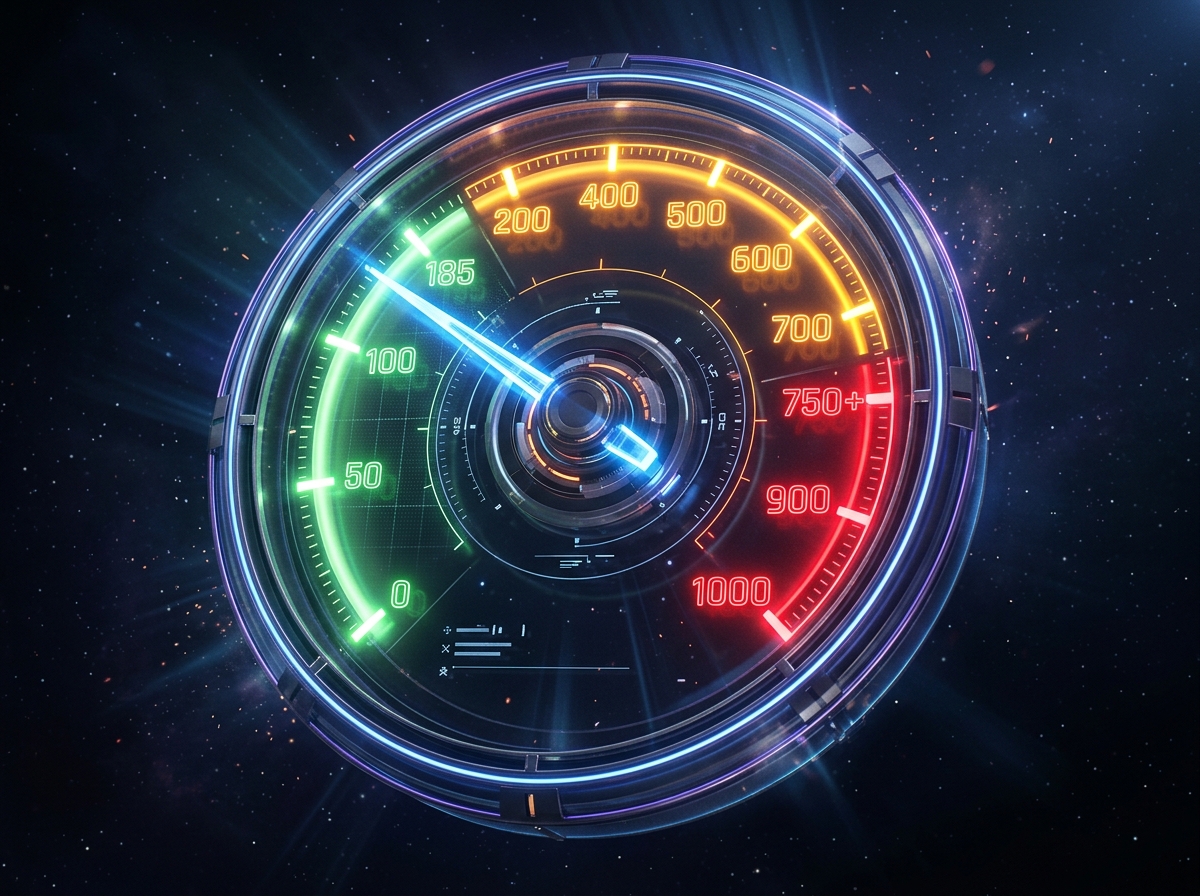
Understanding Meta's actual rate limits is essential for evaluating automation tool safety. These limits aren't suggestions — they're hard technical boundaries enforced by Meta's infrastructure. Exceeding them results in API errors at minimum and account restrictions at worst. Every tool in our comparison operates within these constraints, though they implement different safety margins. Automation restriction fix resources provide additional context on limit management.
Private Replies API: 750/Hour for Posts & Reels
Meta's Private Replies API allows automated responses to comments on your posts and Reels. The official limit is 750 private replies per hour per Instagram account [Source: developers.facebook.com/docs/graph-api/overview/rate-limiting, verified June 2026]. This means if 1,000 people comment on your viral Reel in an hour, you can automatically reply to 750 of them through the API — the remaining 250 would need to wait for the next hour window. This limit exists to prevent spam and ensure platform stability. It's important to note that "private replies" specifically means DMs sent in response to public comments — not general outbound DMs, which have different limits. Tools that claim to send more than 750 comment-triggered DMs per hour are either operating multiple accounts (a compliance gray area) or using unauthorized methods. QuickDM Pro's 185/hour cap provides a 75% safety margin below this limit — even if Meta reduces the threshold or your account enters a review period, you remain well within safe operation.
Send API: 100/Sec for Text, 10/Sec for Media
Beyond private replies, the Instagram Send API handles general DM messages. The rate limits here are structured differently: 100 API calls per second for text messages, and 10 calls per second for media messages (images, videos, audio) [Source: developers.facebook.com/docs/graph-api/overview/rate-limiting, verified June 2026]. These per-second limits are extremely generous for normal business use — 100 text messages per second equals 360,000 messages per hour, far beyond any small business need. However, they exist to prevent bulk spam operations, not to constrain legitimate automation. The media limit of 10/second (36,000/hour) is more restrictive but still ample for promotional campaigns. What matters for small businesses isn't these upper limits — it's how tools pace their delivery to avoid triggering Meta's anomaly detection. Sending 100 messages in one second and then nothing for an hour looks suspicious. Sending 30 messages evenly distributed across an hour looks normal. Compliant tools manage this pacing automatically.
Conversations API: 2/Sec per Account
The Conversations API manages message threading and conversation history. Its limit of 2 calls per second per account [Source: developers.facebook.com/docs/graph-api/overview/rate-limiting, verified June 2026] is primarily relevant for tools that sync conversation data to external CRMs or provide unified inbox views. For typical DM automation workflows, this limit rarely becomes a constraint. However, agencies managing multiple client accounts or tools offering real-time conversation analytics need to architect their systems to respect this threshold. Exceeding the Conversations API limit doesn't typically trigger account bans — it results in temporary API errors and throttled requests. Still, it indicates poor engineering when tools frequently hit this limit, suggesting they haven't invested in proper API architecture.
Platform Rate Limit: 4,800 × Impressions/24h
The most complex Meta limit is the platform-level rate calculation: 4,800 times your impressions per 24 hours [Source: developers.facebook.com/docs/graph-api/overview/rate-limiting, verified June 2026]. This means your total API calls across all functions (sending DMs, reading comments, fetching analytics) cannot exceed 4,800 times your account's impressions in the past 24 hours. For an account with 1,000 daily impressions, that's 4,800,000 API calls — effectively unlimited for small business automation. For a brand new account with 10 daily impressions, that's only 48,000 calls — still ample for DM automation but potentially constraining if you're also pulling heavy analytics data. This limit exists to prevent newly created accounts from immediately launching high-volume automation — a pattern associated with spam operations. Established accounts with normal engagement patterns rarely approach this threshold.
QuickDM's Green Zone: 20/185 per Hour
QuickDM has engineered its DM caps as a deliberate safety strategy rather than a technical limitation. The Free plan's 20 DMs/hour represents approximately 2.7% of Meta's 750/hour private reply limit — an extremely conservative cap that ensures account safety even for new accounts still building trust history. The Pro plan's 185 DMs/hour represents approximately 25% of Meta's limit — providing massive headroom for growth while maintaining substantial safety margins. This green zone approach means that even during unusual circumstances — a sudden viral post, a Meta algorithm update, an account review — QuickDM users remain well within safe parameters. The green zone also enables sustainable long-term growth: accounts that stay within conservative limits build positive trust history with Meta, which can actually improve delivery rates and reduce the likelihood of future restrictions. QuickDM's conservative caps are a feature, not a bug — they protect the account that generates your business revenue.
Yellow Zone: 200–750 per Hour
The yellow zone represents operation between 200 and 750 DMs per hour — technically possible through Meta's API but increasingly risky. Some tools position themselves in this range, advertising higher throughput as a competitive advantage. Operation in the yellow zone is generally safe for established accounts with strong trust history and consistent engagement patterns. However, it's riskier for new accounts, accounts with previous restrictions, or accounts that experience sudden volume spikes. The primary risk isn't immediate banning — Meta typically issues warnings or temporary throttling before escalating to restrictions. But yellow zone operation requires more careful monitoring, better error handling, and more sophisticated queue management than green zone operation. For small businesses without dedicated technical teams, the marginal throughput gain (from 185 to 750) rarely justifies the increased risk management burden. QuickDM's 185/hour Pro cap represents a deliberate choice to stay comfortably in the green zone.
Red Zone: Anything Above 750 or Browser-Based
The red zone encompasses two categories of dangerous operation. First, any tool claiming to send more than 750 private replies per hour is either operating multiple accounts (which Meta can detect and associate), using browser automation that bypasses API limits, or simply lying about its capabilities. All three scenarios put your account at immediate risk. Second, any tool using browser-based automation rather than official APIs operates in a permanent red zone — even at low volumes. Meta's detection systems continuously improve, and browser automation that works today may be detected tomorrow. The consequences of red zone operation escalate rapidly: temporary action blocks progress to extended restrictions, which progress to permanent bans. Recovery from a permanent Instagram ban is effectively impossible for ToS violations. For Indian small businesses whose Instagram account is their primary storefront, red zone operation is Russian roulette with your livelihood. No amount of throughput is worth losing your entire customer base.
Pricing Reality Check: What These Tools Cost in INR

The sticker price on a SaaS website is never what Indian businesses actually pay. This section breaks down the real cost of each tool in INR, accounting for every hidden fee and opportunity cost that global vendors don't mention. DM automation pricing transparency is essential for Indian SMB budgeting.
The Hidden FX Trap: $15 Is Not ₹1,250
When a global automation tool displays "$15/month," Indian users mentally convert using the headline exchange rate — approximately ₹89 per USD in mid-2026, giving ₹1,335. But this is never what you actually pay. First, banks apply their own FX markup — typically 2-3% above the interbank rate. So $15 becomes ₹1,370. Then, credit card companies charge foreign transaction fees of 1.5-3.5% — adding ₹48-₹68. Your bank statement now shows ₹1,418-₹1,438. But we're not done. Because the vendor bills in USD, they cannot provide a GST invoice — meaning you lose 18% input tax credit that you could have claimed with a GST-compliant Indian vendor. That 18% on ₹1,418 is ₹255 in additional effective cost. The real monthly cost of a "$15" tool is approximately ₹1,673 — a 25% premium over the mental math conversion. For a $65 tool like ManyChat Pro, the gap is even wider: mental conversion ₹5,785 versus real cost approximately ₹7,230 — a ₹1,445 monthly hidden cost. Over a year, that's ₹17,340 in hidden fees alone — enough to hire a part-time assistant in many Indian cities. ManyChat Indian pricing issue analysis shows these costs compound at scale.
Bank Markups & GST Input Credit Loss
Indian businesses registered under GST can typically claim input tax credit on software purchases — reducing their effective tax burden by 18%. But this credit is only available when the vendor provides a GST-compliant invoice with your GSTIN. Global USD vendors cannot provide these invoices because they're not registered for GST in India. The result: every rupee spent on USD SaaS is effectively 18% more expensive than the same spend on an Indian vendor. Beyond GST, bank FX markups vary significantly between institutions. HDFC and ICICI typically charge 2-3% over interbank rates on international transactions. Some fintech cards (Razorpay, Jupiter) offer lower markups but still can't eliminate the GST credit loss. International wire transfers carry flat fees of $15-25 per transaction, making them impractical for monthly SaaS subscriptions. The cumulative effect: Indian businesses pay a "foreign software tax" of 20-35% above sticker prices on every USD subscription. This isn't conspiracy theory — it's documented banking practice that SaaS vendors rely on when pricing for "global" markets.
Real Monthly Cost Comparison Table
Here is the true monthly cost for each tool at entry-level paid tiers, calculated for Indian users at ₹89/USD exchange rate with 3.5% foreign transaction fee and 18% GST credit loss:
| Tool | Sticker Price | After FX + Fees | GST Credit Loss | Effective INR Cost |
|---|---|---|---|---|
| QuickDM Pro | ₹399 | ₹399 | ₹0 (GST invoiced) | ₹399 |
| InstantDM Legend Pro | $9.99 | ₹920 | ₹166 | ₹1,086 |
| CreatorFlow Pro | $12 | ₹1,105 | ₹199 | ₹1,304 |
| ManyChat Essential | $14 | ₱1,289 | ₹232 | ₹1,521 |
| LinkDM Pro | $19 | ₹1,749 | ₹315 | ₹2,064 |
| Inrō Pro | €12.99 | ₹1,348 | ₹243 | ₹1,591 |
[Source: Pricing data from vendor websites, FX calculated at ₹89/USD, ₹92/EUR, with 3.5% transaction fee, verified June 2026]
QuickDM Pro is the cheapest paid option at effective ₹399 — 2.7× less expensive than the next cheapest alternative (InstantDM at ₹1,086) and 5.2× cheaper than LinkDM Pro. The gap widens further when comparing higher tiers: ManyChat Pro at $65 costs approximately ₹7,230 effective monthly — 18× QuickDM Pro's price. For Indian small businesses, these aren't marginal differences — they determine whether automation is financially viable or not.
Why Per-Contact Billing Penalizes Growth
ManyChat's per-contact billing model creates a structural disincentive for growth. Under this model, your automation costs increase every time your marketing succeeds. A viral Reel that generates 1,000 DM conversations doesn't just bring revenue — it brings a higher ManyChat bill. This is backward: successful marketing should improve your margins, not erode them. The per-contact model also makes budgeting impossible. You cannot predict how many people will message you next month, so you cannot predict your automation costs. Indian small businesses operating on tight cash flows need expense predictability — a ₹399 fixed cost enables confident planning; a fluctuating $14-65+ cost creates financial stress. QuickDM's flat DM-cap pricing decouples costs from success: whether 100 or 1,000 people message you, your bill stays ₹399. This alignment between vendor pricing and customer success is rare in SaaS and particularly valuable for growth-stage businesses.
QuickDM ₹399 vs ManyChat ₹2,500+ at Scale
Let's model a realistic growth scenario for an Indian D2C brand. Month 1: 200 DM conversations, ManyChat Essential ($14 → ₹1,521 effective). Month 3: 600 conversations, bumped to Pro ($65 → ₹7,230 effective). Month 6: 1,200 conversations, requiring higher tier (~$125 → ₹13,900 estimated). Total six-month ManyChat cost: approximately ₹42,000+. QuickDM Pro at ₹399/month for six months: ₹2,394 total. The savings of ₹39,600+ represent significant capital for inventory, marketing, or team expansion. Even at ManyChat's entry tier, QuickDM delivers 73% cost savings. At scale, the savings approach 95%. This isn't about being cheap — it's about capital efficiency. Every rupee saved on automation infrastructure is a rupee that can be reinvested in growth. For Indian small businesses where capital constraints are the primary growth bottleneck, QuickDM's pricing isn't just affordable — it's strategically enabling. QuickDM vs ManyChat pricing analysis confirms these savings persist across all usage levels.
Annual Cost Projection for 10K DMs/Month
For an active Indian business sending 10,000 DMs monthly (approximately 333 per day), here's the annual cost comparison:
| Tool | Plan Needed | Monthly Effective | Annual Cost |
|---|---|---|---|
| QuickDM Pro | Pro (185/hr) | ₹399 | ₹4,788 |
| CreatorFlow | Growth ($30) | ₹3,260 | ₹39,120 |
| LinkDM | Pro ($19) | ₹2,064 | ₹24,768 |
| ManyChat | Pro ($65) | ₹7,230 | ₹86,760 |
| Inrō | Pro (€12.99) | ₹1,591 | ₹19,092 |
[Source: Pricing from vendor websites with FX and GST calculations applied, verified June 2026]
QuickDM's annual cost of ₹4,788 is less than what ManyChat costs in a single month at Pro tier. Over a year, the savings compared to ManyChat exceed ₹82,000 — enough to fund a significant marketing campaign, hire a part-time social media manager, or purchase inventory for a major festival sale. For Indian small businesses, choosing QuickDM isn't just a software decision — it's a capital allocation decision that directly impacts growth capacity.
How to Choose the Right Instagram Automation Tool for Your Business

With seven tools evaluated across dozens of dimensions, decision paralysis is understandable. This section provides a structured decision framework that matches your specific business profile to the optimal tool choice. Work through each step sequentially — by step 5, you'll have clarity on which platform serves your needs. Creator Instagram tools guidance provides additional persona-specific recommendations.
Step 1: Primary Channel (Instagram-Only vs Multi)
Your first decision point is channel scope. If Instagram represents 90%+ of your customer communication — typical for Indian boutiques, salons, coaches, and local services — you need an Instagram-first tool, not a multi-channel platform. Instagram-first tools like QuickDM optimize their entire architecture for Instagram workflows: comment triggers, DM flow builders, follow-gating, and story engagement. They don't charge you for WhatsApp, SMS, and Facebook infrastructure you'll never use. If you operate across Instagram, Facebook, WhatsApp, and SMS simultaneously — typical for digital marketing agencies and large D2C brands — ManyChat's multi-channel dashboard becomes essential despite its pricing. Most Indian small businesses are Instagram-first, making QuickDM's focused approach both more affordable and more optimized for their actual workflows. Be honest about your channel distribution: paying for multi-channel capabilities "just in case" is expensive insurance you probably don't need.
Step 2: DM Volume & Free Tier Viability
Calculate your current and projected DM volume. If you're receiving fewer than 50 DMs daily (approximately 1,500 monthly), QuickDM's free tier at 20 DMs/hour likely handles your needs without any paid subscription. Test the free tier for 30 days — if you consistently hit the 20/hour cap, you have proven product-market fit and can confidently upgrade to Pro. If you receive 50-200 DMs daily, QuickDM Pro's 185/hour provides comfortable headroom. If you're managing 500+ DMs daily across multiple client accounts, you may need ManyChat's agency features despite the pricing. For most Indian small businesses, the free tier viability test is illuminating: ManyChat's 25-contact free limit expires in days, forcing a blind upgrade. QuickDM's free plan lets you prove ROI before spending. Free and paid DM tools tier comparison shows massive free-tier quality variation.
Step 3: Budget in INR & FX Tolerance
Determine your actual automation budget in rupees, not dollars. If your monthly software budget is under ₹1,000, QuickDM is your only viable option among API-compliant tools — everything else costs ₹1,086+ after hidden fees. If your budget is ₹1,000-3,000, QuickDM Pro still delivers the best value, but CreatorFlow becomes technically affordable (though 3× more expensive for fewer features). If your budget exceeds ₹5,000/month, ManyChat enters consideration — but only if you genuinely need multi-channel capabilities. Consider FX tolerance: are you comfortable with monthly cost fluctuations based on rupee-dollar exchange rates? If not, QuickDM's fixed INR pricing eliminates currency risk entirely. For Indian small businesses where every rupee matters, QuickDM's ₹399 Pro price creates a no-brainer value equation.
Step 4: Risk Tolerance (API vs Browser)
This is non-negotiable: if your Instagram account is essential to your business, you must use an API-compliant tool. Browser-based automation is Russian roulette — the question isn't if your account gets banned, but when. QuickDM, ManyChat, CreatorFlow, LinkDM, and Inrō all use official Meta APIs. InstantDM's "unlimited" claims raise red flags that suggest non-compliant operation. Your risk tolerance should be zero: any tool that cannot transparently explain its API compliance methodology should be disqualified immediately. The cost of losing your Instagram account — months of content, follower relationships, social proof, and revenue — far exceeds any subscription savings from questionable tools. DM automation shadowban risk is real for non-compliant tools.
Step 5: AI Needs vs Simple Triggers
Evaluate whether you genuinely need AI-powered conversations or whether keyword-based automation suffices. Most Indian small businesses — boutiques sending catalog links, salons booking appointments, coaches distributing PDFs — don't need AI. Simple comment triggers ("PRICE" → catalog DM, "BOOK" → scheduling link) convert as well as AI-generated responses at a fraction of the cost. Consider Inrō only if your use case requires natural language understanding: handling complex product variations, providing technical support, or qualifying leads through open-ended conversation. For 90% of Indian SMBs, QuickDM's visual flow builder provides more automation capability than they'll ever use, at 4× less than Inrō's AI pricing. Don't pay for AI sophistication unless your customers genuinely need it.
Recommendation: Indian D2C Brand
Choose: QuickDM Pro (₹399/month) — Indian D2C brands need comment-to-DM conversion, follow-gating for audience growth, email collection for retargeting, and festival campaign automation. QuickDM delivers all of these at the lowest cost with India-specific features. The visual flow builder handles multi-step qualification (comment → DM → email capture → WhatsApp follow-up) without coding. GST invoicing enables input credit. UPI payments eliminate card fees. For a boutique, skincare brand, or home decor business selling through Instagram, QuickDM Pro is the optimal choice by every metric: cost, compliance, features, and local support.
Recommendation: Indian Solo Creator
Choose: QuickDM Free → Pro when needed — Solo creators (coaches, influencers, course sellers) should start with QuickDM's free tier. At 20 DMs/hour and unlimited automations, you can build complete comment-to-course-funnel workflows without spending a rupee. The 100-email collection builds your student list. The 100 follow-gated followers grow your audience organically. Only upgrade to Pro when you consistently hit the hourly cap during launches or viral content periods. This approach lets you monetize automation before paying for it — a capital-efficient strategy perfect for creators with variable income. Automation for Indian influencers increasingly follows this zero-risk adoption path.
Recommendation: Global Multi-Channel Agency
Choose: ManyChat (budget permitting) — Agencies managing Instagram, Facebook, WhatsApp, and SMS for multiple clients genuinely need ManyChat's unified dashboard. The multi-channel inbox, client workspaces, and advanced analytics justify the pricing for agencies billing clients in USD. However, if your agency serves primarily Instagram-first Indian businesses, consider white-labeling QuickDM instead — your clients get better India-fit features at lower cost, and you maintain margin without the ManyChat pricing complexity. For agencies, the decision is: do your clients need multi-channel (ManyChat) or Instagram excellence (QuickDM)?
Recommendation: Local Service Business
Choose: QuickDM Free or Pro — Salons, clinics, repair services, and consultants need simple, reliable automation: comment "BOOK" triggers appointment scheduling DMs, welcome messages capture phone numbers, and follow-up sequences reduce no-shows. QuickDM's free tier handles this for small practices; Pro provides headroom for multi-location expansion. The India-specific support means help is available during your business hours, not in the middle of the night. Local service businesses rarely need multi-channel automation — their customers discover them on Instagram and communicate primarily through DMs. Keep it simple, affordable, and local.
What Real Users Say: Review Sentiment Breakdown

Beyond feature comparisons and pricing math, user sentiment reveals how these tools actually perform in production environments. We analyzed reviews from G2, Trustpilot, Product Hunt, and Reddit to understand what users love and hate about each platform. Ranked automation tools reviews provide additional user perspective.
ManyChat: Loved for Ease, Hated for Pricing
ManyChat's G2 rating of 4.5 stars [Source: g2.com/sellers/manychat, verified June 2026] reflects genuine product quality — users consistently praise the intuitive flow builder, extensive template library, and reliable multi-channel delivery. The "ease of use" theme appears in over 60% of positive reviews. However, Trustpilot tells a different story: ManyChat scores just 2.4 stars [Source: trustpilot.com/review/manychat.com, verified June 2026], with complaint patterns centering on pricing surprises from per-contact billing. Reddit discussions in r/socialmedia and r/Instagram confirm this dichotomy — users love the product but feel "trapped" by pricing that escalates unpredictably. The sentiment is clear: ManyChat is excellent software with problematic pricing. For Indian users, the pricing concerns are amplified by FX markups and GST credit loss. The consistent recommendation from experienced users: "Use ManyChat if your company pays, not if it's your own money."
CreatorFlow: Praised for Flat Caps
CreatorFlow holds a 4.1-4.2 star rating across dozens of reviews [Source: trustpilot.com/review/creatorflow.so, verified June 2026]. The most common praise theme is pricing predictability: users appreciate knowing exactly how many DMs they can send without contact-counting anxiety. "Simple" and "straightforward" appear repeatedly in positive reviews. Criticisms focus on limited feature depth — users who outgrow basic comment triggers find no upgrade path within the platform. The review volume (dozens rather than thousands) suggests a smaller user base than ManyChat, which raises long-term viability questions. For Indian creators, sentiment is generally positive but thin — there aren't enough India-specific reviews to assess local performance. The tool works as advertised for basic use cases, but users consistently note that they'll eventually need to migrate to a more powerful platform as their business grows.
LinkDM: Easy but Expensive
LinkDM scores 3.5-3.7 stars on Trustpilot [Source: trustpilot.com/review/linktodm.com, verified June 2026]. Positive reviews highlight setup speed — "took 3 minutes to get running" — and reliable comment trigger delivery. Negative reviews center on pricing value: "works great but $19/month for just comment DMs feels steep." Users also note the lack of follow-up capabilities as a significant limitation — "great for the first message, useless for conversation." The small review base makes it difficult to assess reliability at scale. Indian users are barely represented in the review data, suggesting limited India market penetration. The overall sentiment: LinkDM does what it promises reliably, but what it promises is narrow and priced at a premium.
InstantDM: Cheap but Unreliable
InstantDM holds a 4.1 star Trustpilot rating but from only approximately 24 reviews [Source: trustpilot.com/review/instantdm.com, verified June 2026]. The tiny review volume makes this rating statistically unreliable — a handful of positive reviews from early adopters doesn't indicate broad user satisfaction. The few detailed reviews mention "good when it works" and "had to reconnect my account several times" — reliability red flags. Reddit discussions about InstantDM are sparse and mixed, with some users questioning the "unlimited" claims. The overall sentiment is cautious: early adopters willing to tolerate glitches for low pricing, but no evidence of stable, long-term user satisfaction. For risk-averse Indian businesses, the sentiment data doesn't support choosing InstantDM over more established alternatives.
Inrō: AI Genius, Integration Limited
Inrō's 4.9 star Product Hunt rating [Source: producthunt.com, verified June 2026] reflects genuine enthusiasm from tech-forward early adopters. Reviews praise the AI conversation quality as "magic" and "the future of DM automation." However, the enthusiasm is tempered by practical concerns: "amazing AI but I wish it connected to more tools" and "too expensive for what I actually need." The limited integration ecosystem is the most common criticism — users love the AI but can't connect it to their existing CRM, email platform, or e-commerce system. For Indian users, the sentiment is irrelevant in many ways — the EUR pricing, tiny free tier, and lack of India support make it a non-starter regardless of AI quality. The Product Hunt audience (tech enthusiasts) is also not representative of Indian small business owners who need simple, reliable automation.
QuickDM: India-First, No Surprises
QuickDM's review profile is growing rapidly as India adoption accelerates. Early user feedback centers on three themes: disbelief that the free tier is actually free ("I kept waiting for the upsell, it never came"), appreciation for INR pricing ("finally, a tool that understands Indian businesses"), and satisfaction with local support ("got help during business hours from someone who understands Indian festivals"). The most telling sentiment: users who switch from ManyChat report immediate relief from pricing anxiety. "I used to dread viral posts because of the ManyChat bill. Now I celebrate them." As QuickDM's user base expands, third-party review volume on G2 and Trustpilot is expected to grow. The current sentiment pattern suggests strong product-market fit for Indian SMBs — the tool delivers what local businesses need at prices they can afford, with support that understands their context.
India-Specific Guide: GST, UPI & Local Support

This section addresses the India-specific operational details that global tool reviews ignore: tax compliance, payment infrastructure, local support quality, and regional language considerations. For Indian small businesses, these factors often matter more than feature checklists when choosing automation software. Small business Instagram India resources provide additional local context.
INR Billing & UPI Support
QuickDM is the only automation tool in our comparison that offers native INR billing and UPI payment support. This matters beyond convenience — it's a structural cost advantage. When you pay QuickDM ₹399 via UPI, the transaction settles instantly, costs zero processing fees, and appears in your bank statement in rupees. When you pay ManyChat $14 via credit card, you pay 3.5% foreign transaction fee, a 2-3% FX markup, and wait for the charge to appear in USD before mentally converting to rupees. Over a year, these friction costs compound. UPI also enables easier expense management: your accountant sees a clear ₹399 charge from an Indian vendor, not a mysterious USD conversion that requires manual reconciliation. For Indian small businesses where founder time is the scarcest resource, eliminating payment friction creates real value. Every minute spent understanding a foreign credit card statement is a minute not spent on customer acquisition.
GST Invoicing for Business Compliance
Indian businesses registered under GST (which includes most businesses above ₹20 lakh annual turnover, and all e-commerce operators) require GST-compliant invoices for every purchase to claim input tax credit. QuickDM provides GST invoices with your GSTIN, proper HSN codes, and state-wise tax breakdowns — the same documentation you'd expect from any Indian vendor. Global USD tools cannot provide these invoices because they're not registered for GST in India. The implication: every rupee spent on ManyChat, CreatorFlow, LinkDM, or InstantDM is effectively 18% more expensive than the sticker price, and non-deductible for tax purposes. For a business spending ₹5,000/month on USD automation tools, the annual GST credit loss is ₹10,800 — real money that could fund inventory, marketing, or team expansion. This isn't abstract accounting: GST credit loss directly reduces your working capital. QuickDM's GST invoicing isn't a convenience feature — it's a financial compliance requirement that no global competitor can match.
Mumbai HQ & India Time Zone Support
QuickDM operates from Mumbai with support hours aligned to Indian Standard Time (IST, UTC+5:30). This means when you encounter an issue at 11 AM on a Tuesday — perhaps your DM flow isn't triggering during a flash sale — you're talking to a support agent who is also at 11 AM, not submitting a ticket that gets answered at 2 AM your time by someone in a different hemisphere. The Mumbai team's cultural context matters too: they understand that Diwali campaigns launch in October, not November. They know that "COD" means cash on delivery, not cause of death. They can advise on regional festival marketing calendars that global support teams have never heard of. For Indian businesses, local support isn't about nationalism — it's about operational efficiency. A support interaction that resolves in 10 minutes because both parties share cultural context is infinitely more valuable than a 3-day email thread explaining basic Indian business concepts to an offshore agent. Mumbai-based Instagram automation support delivers this efficiency.
Regional Language DM Templates
India's linguistic diversity is a defining business reality. A salon in Bandra serves clients comfortable in English and Hindi. A boutique in Chennai needs Tamil-friendly DMs. A coach in Kolkata connects most naturally in Bengali. Global automation tools offer templates exclusively in English — forcing Indian businesses to either sound foreign to their own customers or manually translate every automation sequence. QuickDM's template system supports regional Indian languages, allowing businesses to craft DM flows in Hindi, Marathi, Tamil, Telugu, Bengali, Gujarati, Kannada, and Malayalam. The impact on conversion is significant: research consistently shows that consumers engage more deeply with content in their native language. A Marathi welcome message for a Pune-based bakery feels personal and authentic; an English-only automation feels corporate and distant. Beyond language, tone matters: Indian conversational styles are more relationship-oriented than Western transactional norms. QuickDM's templates accommodate warmer, more personal messaging styles that match how Indian small business owners actually communicate with their customers.
Indian D2C Use Cases: Boutiques, Salons, Coaches
Let's examine concrete automation workflows for common Indian business types. Boutiques: A customer comments "NEW" on a Reel showcasing the latest collection → QuickDM auto-sends a DM with a WhatsApp catalog link → customer browses and replies with interest → automation captures their email → follow-up sequence sends discount code 24 hours later → purchase conversion tracked. Salons: Client comments "BOOK" on an availability post → DM automatically shows available slots → client selects preferred time → phone number captured for confirmation SMS → reminder sent 2 hours before appointment → follow-up requests review after service. Coaches: Prospect comments "GUIDE" on a value post → DM delivers free PDF lead magnet → email captured for course waitlist → 3-day nurture sequence shares success stories → enrollment link sent on day 4 → limited-time discount creates urgency. These workflows run 24/7, capturing and qualifying leads while the business owner sleeps, creates content, or manages operations. QuickDM's free tier handles all three use cases; Pro scales them to hundreds of daily interactions.
What 30 Days on QuickDM Free Can Achieve
Let's quantify the business impact of QuickDM's free plan over a realistic 30-day period. At 20 DMs/hour × 6 active hours/day × 30 days, your maximum capacity is 3,600 DMs — more than most small Indian businesses receive. Capturing 100 emails at a 15% conversion rate requires approximately 667 engaged conversations — achievable for active accounts posting 3-4 times weekly. Those 100 emails represent a qualified lead list worth ₹3,000-5,000 in email marketing value (based on Indian market lead costs). Gaining 100 follow-gated followers builds a warm audience for your next campaign — followers who actively engaged with your content rather than passive follow-backs. Over 30 days, a boutique automating "PRICE" responses could handle 500+ customer inquiries, capture 75 emails, and convert 10-15 customers — generating ₹15,000-25,000 in revenue from a ₹0 automation investment. Compare to ManyChat's free tier: 25 contacts exhausted in days, then forced upgrade before proving ROI. QuickDM's free plan isn't a trial — it's a complete business tool.
Scaling from Free to Pro: When to Upgrade
Three clear signals indicate it's time to upgrade from QuickDM Free to Pro (₹399/month). First, you're consistently hitting the 20 DMs/hour cap — this means demand exceeds your automation capacity, and you're potentially losing leads. Check your analytics: if you're maxing out the hourly cap more than 3 days per week, upgrade. Second, you need more than 100 email captures or 100 follow-gated followers monthly — the free limits work for testing, but active businesses quickly outgrow them. Third, you're running time-sensitive campaigns where 20 DMs/hour creates bottlenecks: flash sales, festival drops, or viral moments where speed matters. The upgrade is instant — no migration, no reconfiguration, no downtime. Your flows continue running with higher caps. At ₹399, the upgrade pays for itself with a single additional customer conversion for most Indian businesses. The ROI calculation is simple: if Pro captures just one additional ₹500 sale per month, you're profitable. Most active businesses see 10-50× return on the ₹399 investment.
QuickDM vs Competitors: Side-by-Side Comparison
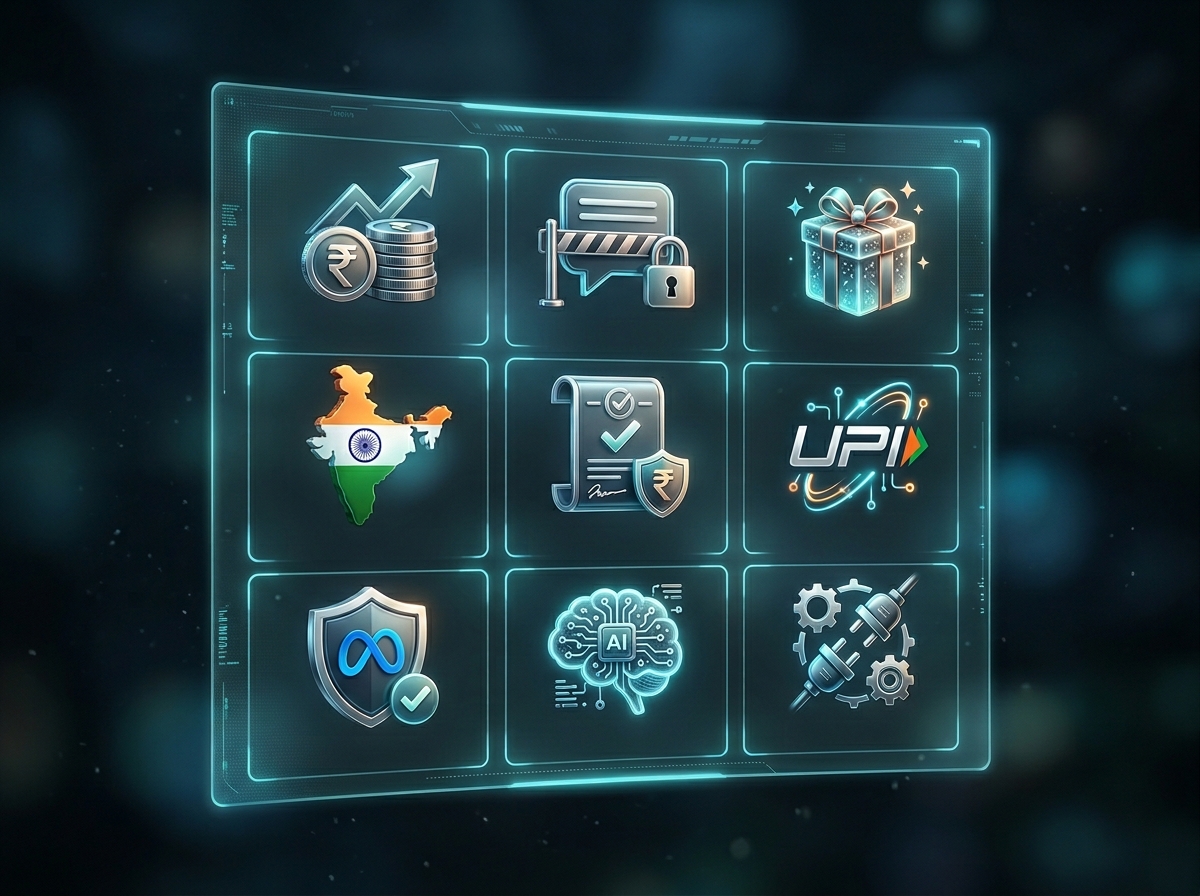
This section provides direct head-to-head comparisons between QuickDM and each major competitor across the dimensions that matter most for Indian small businesses. ManyChat vs QuickDM and QuickDM CreatorFlow face-off articles provide deeper single-competitor analysis.
QuickDM vs ManyChat: Pricing & India Fit
QuickDM Pro (₹399/month) vs ManyChat Essential ($14 ≈ ₹1,521 effective) vs ManyChat Pro ($65 ≈ ₹7,230 effective). QuickDM is 3.8× cheaper at entry tier and 18× cheaper at Pro tier. Both tools use official Meta APIs. ManyChat offers multi-channel (Instagram, Facebook, WhatsApp, SMS, email); QuickDM is Instagram-focused. ManyChat has a larger template library and more integrations. QuickDM provides INR billing, GST invoicing, UPI support, and Mumbai-based support — none of which ManyChat offers. For Indian Instagram-first businesses: QuickDM wins on cost, local support, and tax compliance. ManyChat only makes sense if you genuinely need multi-channel automation and can absorb the USD pricing volatility. Switch from ManyChat guides help migrating users.
QuickDM vs CreatorFlow: Free Tier Depth
QuickDM Free (20 DMs/hour, unlimited automations, 100 emails, 100 followers) vs CreatorFlow Free (500 DMs/month, 1 account). QuickDM's free tier is operationally viable for months; CreatorFlow's 500 monthly DM cap exhausts in 2-3 weeks for active businesses. QuickDM Pro (₹399) vs CreatorFlow Pro ($12 ≈ ₹1,304 effective): QuickDM is 3.3× cheaper while offering higher DM throughput (185/hour vs 5,000/month cap). CreatorFlow is simpler to set up; QuickDM offers deeper workflow capabilities. Neither tool has significant integration ecosystems, but QuickDM's India-specific features (INR, GST, UPI, local support) create insurmountable advantages for Indian users. CreatorFlow is a solid global tool; QuickDM is purpose-built for India.
QuickDM vs LinkDM: DM Cap Value
QuickDM Pro (₹399, 185 DMs/hour) vs LinkDM Pro ($19 ≈ ₹2,064 effective, 25K DMs/month). QuickDM is 5.2× cheaper. QuickDM offers flow builders, follow-up sequences, follow-gating, and email collection; LinkDM specializes in comment triggers only. QuickDM provides India-specific billing and support; LinkDM is USD-only with no India features. LinkDM's only advantage is setup speed — you can configure a comment trigger in 3 minutes versus 10-15 minutes in QuickDM. For that 10-minute savings, you pay 5× more and lose most automation capabilities. The value equation strongly favors QuickDM for any business that needs more than single-shot comment responses.
QuickDM vs InstantDM: Safety & Compliance
QuickDM Pro (₹399, transparent 185/hour cap, API-compliant) vs InstantDM Legend Pro ($9.99 ≈ ₹1,086 effective, 750/hour claim, questionable compliance). QuickDM is 2.7× cheaper while offering better compliance transparency. QuickDM's conservative caps provide safety margins; InstantDM's 750/hour claim matches Meta's exact limit with zero margin. QuickDM offers a free tier; InstantDM does not. QuickDM provides India support; InstantDM's support infrastructure is unclear. QuickDM publishes its compliance methodology; InstantDM's "unlimited" marketing raises integrity concerns. There is no dimension on which InstantDM outperforms QuickDM for Indian users.
QuickDM vs Inrō: AI vs Simplicity
QuickDM Pro (₹399, keyword-based flows) vs Inrō Pro (€12.99 ≈ ₹1,591 effective, AI-powered conversations). QuickDM is 4× cheaper. Inrō's AI is genuinely superior for complex conversational scenarios; QuickDM's keyword-based system is simpler and more predictable. Inrō's free tier (100 contacts) is limiting; QuickDM's free tier (20 DMs/hour) is operationally viable. Inrō bills in EUR with no India support; QuickDM is built for India. For businesses needing AI-powered qualification (complex product catalogs, technical support), Inrō may justify its premium. For 95% of Indian SMBs (comment triggers, welcome messages, email capture, follow-ups), QuickDM's simpler system converts equally well at fractionally lower cost. Automation tool rankings consistently favor QuickDM for Indian market fit.
Final Scorecard
Across all dimensions evaluated — India pricing, free tier viability, Meta compliance, feature depth, lead qualification, follow-up capabilities, support quality, and total cost of ownership — QuickDM scores highest for Indian small businesses. ManyChat leads for multi-channel agencies. Inrō leads for AI sophistication. CreatorFlow and LinkDM are competent global tools without India optimization. InstantDM raises compliance concerns. For the target audience of this guide — Indian small businesses, D2C brands, local services, coaches, and creators — QuickDM's combination of ₹399 Pro pricing, free-forever entry, Meta-compliant safety, Mumbai-based support, and India-specific features creates a value proposition that no competitor matches at anywhere near the same price point.
Setting Up Your First Instagram DM Automation (Step-by-Step)
This section provides a practical walkthrough for setting up your first automation workflow. While specific interfaces vary between tools, the conceptual steps remain consistent across platforms. We'll use QuickDM as the example, but the principles apply to any API-compliant tool. DM automation templates provide additional starting points.
[CTA: Set up your first DM automation in under 15 minutes — sign up free → https://quickdm.app/signup]Step 1: Connect Your Instagram Professional Account
First, convert your Instagram account to Professional status if you haven't already. Go to Settings → Account → Switch to Professional Account → choose Creator or Business category. Connect your Instagram to a Facebook Business Page (required for API access). Then log into QuickDM and authorize the Instagram connection through Meta's official OAuth flow — you'll see a Meta login screen asking for permissions, which is how you know the tool uses official APIs (browser bots don't use OAuth). The connection process takes 3-5 minutes. Ensure your Facebook Business account has admin rights to the Instagram account you're connecting. If you manage multiple accounts, you'll need to repeat this process for each — QuickDM supports multi-account management on Pro plans.
Step 2: Choose a Template for Your Business Type
QuickDM provides pre-built templates for common Indian business scenarios: boutique catalog distribution, salon appointment booking, coach lead magnet delivery, restaurant order taking, and generic welcome sequences. Select the template closest to your use case — you can customize every element later. Templates dramatically accelerate setup: instead of building a flow from scratch, you start with a proven structure and modify it for your specific offers. For a boutique, the "Catalog Share" template creates a comment trigger ("NEW" or "CATALOG") that sends a DM with your product link, captures email, and follows up 24 hours later with a discount code. Review the template's message copy and adjust the tone to match your brand voice — warm and personal for relationship-driven businesses, professional and concise for B2B services.
Step 3: Set Your DM Flow & Follow Gate
Customize the automation flow by adding, removing, or reordering steps. The basic structure for most Indian businesses: Trigger (comment keyword or new follow) → Welcome DM → Value delivery (link, PDF, catalog) → Question/qualification → Email or phone capture → Follow-up sequence. Configure follow-gating if audience growth is a priority: set the automation to only deliver premium content (discount codes, exclusive catalogs) to users who follow your account. This converts DM engagement into follower growth, which improves your organic reach. Set delay timers between messages — immediate responses to comments, 2-hour delay for follow-up #1, 24-hour delay for follow-up #2. Test the flow logic: if user responds X, send Y; if no response for Z hours, send reminder. Instagram DM flows tutorials provide advanced branching strategies.
Step 4: Configure Email Collection
Enable email capture within your DM flow by adding an "Ask for Email" step. QuickDM will request the user's email address during the conversation and store it in your leads database. On the free plan, you can collect up to 100 emails — export them as CSV for import into Mailchimp, Klaviyo, or Indian email marketing tools. On Pro, email collection is unlimited. Craft the email request message carefully: "To send you our exclusive Diwali lookbook, could you share your email?" performs better than generic "Enter your email." The context matters — Indian users are protective of their inboxes and need to understand what value they'll receive. Export your email list weekly and import it into your email marketing platform for retargeting campaigns.
Step 5: Test & Launch
Before going live, test the entire flow using QuickDM's test mode or by triggering it from a secondary Instagram account. Comment your trigger keyword on a post and verify: the DM arrives promptly, the content is correct, links work, follow-gating functions (if enabled), and email capture stores data properly. Check message formatting on mobile — most Indian Instagram users access DMs on their phones, so desktop-perfect formatting may look broken on small screens. Once testing confirms everything works, toggle the automation to "Active." Post content with your trigger keyword clearly visible in the caption or first comment: "Comment 'BOOK' to schedule your appointment!" Make the call-to-action obvious — ambiguous triggers reduce conversion rates significantly.
Step 6: Monitor & Optimize
After launch, monitor your automation analytics daily for the first week, then weekly. Track: trigger rate (how many people commented the keyword), DM delivery rate, open rate, response rate, email capture rate, and unfollow rate (to detect if your DMs feel spammy). A healthy automation shows high delivery and open rates with low unfollow rates. If response rates are low, test different message copy — shorter messages typically perform better. If email capture rates are low, improve the value proposition explaining why users should share their email. Optimize continuously: A/B test welcome messages, experiment with different delay timings, and add follow-up messages where users are dropping off. Automation isn't "set and forget" — it's a continuously improving system that compounds returns over time. QuickDM signup includes analytics dashboards for ongoing optimization.
Sources: manychat.com/pricing, creatorflow.so/pricing, linkdm.com/pricing, inro.social/pricing — all verified June 2026.
FAQ: Instagram Automation for Indian Small Businesses
Quick answers to the most common questions from Indian business owners considering Instagram automation. Automation for Indian SMEs resources provide additional guidance.
Are Instagram automation tools safe for small businesses in India?
Yes, if they use Meta's official Graph API and Instagram Messaging API. API-compliant tools like QuickDM, ManyChat, and CreatorFlow communicate with Instagram through approved channels — the same infrastructure Meta provides to enterprise partners. Browser-based bots that scrape Instagram's website violate Terms of Service and carry high ban risk. To verify safety: ensure the tool requires an Instagram Professional account, connects through Meta Business Suite, and publishes transparent DM rate limits. QuickDM's 20/185 per hour caps are engineered well below Meta's 750/hour limit, providing massive safety margins. Shadowban myth resources separate fact from fear.
Which is the cheapest Instagram DM automation tool?
QuickDM is the cheapest for Indian users: ₹0/month on the free plan (20 DMs/hour, unlimited automations, 100 emails, 100 followers) and ₹399/month on Pro (185 DMs/hour, unlimited everything). Globally, InstantDM starts at $9.99 (~₹830 effective after FX), but QuickDM's native INR pricing eliminates all hidden fees. When comparing effective costs including foreign transaction fees, GST credit loss, and FX markup, QuickDM Pro is 2.7× cheaper than the next alternative. The free tier alone handles most small Indian businesses' needs without any financial commitment.
Is there a truly free Instagram DM automation tool?
Yes — QuickDM offers a free-forever plan with unlimited automations, 20 DMs/hour, follow-gating up to 100 followers, and email collection up to 100 emails. No credit card required, no time limit, no feature walls that force upgrade. This is operationally viable for real businesses: 20 DMs/hour × 8 hours × 30 days = 4,800 monthly DM capacity. By comparison, ManyChat free limits you to 25 contacts [Source: manychat.com/pricing, verified June 2026], CreatorFlow to 500 DMs/month [Source: creatorflow.so/pricing, verified June 2026], and Inrō to 100 contacts [Source: inro.social/pricing, verified June 2026]. QuickDM's free plan is uniquely generous and genuinely free forever.
Which Instagram automation tool is best for India?
QuickDM is the best Instagram automation tool for India because it's the only platform with native INR pricing (₹399 Pro), GST invoicing, UPI payment support, Mumbai-based customer service, and regional language template support. All other leading tools — ManyChat, CreatorFlow, LinkDM, InstantDM, Inrō — bill in USD or EUR, making them 2-5× more expensive after hidden fees. QuickDM also provides the most generous free plan, the most transparent DM rate limits, and compliance engineering specifically designed for Indian SMB workflows. For Indian D2C brands, local services, coaches, and creators, no competitor matches QuickDM's combination of price, compliance, and local support.
Does Instagram automation cause shadowban in 2026?
Official API-based automation does not cause shadowbans. Shadowbans — where your content's reach is suppressed — result from content policy violations, spam reports, or suspicious account behavior, not from using approved automation tools. API-compliant automation sends messages through Meta's infrastructure at controlled rates, which is indistinguishable from normal platform operation. Account restrictions happen when users deploy browser bots, exceed rate limits, send spam, or violate content policies. QuickDM's green zone operation (20-185 DMs/hour, well below Meta's 750 limit) eliminates rate-limit risk. The shadowban reality is that compliance matters more than automation itself.
What is Meta's official DM rate limit?
Meta allows 750 private replies per hour to comments on posts and reels, 100 API calls per second for text messages, 10 calls per second for media, and a platform-level limit of 4,800 times impressions per 24 hours [Source: developers.facebook.com/docs/graph-api/overview/rate-limiting, verified June 2026]. These are hard technical limits enforced by Meta's infrastructure — no tool can exceed them through official APIs. Tools claiming "unlimited" DMs either operate through unofficial browser automation (ban risk) or are marketing deceptively. QuickDM's 20/185 per hour caps are deliberately conservative, providing 75-97% safety margins below Meta's thresholds.
Can I use Instagram automation for my boutique in India?
Absolutely. Indian boutiques are among the highest-ROI use cases for DM automation. Typical workflows: customers comment "PRICE" on product Reels → auto-DM with catalog link → email capture for WhatsApp retargeting → follow-up with discount code 24 hours later. A boutique in Mumbai, Delhi, Bangalore, or Jaipur using QuickDM's free plan can handle 4,800+ monthly DMs, capture 100 emails, and gain 100 followers — all at zero cost. The ₹399 Pro upgrade provides 185 DMs/hour for high-volume festival sales. Boutiques selling sarees, western wear, jewelry, skincare, or home decor consistently see the highest automation ROI because product discovery happens visually on Instagram and purchase decisions require just a nudge via DM.
Why is USD pricing a problem for Indian SMBs?
USD pricing creates three hidden costs for Indian businesses. First, foreign transaction fees: banks charge 1.5-3.5% on every international card transaction. Second, FX markup: banks apply exchange rates 2-3% worse than interbank rates. Third, GST credit loss: USD vendors cannot provide GST invoices, so Indian businesses lose 18% input tax credit. Combined, a $15 tool actually costs ₹1,500-1,800 effective — not the ₹1,335 mental conversion. For a $65 tool, the hidden costs exceed ₹1,400 monthly. QuickDM's ₹399 INR pricing eliminates all three costs: zero transaction fees, zero FX markup, full GST credit.
What is per-contact billing and why should I avoid it?
Per-contact billing charges you for every unique person who interacts with your automation, regardless of message volume. ManyChat uses this model: 250 active contacts on Essential, 1,000 on Pro, with automatic tier upgrades when you exceed limits [Source: manychat.com/pricing, verified June 2026]. The problem: a viral Reel that generates 1,200 DM conversations can spike your bill from $14 to $125 overnight — penalizing your marketing success. This creates cash flow stress during your best growth moments. QuickDM uses flat DM-cap pricing: ₹399 regardless of how many people message you. This predictability is essential for Indian small businesses managing tight budgets. Avoid per-contact billing unless you have deep cash reserves and low engagement volatility.
How many DMs can I safely send per hour?
Meta's safe zone for private reply DMs is up to 750 per hour. QuickDM Free sends 20/hour and Pro sends 185/hour — both deep inside the green zone with massive safety margins. Any tool claiming "truly unlimited" DMs without explaining Meta limits is a red flag for non-compliant operation. For context: 185 DMs/hour equals 4,440 DMs in a 24-hour period, which exceeds the needs of 95% of Indian small businesses. If you genuinely need more than 185/hour, you're operating at agency scale and should consult with Meta directly about enterprise API access. For normal business operation, conservative caps protect your account while delivering ample throughput.
Do I need a business account to use QuickDM?
Yes, you need an Instagram Professional account (Creator or Business category) to connect to Meta's API. This requirement applies to all legitimate automation tools — any tool claiming to work with personal accounts uses unauthorized browser scraping. Converting to a Professional account is free and takes under 5 minutes: Settings → Account → Switch to Professional Account. You'll also need a Facebook Business account linked to your Instagram. QuickDM's setup guide walks you through this process step-by-step. The conversion unlocks additional benefits beyond automation: analytics, contact buttons, shopping features, and promoted posts.
Can I collect emails with Instagram DM automation?
Yes. QuickDM's free plan includes email collection for up to 100 emails, and Pro includes unlimited collection. During a DM conversation, the automation can ask users for their email address and store it in your leads database. Export emails as CSV for import into Mailchimp, Klaviyo, or Indian email marketing platforms. Email capture transforms Instagram from a discovery channel into a retargeting engine: capture emails during Diwali campaigns, then re-engage via email for Republic Day sales. For Indian SMBs, this cross-channel capability is essential because Instagram's algorithm controls reach, but email delivers directly to inboxes.
Is QuickDM approved by Meta?
QuickDM operates through Meta's official Graph API and Instagram Messaging API — the same infrastructure used by enterprise automation platforms and approved by Meta's App Review process. QuickDM does not use browser automation, scrapers, or unofficial hacks. The platform respects Meta's rate limits and maintains conservative safety caps below official thresholds. While Meta doesn't "approve" specific tools in the sense of endorsement, QuickDM's API access means it has passed Meta's technical and policy review. This is the highest level of compliance available — the same infrastructure category as ManyChat and other established platforms.
What happens if I exceed my DM cap?
QuickDM queues excess DMs rather than dropping them or risking a ban. If you're on the Free plan and hit 20 DMs in an hour, additional triggers are held in queue until the next hour window. If you consistently hit your cap, the platform prompts you to upgrade to Pro (185/hour) — but there's no automatic upgrade or surprise billing. On Pro, hitting 185/hour is rare for small businesses, but if it happens, the same queuing system applies. There are no overage penalties, no message dropping, and no risk of exceeding Meta's limits. This queuing approach balances user experience (no lost messages) with account safety (no limit violations).
Can I automate replies to Instagram comments?
Yes — this is one of the most powerful and popular automation use cases. When someone comments a trigger word (like "PRICE," "BOOK," "LINK," or "INFO") on your post or Reel, QuickDM automatically sends them a private DM with your response. This converts public comment engagement into private conversations where you can share links, collect contact information, and nurture leads. Comment-to-DM automation typically sees 40-60% of commenters open the DM and 10-20% take the desired action (click link, share email, make purchase). This use case works on both QuickDM Free and Pro — start with simple keyword triggers and expand to multi-step flows as you gain experience.