Best Instagram DM Automation Tools in 2026 (Free, Paid & Meta-Compliant)
⚡ Quick Answer: The best Instagram DM automation tools in 2026 are QuickDM (best free forever), ManyChat (best for large enterprise), CreatorFlow (best for creators on a budget), and LinkDM (best for high-volume agencies). All safe tools use Meta's official Graph API. Unsafe browser bots risk instant account bans.
📦 Key Takeaways
QuickDM offers truly unlimited automations and 20 DMs/hour free — forever, no credit card required
ManyChat scales by contact count ($15–$65+/mo), not DM volume — costs spike fast
CreatorFlow caps free users at 500 DMs/month; paid starts at $15/mo
LinkDM's free tier allows 1,000 DMs/month but lacks advanced flows
Meta's Graph API is the only safe automation path — browser bots cause bans
Indian creators: QuickDM is the only INR-priced tool at ₹399/mo Pro
Tools using "follow-to-DM" triggers may rely on non-public Meta hooks — use with caution
The 2026 Instagram DM Automation Landscape — Opportunity and Risk
Why DMs Are Now Instagram's Most Powerful Sales Channel
Instagram Direct Messages have quietly become the highest-converting touchpoint in the creator and brand marketing playbook. Unlike posts or Stories — which disappear into the feed — a DM lands in an inbox that most users check multiple times per day. According to Meta's own business data, messages sent through DM automations achieve open rates that dwarf email (often 80–90%+ open rates vs. the industry email average of 20–30%). The shift started around 2022 when Instagram began pushing its Messenger API to business accounts, but by 2025–2026 the ecosystem has matured dramatically: brands now run entire sales funnels — from comment to cart — entirely within the DM channel.
The "comment to DM" mechanic is particularly transformative. A creator posts a Reel, asks followers to comment a keyword like "LINK" or "PRICE", and within seconds every commenter receives a personalized DM with a product link, freebie, or registration URL. This single workflow has replaced landing pages, email opt-in forms, and even live sales calls for thousands of Indian D2C brands and global content creators. The result: more leads, captured faster, with less manual effort. Understanding how to set up comment triggers on Instagram has become one of the most valuable skills a creator or marketer can have in 2026.
The commercial stakes are enormous. Instagram's global advertising revenue exceeded $70 billion in 2024, and a growing share of that spend is being optimized around DM-based conversion funnels. Brands that master DM automation are pulling ahead — not just in sales volume but in customer lifetime value, because a DM relationship is inherently more personal and trust-building than a retargeted ad. For solo creators and large agencies alike, DM automation is no longer optional — it is the infrastructure of modern Instagram commerce. That said, making automated DMs feel personal is a craft that separates great funnels from spammy ones.
The Engagement Gap: What Happens When You Don't Automate
Manually responding to DMs at scale is simply not viable. A moderately successful creator receiving 300 comments on a Reel cannot realistically DM every commenter within the 15–30 minute window when engagement is hottest and conversion rates are highest. The math is brutal: at two minutes per manual DM (opening the profile, typing a personalized reply, sending a link, closing), 300 DMs takes 10 hours. By that time, the algorithm has already moved on, the commenter's attention has shifted, and the conversion window has closed.
The engagement gap compounds over time. Creators who don't automate their DM responses see their comment-to-purchase conversion rates plateau at 1–3%, while those running automated comment-to-DM flows regularly report 8–15% conversion rates from comment to link click, and 3–7% from comment to purchase. The difference is not the quality of the product — it is the speed and personalization of the first response. Automation closes that gap by delivering a relevant, warm DM within seconds of every qualifying comment, 24 hours a day, across time zones. This is why Instagram automation for agencies managing multiple client accounts has become a core competency, not a nice-to-have.
Beyond the direct sales impact, the engagement gap affects algorithmic reach. Instagram's recommendation system rewards high-engagement content — and DM replies count as engagement signals. Accounts that drive DM conversations through automation see their content distributed to wider audiences, creating a compounding growth loop: better reach leads to more comments, more comments trigger more DMs, more DMs drive more conversions, which funds more content production. Brands that skip automation are not just leaving money on the table; they are inadvertently suppressing their own reach.
Growth vs. Ban Risk — The Core Trade-Off Every Creator Faces
The central tension in Instagram DM automation is not about cost or features — it is about risk. Every automation tool promises growth, but not every tool delivers it safely. The ecosystem is split between tools that operate through Meta's official Graph API (which is explicitly permitted and rate-limited) and tools that use browser automation, unofficial API hooks, or reverse-engineered endpoints (which violate Instagram's Terms of Service and have resulted in documented account suspensions, restrictions, and permanent bans).
The appeal of unofficial tools is obvious: they often promise higher DM volumes, cheaper prices, or features that the official API doesn't yet support (like automated DMs to non-followers). But the risk calculus has shifted dramatically since 2024. Meta has invested heavily in bot detection infrastructure — machine learning models that analyze message patterns, timing signals, device fingerprints, and behavioral anomalies to identify and penalize accounts using unauthorized automation. The days of "undetectable" bots are largely over. Accounts suspended for bot usage frequently lose years of built-up audience, brand deals, and revenue overnight.
The good news is that the official API ecosystem has matured enough that most creators and brands no longer need to take that risk. Tools like QuickDM, ManyChat, CreatorFlow, and LinkDM offer powerful automation within Meta's sanctioned limits. Understanding the shadowban and Instagram DM automation connection — and how to avoid it — is essential reading before choosing any tool. The question for most users is not "official vs. unofficial" but rather "which official tool best fits my volume, budget, and use case?" That is precisely what this guide answers.
What Changed in Meta's Enforcement Policies in 2025–2026
Meta significantly tightened its enforcement posture toward unauthorized automation between 2024 and 2026. Three major changes reshaped the landscape. First, Meta expanded its automated detection of browser-based automation tools — specifically targeting tools that use Selenium, Puppeteer, or headless browser environments to simulate human Instagram sessions. These tools had previously operated in a grey zone for years; by late 2024, Meta's systems had become sophisticated enough to flag and restrict accounts using them within 48–72 hours in many documented cases.
Second, Meta updated its Messaging API to introduce clearer separation between user-initiated and business-initiated messaging tiers, each with distinct rate limits and enforcement thresholds. This formalized what had previously been informal guidance, giving compliant tools clearer guardrails and making non-compliant behavior easier to detect. Third, Meta introduced tighter requirements for apps accessing the Instagram Graph API — including stricter review processes for new apps and more aggressive auditing of existing integrations. Tools that had previously operated on the edge of compliance found themselves either suspended from API access or forced to restructure their feature sets.
For users, the practical implication is clear: tool choice is now a safety decision, not just a feature comparison. An account banned for using an unauthorized automation tool in 2026 has fewer appeals options and a longer recovery path than in previous years. Will using multiple Instagram automation tools get you banned? The answer depends entirely on which tools — and this guide will help you evaluate every major option.
How Instagram DM Automation Actually Works (Official vs. Unofficial)
Meta's Official Graph API — The Only Safe Automation Path
Meta's Graph API is the officially sanctioned gateway through which third-party applications can interact with Instagram data and messaging on behalf of account holders. When a creator connects their Instagram account to a compliant tool like QuickDM, they are granting that tool access via OAuth — Instagram's secure authorization protocol — which creates a tokenized connection that Meta explicitly approves and logs. Every DM sent, every trigger evaluated, and every automation executed flows through Meta's own servers in a fully traceable, auditable way.
This architecture has three critical implications for safety. First, compliant tools cannot physically exceed Meta's rate limits — the API returns an error and queues the message if the limit is approached, rather than hammering Instagram's servers with unauthorized requests. Second, Meta can audit the behavior of any connected app at any time, and apps that behave abusively (even within the API) can have their access revoked — but individual user accounts are protected because the abuse is attributed to the app, not the account. Third, Meta's Terms of Service explicitly permit automation through the Graph API, meaning creators using compliant tools have no ToS exposure from the automation itself.
Understanding comment to DM automation setup within this framework is straightforward: the tool registers a webhook with Meta that fires whenever a qualifying comment appears on a connected account's post. The webhook payload includes the commenter's user ID and the comment text; the tool evaluates whether a keyword trigger matches; if it does, the tool calls the API's Send Message endpoint with the pre-configured DM content. The entire flow — from comment to delivered DM — typically takes under five seconds and is fully within Meta's sanctioned behavior.
What Browser Automation and Unofficial APIs Actually Do (And Why They Get Accounts Banned)
Browser automation tools — including well-known products like Phantombuster, Instamber, and dozens of smaller "Instagram bot" services — work by simulating a human user operating Instagram through a web browser. Instead of calling Meta's official API, these tools control a browser session (often headless, meaning invisible) that logs into your Instagram account, navigates the interface, and performs actions — clicking "send message," typing text, scrolling feeds — exactly as a human would, but at machine speed.
The fundamental problem is that Instagram's web and mobile interfaces are not designed for programmatic access, and Meta actively instruments them to detect non-human behavior. Every real browser session generates characteristic behavioral signatures: mouse movement patterns, scroll velocities, tap timings, interaction sequences, and session metadata that differ measurably between humans and bots. Meta's detection systems are trained on billions of authentic sessions; a bot session stands out statistically even when the tool developer has invested in "human-like" randomization.
Unofficial API tools (sometimes called "private API" or "reverse-engineered API" tools) are even riskier. These tools intercept and replay the API calls that Instagram's official mobile apps make to Meta's servers — calls that are not documented or officially available to third parties. Using them requires sending requests with authentication tokens and device fingerprints that impersonate the official Instagram app, which is an explicit Terms of Service violation. Meta detects these impersonation attempts through certificate pinning, app attestation, and server-side behavioral analysis. The Instagram shadowban truth in 2026 is that most shadowbans and restrictions originate from exactly this type of unauthorized access.
Webhooks, Comment Triggers, and Story Reply Triggers Explained
For users new to the technical side of DM automation, three concepts are worth understanding: webhooks, comment triggers, and story reply triggers. A webhook is a URL that Meta calls (like a phone number Meta dials) whenever a specific event occurs on your Instagram account — a new comment, a new follower, a story reply, a DM received. Your automation tool registers its webhook URL with Meta through the Graph API; from that point, Meta sends real-time notifications to your tool whenever the subscribed event fires.
Comment triggers work as follows: when Meta detects a new comment on one of your posts, it sends a webhook notification to your automation tool containing the commenter's details and the comment text. The tool checks whether the comment text matches any configured keyword trigger (exact match, contains, starts with, etc.). If a match is found, the tool calls Meta's Send Message endpoint to deliver the configured DM to the commenter's inbox. This entire flow is event-driven and real-time, which is why responses appear within seconds of the comment being posted. For a complete walkthrough of step-by-step comment-to-DM setup, QuickDM's documentation covers every configuration option.
Story reply triggers are more complex because they depend on a different Meta API subscription — the Messaging webhook for story_mention and message events. When a user replies to your Story, Meta sends a notification that includes the reply text and, in some cases, the story asset ID. The automation tool can then respond with a DM based on the reply content or simply trigger a pre-configured message sequence. Not all tools implement story reply triggers identically, and Meta's documentation on story reply webhooks is less comprehensive than its comment trigger documentation — which is one reason why this feature varies in reliability across tools.
The "Follow-to-DM" Problem: Why Even Meta-Partner Features Can Break
One of the most discussed reliability issues in the Instagram automation community is the "follow-to-DM" trigger — a feature offered by several tools, including ManyChat, that promises to automatically send a DM to any new follower. On paper, this sounds like a powerful acquisition tool: someone follows you, they immediately receive a welcome DM with your lead magnet or product offer. In practice, however, this feature is notoriously unreliable, and the reason is rooted in how Meta's API handles follow events.
Meta's Graph API documentation includes a webhook subscription for the follows event, but unlike comment or message webhooks, this subscription is not consistently available through the standard business account API tier. Multiple Reddit threads — including a frequently referenced post titled "Why ManyChat's Follow to DM feature barely works" in r/Instagram and r/InstagramMarketing — document the same pattern: the trigger fires inconsistently, sometimes catching 30–40% of new followers and missing the rest, with no error notifications or failure logs visible to the user. The root cause appears to be that Meta's follow event webhook exists in the API schema but is not fully publicly subscribed — meaning it works for some account configurations and not others, depending on account history, API permissions tier, and Meta's server-side routing.
The practical advice: do not build a core business workflow around follow-to-DM triggers. Use comment-to-DM and message-based triggers for reliable, consistently-firing automations. If follow-to-DM works for your account, treat it as a bonus — not a dependency. Tools that prominently market follow-to-DM without disclosing its unreliability are being less than transparent with their users. This is one area where human-sounding DM automation principles matter most, because inconsistent delivery breaks the conversational flow you are trying to create.
How Instagram Detects Bot Behavior — Pattern Recognition, Device Fingerprinting, and Rate Signals
Meta's bot detection infrastructure is a multi-layered system that analyzes behavior across three primary dimensions: pattern recognition, device fingerprinting, and rate signals. Understanding how these systems work helps explain why official API tools are safe while browser bots and unofficial API tools are not — and why even compliant tools need to manage their sending rates carefully.
Pattern recognition examines the statistical distribution of user actions. Human Instagram users exhibit natural variability in their behavior: they read some posts for 10 seconds, others for 45 seconds; they comment sometimes and scroll past other times; their active hours cluster around specific times of day consistent with their time zone. Bot behavior, by contrast, tends to be unnaturally consistent — DMs sent at exactly one-second intervals, actions performed at machine speed, sessions active at 3am without any variation. Meta's ML models are trained to identify these statistical signatures, and they are effective enough that even bots with "randomized" delays are detectable because the randomization itself follows non-human distributions.
Device fingerprinting captures the unique characteristics of the device or environment accessing Instagram. Every real device — phone, tablet, laptop — has a combination of hardware identifiers, OS version, app version, network characteristics, and sensor data (gyroscope, accelerometer) that creates a unique fingerprint. Browser bots running in headless environments produce fingerprints that don't match any real device profile. Unofficial API tools send requests with app-level authentication tokens from devices that Meta's servers can verify don't match the token's registered device history. These mismatches are red flags that trigger deeper scrutiny. The stacking DM automation tools risk is particularly acute here: using multiple tools creates multiple device fingerprints associated with one account, which is inherently anomalous.
Meta's Official Rate Limits — Safe DM Volumes Per Account
User-Initiated vs. Business-Initiated Messaging — Two Different Limit Tiers
Meta's messaging rate limits are not uniform — they vary based on who initiated the conversation. This distinction, called the "messaging window" model, is fundamental to understanding how much automation volume is actually safe for your account. In the user-initiated tier, a human Instagram user sends your account a DM first, opening a 24-hour messaging window. During this window, your account can send an unlimited number of messages to that user without triggering rate limit concerns — because the user has explicitly invited contact. This tier is the most permissive and is where support automation, FAQ bots, and conversation-continuation flows operate.
Business-initiated messaging — where your account sends the first DM, typically triggered by a comment keyword — is subject to much stricter limits. These are the limits that matter most for comment-to-DM automation, story reply flows, and follow-to-DM triggers. Meta's business-initiated limits are tied to your account's history, the API app's permissions tier, and your account's overall messaging behavior track record. New accounts and new API connections start with lower limits that increase over time as Meta's systems verify non-abusive behavior — a process sometimes called "warming up" the account.
The practical implication: tools that treat all DM automation equally — without distinguishing between user-initiated and business-initiated limits — may unknowingly push accounts toward business-initiated thresholds while the user-initiated window remains wide open. This is why sophisticated tools like QuickDM apply limit logic specifically to outbound business-initiated DMs (your comment-to-DM flows) rather than to all messaging activity. Avoid Instagram shadowban with automation by ensuring your tool correctly categorizes and limits its business-initiated sending.
Per-App and Per-Account Rate Limits: The Exact Numbers
Meta's Graph API documentation [Source: developers.facebook.com/docs/graph-api/overview/rate-limiting/#messaging-rate-limits, verified Jan 2026] specifies rate limits at two levels: per-app and per-account. Per-app limits apply to the total volume of API calls an authorized application can make across all connected accounts — a guardrail that prevents any single tool from overwhelming Meta's infrastructure regardless of how many users are on it. Per-account limits apply to individual Instagram accounts connected to the API, capping how many DMs a single account can send through the API in a given time window.
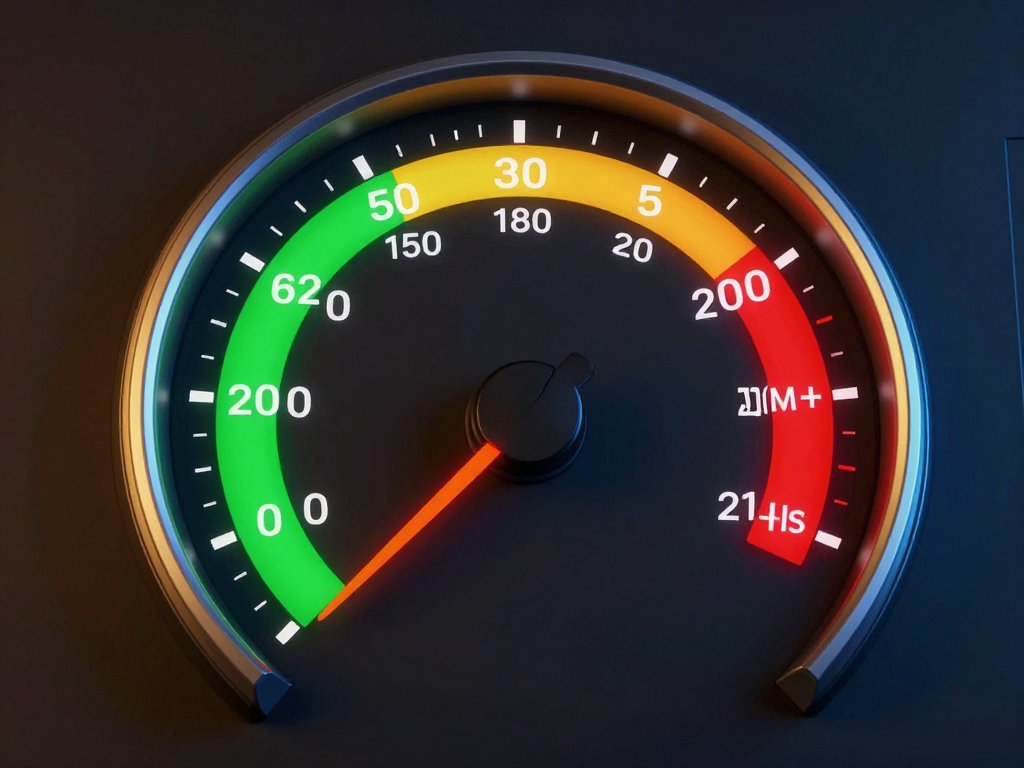
The per-account hourly limit for business-initiated DMs is commonly cited as approximately 200 DMs per hour for accounts in good standing with mature API connections. However, Meta does not publish a single, static number — the actual limit varies based on account age, follower count, engagement history, and API tier. Accounts that are new to the API, have a history of spam reports, or are connected to apps with lower permission tiers will have lower effective limits. The 200/hour figure should be understood as the ceiling for established accounts, not a guaranteed starting allocation.
This is why QuickDM's Pro plan caps at 185 DMs/hour rather than 200 — it intentionally operates 7.5% below Meta's stated ceiling to provide a safety buffer. If Meta's actual enforced limit for a given account is 180 DMs/hour (below the stated maximum due to account-specific factors), running at 185 would still stay within safe territory. Operating at exactly the stated limit with no buffer is how accounts accumulate "limit approached" signals that gradually reduce their effective rate ceiling over time.
What "185 DMs/Hour" Actually Means in Daily and Monthly Terms
QuickDM Pro's 185 DMs/hour limit translates to significant practical capacity when projected across realistic usage windows. At 185 DMs/hour sustained for 8 hours/day (a reasonable active business day), that represents 1,480 DMs per day. Over a 30-day month with 8-hour active days, that is 44,400 DMs per month — sufficient for virtually all individual creator accounts and most small-to-medium agency clients.
In reality, most creators do not need sustained 185 DMs/hour. The typical use case is burst sending triggered by a high-engagement post or Reel: a creator posts content, comments flood in over 2–4 hours, and the automation processes all qualifying keyword comments in that window. A post receiving 500 qualifying comments would require approximately 2.7 hours of sustained sending at 185 DMs/hour — fully achievable within a single viral content cycle. For daily workflow automation (welcome messages, support replies, ongoing campaigns), the effective daily volume is more than adequate for most use cases without ever approaching the hourly ceiling.
For Indian D2C brands running product launch campaigns or flash sale announcements, the math is similarly favorable. A WhatsApp-scale launch announcement reaching 5,000 engaged followers through comment-to-DM would require approximately 27 hours of sustained sending at 185/hour — spread across two days, this is entirely manageable and keeps the account comfortably within Meta's safety thresholds. At ₹399/mo, accessing this capacity costs less than a single Facebook ad boost. To understand the full capability, see the agency guide to Instagram automation which covers burst campaign planning in depth.
How QuickDM's Default Settings Keep You Safely Below Meta's Ceilings
QuickDM is designed around the principle of conservative-by-default rate management. Out of the box, without any user configuration, the tool applies intelligent throttling that prevents any connected account from approaching Meta's limit thresholds. This approach is deliberate: a new user connecting their Instagram account for the first time should not need to understand Meta's rate limit documentation to stay safe — the tool should handle that automatically.
QuickDM's free plan defaults to 20 DMs/hour — a conservative limit that is safe for essentially any Instagram account, including very new accounts with limited API history. This is not a restrictive cap imposed by QuickDM for commercial reasons; it reflects the genuinely conservative sending rate that is appropriate for accounts establishing their API connection for the first time. As accounts mature and build API sending history, upgrading to Pro unlocks the 185 DMs/hour limit, which QuickDM applies with built-in slow-down logic to prevent burst spikes that could trigger Meta's real-time detection.
This safety-first architecture means QuickDM users do not need to monitor sending rates manually or configure complex throttling rules. The tool does the math automatically, queuing DMs when rate limits are approached and resuming sending when the window resets. For agencies managing client Instagram accounts at scale, this automatic rate management is especially valuable — it removes the risk of an overzealous campaign accidentally pushing a client's account into restricted status.
Hourly Slowdown Mode — What It Is and Why Every Safe Tool Has One
Slowdown mode (sometimes called "rate-throttling, "safe mode," or "smart slowdown" depending on the tool) is a feature that automatically reduces the DM sending velocity when the tool detects that an account is approaching its hourly rate limit. Rather than sending DMs as fast as possible until the limit is hit — and then stopping abruptly (a sending pattern that itself looks suspicious to Meta's systems) — slowdown mode gradually reduces the sending cadence as the limit approaches, creating a more natural-looking traffic curve.
The distinction between "hard stop" and "gradual slowdown" matters because Meta's detection systems analyze sending patterns over time, not just instantaneous volumes. An account that sends 185 DMs in the first 30 minutes of an hour, then zero DMs for the next 30 minutes, produces a characteristic "burst-and-stop" pattern that is rare in legitimate human communication. An account that sends DMs at a gradually declining rate as the hour progresses — peaking in the first few minutes after a post goes live, then tapering as the queue processes — looks much more like organic human behavior.
QuickDM includes slowdown mode in both its free and Pro tiers. LinkDM explicitly brands this as "Slow Down Mode" and markets it as a safety feature. ManyChat's implementation is less documented externally. CreatorFlow does not explicitly mention a slowdown mechanism on its public-facing pages, which is worth noting for high-volume users. InstantDM labels its version "smart slowdown" in its Legend Pro tier. Any tool that lacks this feature — or that allows unlimited sending with no rate management — should be treated with caution regardless of whether it claims to use the official API.
Meta Rate Limit Translation Table (Approximate — verify against Meta developer docs before relying on specific numbers) | |||
Limit Type | Meta's Cap | Safe Daily Volume | Safe Monthly Volume |
|---|---|---|---|
User-initiated DMs (reply in 24hr window) | No enforced cap within window | Depends on active conversations | Unlimited within windows |
Business-initiated DMs | ~200/hr (established accounts) | ~1,480/day (8hr active) | ~44,400/month (8hr/day) |
Per-hour burst (new accounts) | 20–50/hr | ~160–400/day | ~4,800–12,000/month |
QuickDM Free default | 20/hr | ~160/day | ~4,800/month |
QuickDM Pro default | 185/hr | ~1,480/day | ~44,400/month |
Free-Tier Comparison — What You Actually Get Before Paying
The Hidden Truth About "Free" Instagram DM Automation Tools
The word "free" in the Instagram automation space requires careful scrutiny. Marketing teams at SaaS tools have become expert at presenting free tiers that look generous on the surface but are constrained in ways that only become apparent through hands-on use. The most common approach is to offer a free tier with a low monthly DM cap that feels adequate for a casual user but forces upgrade within weeks for anyone doing serious content marketing. A second approach — pioneered by ManyChat — is to offer free access based on "contacts" rather than DMs, which sounds unlimited but quickly becomes restrictive once an account's follower base grows.
A third, subtler approach is to restrict the free tier to a small number of automations or "flows, " meaning users can try the product but cannot actually run the multi-step funnels that make DM automation valuable. Some tools also include branding in free-tier messages ("Sent via [Tool Name ]") — which undermines the professionalism of automated DMs and effectively forces creators to pay to remove the watermark. Understanding these hidden constraints before choosing a tool prevents frustration and unexpected upgrade costs. When evaluating is ManyChat worth it in 2026?, the free tier comparison is often the most revealing data point.
QuickDM takes a philosophically different approach to its free tier: the only limitation is the hourly DM rate (20 DMs/hour), not the number of automations, keyword triggers, contacts, or flows. This means a creator can build a sophisticated multi-step comment-to-DM funnel, connect it to multiple posts, configure unlimited keyword triggers, and run it indefinitely — without ever paying. The 20 DMs/hour limit is the only constraint, and for most early-stage creators or small businesses, it is more than sufficient. This is what "free forever, no credit card required" actually means in practice.
Free DM Cap Comparison Across All Major Tools (2026)
The free DM volume available across major Instagram automation tools in 2026 ranges from essentially zero (for tools with very restrictive free tiers) to 2,000 DMs/month for the most generous public offer. Understanding these caps in context — accounting for the type of cap, what features are included, and what gets restricted — is essential for making an informed choice before committing to any platform.
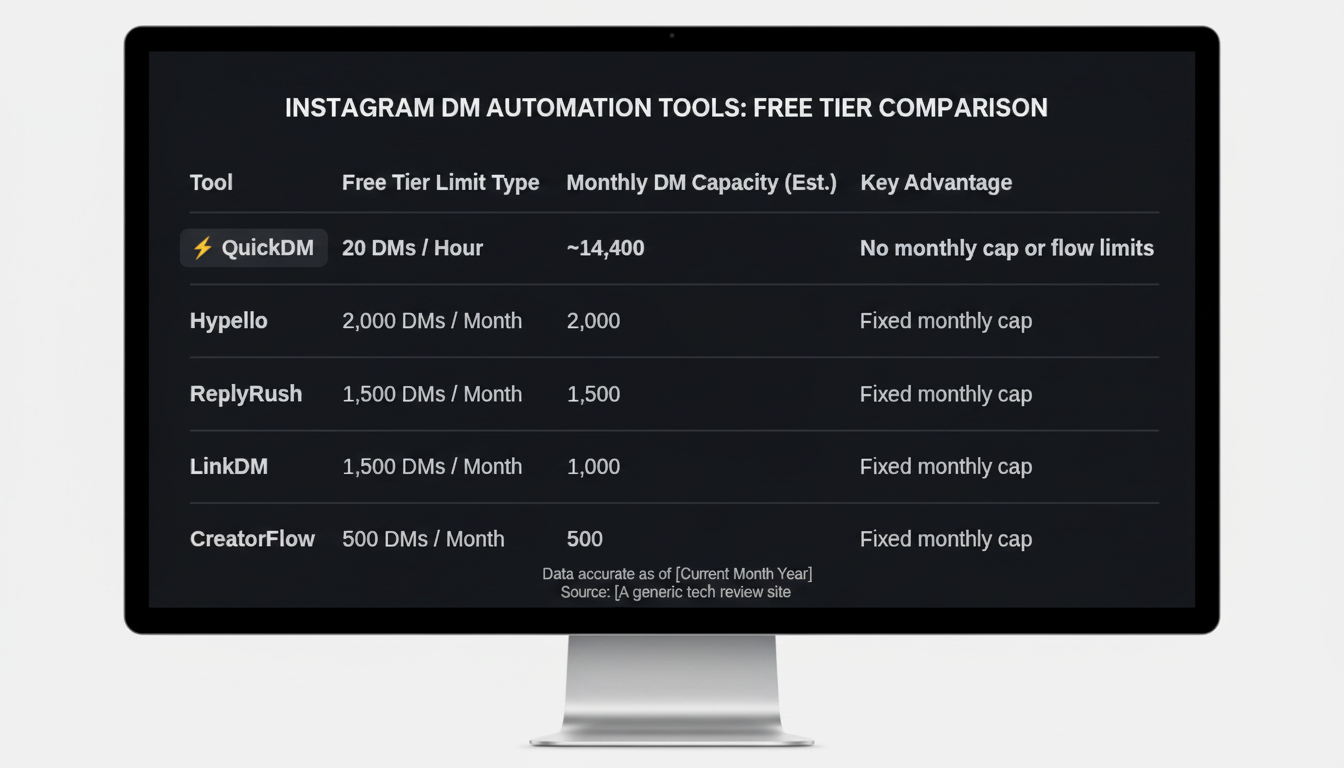
QuickDM Free provides 20 DMs/hour with no monthly cap — meaning in a full day of active sending, a free user could theoretically deliver 480 DMs. More practically, running automation for 4–6 active hours around content posting windows, a free QuickDM user can send 80–120 DMs per day without any constraint. Crucially, all automation features — unlimited keyword triggers, unlimited flows, multiple posts — are available on the free plan. This is genuinely the most feature-complete free tier in the market. For a detailed QuickDM vs CreatorFlow feature face-off, the free tier comparison section is particularly illuminating.
Hypello's free tier offers 2,000 DMs/month — the highest raw monthly volume in the market on a free plan. However, this cap applies to total DMs sent, and at 2,000 DMs spread across 30 days, that is approximately 67 DMs/day — significantly less daily capacity than QuickDM's 20/hour (which yields ~480/day theoretical maximum). ReplyRush offers 1,500 DMs/month free, which translates to ~50 DMs/day. LinkDM offers 1,000 DMs/month free (~33/day). CreatorFlow offers 500 DMs/month free (~17/day). ManyChat's free tier is not DM-capped but is limited to 1,000 contacts — once your connected audience reaches 1,000 people, further growth requires upgrading. The is CreatorFlow free worth it? analysis depends heavily on your actual daily DM volume needs.
Contact-Based vs. DM-Volume-Based Pricing — Why the Difference Matters
The fundamental pricing philosophy of an automation tool determines how its cost scales with your growth — and the difference between contact-based and DM-volume-based pricing can mean thousands of dollars in annual costs for fast-growing accounts. ManyChat and Inrō use contact-based pricing: you pay based on how many total contacts (users who have ever interacted with your account through the tool) are in your connected database. ManyChat's free tier covers 1,000 contacts; paid tiers scale from $15/mo (500 contacts, bizarrely fewer than the free tier's 1,000 — the paid tier removes contact limits for active contacts while adding features) up to $435+/mo for 100,000+ contacts [Source: manychat.com/pricing, verified Jan 2026].
DM-volume-based pricing — used by CreatorFlow and LinkDM — charges based on how many DMs you actually send per month, regardless of how large your audience database is. This model is more intuitive for creators: if you run one campaign this month sending 3,000 DMs, you pay for 3,000 DMs. Next month if you only run maintenance flows sending 500 DMs, you pay less. The cost tracks actual usage rather than accumulated audience size. The risk is that high-volume campaign bursts (a viral post triggering 10,000 comments) can push you into higher-cost tiers unexpectedly.
QuickDM's flat-rate model is the simplest: $7/mo globally (₹399/mo India) for Pro, regardless of contacts or DM volume, up to the 185/hour rate limit. This model is particularly valuable for fast-growing accounts where contact databases grow rapidly — there are no surprise bill spikes as your audience scales. The ManyChat per-contact pricing trap is a real concern for accounts with 10,000+ followers, where ManyChat's costs can easily reach $65–$130/mo while QuickDM stays at $7/mo.
When Free Plans Force You to Upgrade (And When They Don't)
Free plans force upgrades when one of three conditions occurs: you hit a hard volume cap and DMs simply stop sending; you need a feature that is gated behind the paid tier; or your free plan generates visible branding that damages your professional image. Understanding which of these conditions will affect you — and how quickly — is the key to evaluating any tool's free tier honestly.
Volume caps are the most common forcing function. CreatorFlow's 500 DMs/month cap, for example, will be reached within the first week by any creator who posts 3–4 times per week with keyword triggers. A Reel receiving 200 keyword comments triggers 200 DMs — a single viral post consumes 40% of the free monthly allowance. At that pace, upgrade pressure arrives within the first month of serious use. ManyChat's 1,000-contact cap similarly applies within weeks for accounts with engaged followings: once 1,000 people have messaged you or been messaged by your account, further automation requires upgrading.
QuickDM's free plan is specifically designed to avoid these forcing functions. The 20 DMs/hour limit is the only constraint — and for creators at an early stage building their automation workflows, testing funnels, and establishing their content cadence, 20 DMs/hour is genuinely sufficient. A creator receiving 50 qualifying comments on a post (a common volume for accounts under 10,000 followers) would process all 50 DMs in under three hours at the free rate. The upgrade to Pro makes sense when you're posting multiple times per week and regularly receiving 200+ qualifying comments per post — a level of engagement that almost always correlates with revenue generation that justifies the $7/mo Pro price.
QuickDM Free vs. Competitors — The Only Truly Unlimited Free Automation
Placing QuickDM's free tier in honest context: it is the only tool in this comparison that offers unlimited automations (flows, triggers, keyword sets) with no time limit, no credit card, and no feature gating behind a paywall — with the single constraint of 20 DMs/hour. Every other tool in this guide either caps monthly DM volume, restricts the number of automations or keyword triggers, requires removing branding from messages, or gates core features (like multi-step flows or lead capture) behind paid tiers.
This is not a marketing claim but a structural fact of how QuickDM's free tier is architected. ManyChat's free plan, for example, restricts users to 3 keyword triggers, limits flows to basic structures, and includes "Powered by ManyChat" branding in all messages — significant limitations that make the free plan a demo rather than a production tool. CreatorFlow's free tier is more generous on features but hard-capped at 500 DMs/month. LinkDM's free tier allows 1,000 DMs/month but restricts multi-account access and some advanced flow features.
[CTA: Start QuickDM Free — Unlimited Automations, No Credit Card Required → https://quickdm.app/signup]
Free Tier Comparison — Major Instagram DM Automation Tools (2026) | |||||
Tool | Free DM Limit | Free Automations | Free Triggers | Branding in DMs | Credit Card Required |
|---|---|---|---|---|---|
QuickDM | 20/hour (no monthly cap) | Unlimited | Unlimited | No | No |
ManyChat | 1,000 contacts | Limited | 3 triggers | Yes | No |
CreatorFlow | 500/month | Full features | Unlimited | No | No |
LinkDM | 1,000/month | Limited | Limited | Yes | No |
InstantDM | 500 automations/month | Limited | Unlimited | No | No |
Hypello | 2,000/month | Limited | Limited | No | No |
ReplyRush | 1,500/month | Limited | Limited | No | No |
Inrō | 100 active contacts | 3 automations | Limited | No | No |
#1 — QuickDM (Best Free Forever + Best for India)

What QuickDM Is and Who Built It
QuickDM is a Mumbai-headquartered Instagram DM automation platform built specifically for the Meta Graph API, with a product philosophy centered on two principles: safety-first automation and accessible pricing for Indian creators and agencies. Founded by a team with deep roots in India's digital marketing ecosystem, QuickDM was designed from the ground up to solve a specific problem: the existing market leaders (ManyChat, in particular) were priced and structured for Western markets, leaving Indian creators paying dollar-rate prices on rupee-scale revenues — or resorting to unsafe bot tools to keep costs down.
QuickDM's integration with Meta's official API means it carries the same technical safety guarantees as enterprise-grade tools like ManyChat — without the enterprise-grade price tag. The team's decision to offer genuinely unlimited free automations (not a 14-day trial, not a feature-limited demo) reflects a bet that the best way to build trust in the Indian creator market is to let the product speak for itself before asking for payment. This bet appears to be paying off: QuickDM has grown its user base substantially since launch, with particular traction in the fashion, beauty, food, and coaching verticals that dominate India's creator economy.
For creators exploring Instagram DM automation for affiliate marketing or writing DMs that don't feel robotic, QuickDM's product blog is one of the most practical resources in the market — reflecting a team that actually thinks deeply about DM strategy, not just the technology that enables it.
QuickDM Free Plan — What "Unlimited Automations, 20 DMs/Hour" Really Means
The QuickDM free plan's key differentiator is architectural: it does not cap the number of automations, flows, keyword triggers, or posts you can connect. You can build a five-step comment-to-DM funnel for your product launch, a separate support auto-reply flow for your most common DM inquiries, and a lead magnet delivery sequence for your latest content — all simultaneously, all on the free plan, with no expiration date and no credit card ever required. The single constraint — 20 DMs/hour — is a rate limit, not a feature limit.
To understand what 20 DMs/hour means practically: for a creator posting 3–4 times per week with keyword triggers, receiving an average of 40–60 qualifying comments per post, 20 DMs/hour means all DMs from a single post are sent within 2–3 hours of the post going live. This is within the engagement window for most Instagram content and is genuinely sufficient for building and testing automation workflows. A creator who is still in the "learning what works" phase — experimenting with different keyword triggers, funnel structures, and message templates — will find the free plan more than adequate for months of serious testing. For a step-by-step comment-to-DM setup walkthrough, QuickDM's documentation covers the entire process from first connection to live automation.
The "forever" aspect of QuickDM's free plan deserves emphasis because it is genuinely rare in the SaaS world. Most tools use a free tier as a time-limited acquisition funnel — a 14-day trial rebranded as "free" with an asterisk. QuickDM's free plan has no expiration, no usage timer, and no mechanism that automatically downgrades or charges after a period of inactivity. A creator who builds their automation stack on QuickDM Free in January can return in September without any disruption to their flows, without any bill, and without any re-configuration. This stability makes it a genuine free-forever tool rather than a deferred-payment plan.
QuickDM Pro ($7/mo Global | ₹399/mo India) — Features and Value
QuickDM Pro unlocks the 185 DMs/hour sending rate — the primary upgrade from the free tier — along with any advanced features the team has added to the paid tier. At $7/month globally, it is the lowest-priced paid Instagram automation tool in this comparison: less than half of ManyChat's $15/month entry price, cheaper than CreatorFlow's $15/month Pro, and significantly below LinkDM's $19/month and InstantDM's $12/month. For Indian users, the ₹399/month price point — available directly in INR with GST-compliant invoicing — makes it even more accessible. At current exchange rates, ₹399 is approximately $4.75, meaning Indian Pro users pay less than the global dollar price.
The value proposition of Pro is clearest for creators who have validated their automation funnels on the free plan and are now running content at scale. At 185 DMs/hour, a creator can process 500 qualifying comments from a viral post in approximately 2.7 hours — capturing essentially all of the engagement within the same business day. For D2C brands running product launches or flash sales where speed of response is directly correlated with conversion rate, the Pro upgrade pays for itself almost immediately. A single successful product launch where 50 additional people convert because they received their DM within 2 hours instead of 2 days — at an average order value of ₹800 — generates 100x the monthly Pro subscription cost. For those considering switching from ManyChat to QuickDM, the Pro plan delivers comparable DM volume at a fraction of the cost.
QuickDM Safety Profile — Meta API Compliance and Rate-Limit Defaults
QuickDM is built exclusively on Meta's official Graph API — there are no browser automation components, no unofficial endpoint calls, and no reverse-engineered API hooks in its architecture. Every automation triggered by QuickDM generates a server-side API call that is fully visible in Meta's API logs, associated with the user's authorized OAuth token, and subject to Meta's standard rate limits. This architecture means QuickDM accounts face zero ToS risk from the automation itself — the tool is doing exactly what Meta's API is designed to enable.
QuickDM's rate-limit defaults are conservative by design: the free plan's 20 DMs/hour is well below any account's effective rate ceiling, and the Pro plan's 185 DMs/hour includes built-in slowdown logic that prevents burst spikes. The tool does not offer a way to override these safety limits — which is a feature, not a limitation. A tool that lets users configure their own rate limits (including limits that exceed Meta's ceilings) is transferring safety risk to the user. QuickDM keeps that responsibility at the platform level, ensuring that no user can accidentally misconfigure their way into a rate limit violation. For anyone researching does DM automation cause Instagram shadowban? — the answer when using QuickDM is no, provided users follow basic best practices around message content quality and diversity.
Who Should Choose QuickDM (Best Fit Use Cases)
QuickDM is the clear first choice for four distinct user profiles. First: Indian creators, D2C brands, and agencies — QuickDM is the only tool in this comparison with INR pricing, GST-compliant invoicing, and a Mumbai-based support team operating in Indian time zones. For any Indian user, the pricing advantage alone (₹399/mo vs. ₹1,245–₹5,395/mo for competitors) is compelling; the local support and invoicing advantages seal the decision. Second: solo creators and early-stage brands who need a capable free tier — QuickDM's unlimited-automation free plan is the most functional free tier in the market, making it the logical starting point for anyone new to DM automation.
Third: budget-conscious global creators who want flat-rate pricing — at $7/mo, QuickDM Pro costs less than most streaming subscriptions and less than half of ManyChat's entry price, with no per-contact scaling risk. For creators with fast-growing audiences where ManyChat's contact-based pricing would escalate rapidly, QuickDM's flat rate provides cost certainty. Fourth: creators who value simplicity and speed-to-launch — QuickDM's interface is designed for non-technical users to set up their first comment-to-DM flow in minutes. For the promote affiliate products through Instagram DMs use case specifically, QuickDM's straightforward keyword trigger setup is the fastest path from intent to live automation.
QuickDM Limitations — Honest Assessment
QuickDM is an excellent tool for the use cases it targets, but it has genuine limitations that certain users should consider. First, the platform is specifically built for Instagram — it does not offer multi-channel automation across Facebook Messenger, WhatsApp, or email. Teams looking for a unified messaging platform across Meta's ecosystem may find ManyChat's multi-channel capabilities worth the higher price. Second, QuickDM's AI and chatbot features are less developed than some competitors: while Inrō offers a trained AI agent for lead qualification and ManyChat supports conditional logic flows, QuickDM's automation is primarily trigger-based rather than conversational-AI-based. This is appropriate for most creator and D2C use cases but may limit more sophisticated enterprise deployments.
Third, some advanced features that the brief flags as "coming soon" — including story reply automation and live engagement features — are not yet available in their full form at time of publication. Users who need these features in production should verify current availability directly with QuickDM before committing. Fourth, QuickDM's review presence on third-party platforms (G2, Trustpilot, Capterra) is limited compared to established players like ManyChat — which may be a consideration for enterprise procurement teams requiring third-party validation. For those who need multi-account Instagram DM management at scale, verifying QuickDM's current multi-account capabilities directly with the team is recommended before making a decision.
[CTA: Try QuickDM Pro Free for 7 Days — ₹399/mo After, No Forex Fees → https://quickdm.app/signup]
#2 — ManyChat (Best for Enterprise, Most Expensive at Scale)

ManyChat Overview and Meta Business Partner Status
ManyChat is the most established player in the Instagram DM automation market, having launched its Instagram integration in 2021 and grown to become one of Meta's officially recognized Business Partners for messaging automation. This Meta Business Partner status is meaningful: it indicates that ManyChat has gone through Meta's partner verification process, operates within Meta's official API guidelines, and has access to certain API features that are not yet available to smaller or newer integrators. For enterprise users who need maximum credibility with their clients or compliance teams, ManyChat's partner status provides a level of institutional validation that newer tools cannot match.
ManyChat's product scope extends well beyond Instagram DM automation — the platform supports Facebook Messenger, WhatsApp, SMS, and email automation through a unified interface, making it a genuine multi-channel customer communication tool. For large brands running coordinated campaigns across multiple Meta properties simultaneously, this multi-channel capability has real value that single-channel tools cannot replicate. However, this breadth comes with complexity: ManyChat's interface is significantly more complex than single-channel tools, with a steeper learning curve that can be a barrier for solo creators or small teams without dedicated marketing automation resources. The full ManyChat vs QuickDM comparison breaks down exactly where this complexity translates to value and where it's simply overhead.
ManyChat Free Plan — 1,000 Contacts, Hard Feature Limits
ManyChat's free plan allows connecting one Instagram account and engaging with up to 1,000 contacts — users who have interacted with your account through ManyChat's automations. Within this 1,000-contact limit, the free plan restricts keyword triggers to 3 (meaning you can only set up 3 different keyword-to-DM flows simultaneously), includes "Sent via ManyChat" branding in all automated messages, and limits flow complexity compared to paid tiers. For a creator just exploring DM automation, these restrictions make the free plan a functional demo but not a production tool.
The 1,000-contact limit is both more and less generous than it appears. "More" because 1,000 contacts sounds like a lot — and for a creator just starting, it may last several months. "Less" because the contact count is cumulative and includes inactive contacts: every person who has ever triggered one of your automations counts toward the limit, regardless of whether they are still engaged with your account. A creator who ran a campaign 6 months ago that triggered automations for 700 people has 700 slots already used — even if those people never messaged again. Reaching the limit requires upgrading immediately, and there is no mechanism to "expire" old contacts on the free plan. This is precisely why creators are increasingly looking for ManyChat alternatives for Instagram with more transparent limit structures.
ManyChat Pro Pricing ($15–$435+/mo) — The Per-Contact Trap
ManyChat Pro pricing is built on a per-contact model that scales exponentially with audience size. The entry tier at $15/month covers 500 active contacts — bizarrely fewer than the free tier's 1,000 contact limit — and prices climb from there: approximately $25/mo for 2,500 contacts, $45/mo for 10,000 contacts, $65/mo for 25,000 contacts, and $435+/mo for 100,000+ contacts [Source: manychat.com/pricing, verified Jan 2026]. For a creator with a fast-growing account, these costs can become significant very quickly.
To illustrate the compounding cost: a creator who starts ManyChat at $15/mo with a 5,000-follower account and grows to 50,000 followers over 18 months — adding perhaps 20,000 new contacts to their automation database — will find their ManyChat bill escalating from $15/mo to $65/mo or more without any change in how they use the product. The cost increase is driven entirely by audience growth, which is the thing creators are actively trying to achieve. This creates a perverse incentive: the more successful you are at building an audience, the more you pay for the tool that helped you build it. For growing creators weighing this against why creators are leaving ManyChat, the per-contact model is consistently the most cited reason for switching.
In comparison, QuickDM Pro charges a flat $7/mo regardless of how many contacts are in the system. A creator with 5,000 followers pays $7/mo. A creator with 500,000 followers pays $7/mo. The cost predictability of flat-rate pricing is a significant operational advantage for any creator who expects (or hopes) to grow their audience substantially.
ManyChat G2 Reviews — What 155+ Users Actually Say (4.5/5)
ManyChat holds a 4.5/5 rating on G2 based on approximately 155 reviews [Source: g2.com/products/manychat/reviews, verified Jan 2026], reflecting genuine satisfaction among its established user base alongside recurring complaints about specific pain points. Positive reviews consistently highlight the platform's breadth of features, its reliability for multi-channel campaigns, and the quality of its template library for building complex automation flows. Enterprise and agency users particularly appreciate the multi-account management and team collaboration features unavailable in simpler tools.
Critical reviews cluster around three themes: pricing escalation as contact lists grow, complexity of the interface for new users, and inconsistent performance of certain trigger types — most notably the follow-to-DM feature discussed below. Several reviewers note that ManyChat's customer support response times can be slow for lower-tier subscribers, with faster support reserved for higher-tier plans. For Indian and emerging-market users specifically, the USD-only pricing and absence of local invoicing options are frequently mentioned as pain points — leading many to explore tools like QuickDM that offer regional pricing.
ManyChat's "Follow-to-DM" — The Feature That Frequently Breaks
ManyChat markets its follow-to-DM feature as a way to automatically welcome new followers with a DM — a seemingly powerful acquisition tool. In practice, this feature has a well-documented reliability problem that ManyChat's official documentation acknowledges in fine print but its marketing materials downplay. Multiple Reddit threads (including posts in r/Instagram, r/InstagramMarketing, and r/socialmedia with hundreds of upvotes) document the same pattern: ManyChat's follow-to-DM trigger fires for roughly 30–50% of new followers in optimal conditions, and less than that for accounts with newer API connections or accounts that have experienced any previous automation issues.
The technical reason, as discussed earlier in this guide, is that the follow event webhook in Meta's API is not consistently subscribed for all account types. ManyChat is not alone in this — the problem would affect any tool that attempts to build a reliable follow-to-DM trigger on the current API. However, ManyChat's marketing of this feature without adequate reliability disclosure has led to significant user frustration. Creators who build welcome sequences, lead magnets, or onboarding flows around follow-to-DM discover too late that large portions of their new follower audience are not receiving the automation.
ManyChat vs. QuickDM — When ManyChat Is Worth It (And When It Isn't)
ManyChat is worth it for: enterprise brands running coordinated campaigns across Instagram, Facebook Messenger, and WhatsApp simultaneously; large agencies that need multi-account management with team permissions, client reporting dashboards, and enterprise SLAs; accounts with complex automation flows involving conditional logic, A/B testing, and CRM integrations that simpler tools cannot support; and organizations where Meta Business Partner validation is required for internal compliance or client assurance purposes.
ManyChat is not worth it for: solo creators on tight budgets who only need Instagram DM automation; Indian users who need INR billing and GST-compliant invoicing; anyone whose primary use case is comment-to-DM automation with straightforward keyword triggers; and any account with a fast-growing audience where per-contact pricing will escalate unpredictably. For the majority of creators and small businesses reading this guide, the correct answer is to start with QuickDM's free plan, validate your automation strategy, and only consider ManyChat if you hit genuine limitations that require multi-channel or enterprise-grade capabilities. The detailed ManyChat vs QuickDM comparison walks through exactly these decision criteria with worked examples.
#3 — CreatorFlow (Best for Budget-Conscious Creators)

CreatorFlow Overview — DM-Cap-Based, No Contact Fees
CreatorFlow is an Instagram-focused DM automation platform that differentiates itself from ManyChat through its DM-volume-based pricing model — you pay based on how many DMs you send per month, not how many contacts are in your database. This makes CreatorFlow's pricing more intuitive and predictable for creators who run campaign-based automation (high DM volume during launches, lower volume during quiet periods) rather than always-on audience engagement. The platform supports comment-to-DM automation, story reply flows, keyword triggers, and lead capture — all the core features needed for a complete Instagram DM funnel.
CreatorFlow's interface is notably more streamlined than ManyChat's, reflecting a product focus on Instagram creators rather than multi-channel enterprise marketers. Setup time for a basic comment-to-DM flow is typically under 10 minutes for a new user, which is competitive with QuickDM's setup experience. The platform uses Meta's official API for all automations, ensuring TOS compliance. For a detailed head-to-head analysis, the QuickDM vs CreatorFlow comparison covers feature parity, pricing scenarios, and use-case recommendations in depth. Setting up keyword trigger DM automation works similarly in both platforms, though the UI differs.
CreatorFlow Free Tier — 500 DMs/Month, Full Features
CreatorFlow's free tier offers 500 DMs/month with access to the platform's full feature set — including unlimited automations, keyword triggers, and flow complexity. This is a genuinely functional free offering: unlike ManyChat's free tier, which restricts features significantly, CreatorFlow's free plan is essentially the paid plan with a volume cap. For a creator receiving fewer than 500 qualifying comments per month across all their posts, the free tier is a permanent solution rather than a trial.
The 500 DMs/month limit becomes constraining relatively quickly for creators at any meaningful scale. Three posts per week, each receiving 50 qualifying keyword comments, generates 600+ DMs per month — already over the free cap by the first week of month two. A single viral Reel receiving 300 keyword comments consumes 60% of the monthly allowance in one day. This means CreatorFlow's free tier is best suited for creators still building their audience (under 5,000 followers) or those who post infrequently and use automation selectively rather than on every piece of content.
CreatorFlow Pro ($15/mo) and Growth ($30/mo) Plans
CreatorFlow Pro at $15/month [Source: creatorflow.so/pricing/, verified Jan 2026] provides 5,000 DMs/month — a 10x increase from the free tier that is sufficient for most mid-volume creators. The Growth plan at $30/month doubles capacity to 10,000 DMs/month, which serves high-volume creators and small agencies with a single primary account. Both paid tiers include all platform features without additional restrictions.
At $15/month, CreatorFlow Pro is priced identically to ManyChat's entry tier but operates on a fundamentally different model: CreatorFlow's 5,000 DMs/month is a concrete, predictable limit, while ManyChat's $15/month covers 500 active contacts (a limit that escalates with audience growth). For creators whose contact database grows rapidly, CreatorFlow's DM-volume model may be more cost-predictable than ManyChat's. However, for high-volume users who regularly exceed 5,000 DMs/month, CreatorFlow's tiered structure can become more expensive than QuickDM's flat $7/mo (which provides 185 DMs/hour with no monthly cap). The why QuickDM beats CreatorFlow for India analysis specifically addresses the pricing crossover point where one tool becomes more cost-effective than the other.
CreatorFlow vs. QuickDM — Free Tier Face-Off
Head-to-head on the free tier: CreatorFlow offers more raw DMs per month (500 vs. QuickDM's ~480 at 20/hr for 24 hours — approximately equivalent) but imposes a hard monthly cap that QuickDM does not. QuickDM's free tier has no monthly DM cap — only an hourly rate limit. A QuickDM free user who runs automation for 4 hours on the day a post goes live and then has no further qualifying comments that month has "used" 80 of a theoretically unlimited free allocation. A CreatorFlow free user who does the same has used 80 of 500 — a meaningful fraction of a fixed monthly budget. Over the course of a month with multiple posts, this distinction matters.
On features, both tools offer comparable free tier functionality: full access to keyword triggers, multi-step flows, and core automation capabilities. The main differences are in DM capacity model (hourly rate vs. monthly cap) and in the meta-pricing: QuickDM's free tier has no ceiling other than the 20/hr rate, while CreatorFlow's has a 500/month hard ceiling. For a creator wanting to test DM automation without any time pressure or monthly budget anxiety, QuickDM's free tier is structurally more relaxed. The CreatorFlow alternative analysis covers additional nuances including support quality, onboarding experience, and feature roadmap comparisons.
Who Should Choose CreatorFlow
CreatorFlow is a strong choice for creators who post content consistently at moderate volumes (1–3 posts per week, 100–200 qualifying comments per post) and prefer the predictability of a monthly DM cap over an hourly rate limit. At $15/month for 5,000 DMs, it is competitively priced for its feature set and has a cleaner interface than ManyChat for Instagram-focused users. It is a particularly good fit for creators who are disciplined campaign planners — those who can forecast their monthly DM volume with reasonable accuracy and stay within the cap without needing the sustained 24/7 high-volume throughput that QuickDM Pro's 185/hour enables.
CreatorFlow is less suited for: Indian users who need INR pricing (CreatorFlow charges USD only); high-volume creators or agencies running burst campaigns that could easily exceed 5,000 DMs/month; and anyone for whom cost is the primary decision criteria (QuickDM Pro at $7/mo is less than half the price for higher hourly throughput). For users who want to try both, both platforms have functional free tiers that enable genuine testing before any payment commitment.
#4 — LinkDM (Best for High-Volume Agencies)

LinkDM Overview and Multi-Account Architecture
LinkDM is positioned as the agency-grade option in the Instagram DM automation market, with a product architecture built around high monthly DM volumes, multi-account management, and the operational needs of teams managing multiple client Instagram accounts simultaneously. Unlike consumer-focused tools that add multi-account as an afterthought, LinkDM's core product is designed for the agency workflow: connecting multiple client accounts, managing separate automation flows per account, and scaling to the DM volumes that professional campaign managers require.
LinkDM uses Meta's official Graph API for all automations and explicitly markets its "Slow Down Mode" as a safety feature — one of the few tools to name and document this capability prominently. For agencies where an account suspension would be a client relations crisis, this emphasis on safety infrastructure is reassuring. The platform's multi-account Instagram DM management capabilities make it a natural comparison point for any agency evaluating their automation stack, particularly when combined with the need for high monthly DM throughput.
LinkDM Free Tier — 1,000 DMs/Month, Single Account
LinkDM's free tier allows 1,000 DMs/month on a single connected account — double CreatorFlow's free cap and one of the more generous free allowances in this comparison. However, the free tier restricts multi-account management (which is LinkDM's primary differentiator), includes branding in DMs (unverified at time of publication — verify at linkdm.com before relying on this), and limits some advanced flow features to paid tiers. For agencies evaluating LinkDM, the free tier is primarily useful as a proof-of-concept for a single account rather than a production tool for client work.
For individual creators (non-agency users) evaluating LinkDM's free tier against competitors: 1,000 DMs/month is a reasonable monthly allocation for a moderately active creator, equivalent to running a medium-scale campaign twice per month. However, given LinkDM's positioning and pricing as an agency tool, individual creators may find better value in QuickDM or CreatorFlow's free tiers, which are more feature-aligned with solo creator use cases. For those wondering about is it safe to use two automation tools together? — using LinkDM for one client account and QuickDM for another does not inherently create safety issues, as long as neither account exceeds its individual rate limits.
LinkDM Pro ($19/mo) and Platinum+ ($99/mo) Plans
LinkDM Pro at $19/month [Source: linkdm.com/pricing/, verified Jan 2026] provides 25,000 DMs/month and supports up to 3 connected accounts — a significant volume increase from the free tier that is suitable for agencies running moderate-scale client campaigns. The Platinum+ tier at $99/month scales to 300,000 DMs/month with support for unlimited accounts, making it one of the highest-volume offerings in this comparison at a price point that is still significantly below what ManyChat would cost for equivalent enterprise-scale usage.
For agencies with 5–10 client accounts running regular campaigns, LinkDM's pricing structure is competitive. At $19/mo for 3 accounts and 25,000 DMs, the per-account cost is approximately $6.33/account/month — comparable to QuickDM Pro's $7/mo per account but with a defined monthly DM cap. At higher volumes, Platinum+ at $99/mo for unlimited accounts and 300,000 DMs is structured for agencies running large client rosters with high-frequency campaigns. The white-label DM automation for agencies requirements are an important consideration that goes beyond LinkDM's standard feature set — verify directly with their team if white-labeling is a requirement for your agency model.
LinkDM's "Slow Down Mode" and Safety Features
LinkDM's explicit "Slow Down Mode" is a notable differentiator: where most tools include rate throttling without documenting it publicly, LinkDM surfaces this as a named, marketed feature — suggesting the team treats it as a genuine product capability rather than just infrastructure. In practice, Slow Down Mode automatically reduces the DM sending velocity when an account approaches its rate limit, creating a more natural-looking sending curve and reducing the risk of triggering Meta's pattern-detection systems through burst sending behavior.
For agencies managing client accounts where any safety incident has reputational and commercial consequences, this explicit safety tooling is reassuring. The fact that LinkDM markets it prominently signals an organizational philosophy around compliance that aligns with best practices in the space. Combined with Meta API compliance, LinkDM's safety profile is among the strongest in this comparison — though QuickDM's built-in conservative defaults achieve similar outcomes without requiring user-level configuration. If you are concerned about shadowban and Instagram DM automation, both LinkDM and QuickDM's approaches to rate management provide strong protection.
LinkDM vs. QuickDM — Agency Use Case Comparison
For agencies managing multiple client accounts, LinkDM and QuickDM are complementary in some respects and competitive in others. LinkDM's multi-account pricing (3 accounts on Pro, unlimited on Platinum+) is structured for agency-scale operations in a way that QuickDM's current plan structure may not fully address for very large client rosters. However, QuickDM's flat per-account pricing and unlimited hourly throughput may be more cost-effective for agencies with 5–15 accounts at moderate campaign volumes than LinkDM's tiered structure.
The decision between them for agency use typically comes down to monthly DM volume vs. hourly throughput needs. LinkDM's 25,000 DM/month Pro cap translates to approximately 833 DMs/day — below QuickDM Pro's theoretical 1,480 DMs/day maximum. For agencies running consistent daily automation across all client accounts, QuickDM's hourly-rate model may provide more aggregate throughput at comparable cost. For agencies that run periodic burst campaigns (high volume for 2–3 days per month, minimal activity otherwise), LinkDM's monthly cap model may be more aligned with actual usage. The Instagram automation for agencies guide covers the full trade-off analysis with worked examples for different agency sizes.
Who Should Choose LinkDM
LinkDM is the strongest choice for digital marketing agencies managing 3–20 client Instagram accounts with consistent high-volume DM campaigns. Its explicit Slow Down Mode, multi-account architecture, and high monthly DM caps make it purpose-built for professional agency operations where reliability and safety are non-negotiable. At $19–$99/month, it is priced for professional use rather than individual creators — the cost-per-account on the free tier and Pro tier is competitive with other agency tools but meaningfully higher than QuickDM for solo creators. For anyone evaluating LinkDM for personal use rather than agency use, CreatorFlow or QuickDM will almost always be better value.
#5 — InstantDM (Mid-Market, Aggressive Free Tier Marketing)
InstantDM Overview — "Legend Pro" and "Trendsetter" Positioning
InstantDM markets itself with confident, growth-oriented branding — plan names like "Legend Pro" and "Trendsetter" signal an audience of ambitious creators looking for maximum automation capability. The product positions itself as capable of handling large automation volumes with AI-assisted comment reply features that go beyond the pure DM trigger-based approach of most competitors. InstantDM's interface emphasizes simplicity and speed-to-launch, with template-driven flows that reduce configuration time for common use cases like lead magnet delivery and product promotion sequences.
InstantDM claims Meta API compliance, though independent verification of all its claimed features against Meta's current API capabilities was not possible at time of publication (cells marked ⚠️ unverified in the comparison table reflect this). Creators considering InstantDM should verify current API compliance documentation directly with the company before connecting their account. The AI comment reply feature, if implemented through the official API, would be a meaningful differentiator in this space — most tools only automate DMs, not public comment replies. The multi-tool Instagram automation ban risk applies here too: if InstantDM's comment reply feature uses a different API mechanism than its DM automation, running both simultaneously could create compounding rate signals.
InstantDM Free Plan — 500 Automations/Month, Then It Pauses
InstantDM's free plan allows 500 "automations" per month — where an automation is counted as each triggered event (a DM sent, a comment replied to, etc.). At 500 automations/month, the free tier is approximately equivalent to CreatorFlow's 500 DMs/month in practical terms. The key difference in how InstantDM implements its free cap is that when the 500-automation limit is reached, the account's automations pause until the next month — rather than simply stopping new DMs while leaving existing flows running. This pause behavior means that a creator who hits the cap mid-month loses their automation coverage for the remainder of the month, which can be disruptive for ongoing campaigns or support flows.
The "500 automations" framing is also worth scrutinizing: if InstantDM counts both DMs and comment replies as separate automations, a creator using both features simultaneously would exhaust their free allocation twice as fast as one using DMs alone. Verify the exact counting methodology with InstantDM before relying on the 500-automation free cap as equivalent to 500 DMs.
InstantDM Legend Pro ($12/mo) — Unlimited But Rate-Capped at 750/Hour
InstantDM's Legend Pro plan at $12/month claims unlimited automations per month with a rate cap of 750 DMs/hour [Source: instantdm.com/pricing/, verified Jan 2026]. The 750/hour figure is notable because it significantly exceeds Meta's published 200/hour guideline for business-initiated messaging — raising the question of how this limit is implemented technically. If InstantDM is sending 750 DMs/hour through the official API, it is either operating on a special high-volume API tier, distributing sends across multiple app credentials, or the 750/hour figure reflects a combination of user-initiated and business-initiated messages counted together.
Creators should verify with InstantDM exactly how the 750/hour rate is achieved before relying on it for high-volume campaigns. If the mechanism involves anything other than fully transparent Meta API calls within standard business-initiated limits, the risk profile changes materially. At $12/month, Legend Pro is priced between QuickDM Pro ($7/mo) and CreatorFlow Pro ($15/mo) — a middle ground that requires clear technical verification to justify for safety-conscious users.
InstantDM "Truly Unlimited" Claim — What the Fine Print Says
InstantDM's higher-tier plans claim "truly unlimited" automation volume — a marketing claim that deserves scrutiny in any tool review. As established in the rate limits section of this guide, no Instagram DM automation tool can actually send unlimited DMs: Meta's per-account hourly limits are enforced at the API level, regardless of what any tool's marketing materials say. A "truly unlimited" claim therefore means one of three things: the tool batches sends across multiple API connections, the claim refers to unlimited automations (flows and triggers) rather than DM volume, or the "unlimited" framing is marketing language that means "no additional cap beyond Meta's native limits."
Any of these interpretations may be accurate and legitimate — but they need to be verified rather than assumed. Before purchasing any "truly unlimited" plan on any platform, ask the tool's support team exactly what "unlimited" means in practice, how the hourly rate cap is implemented, and what happens when an account approaches Meta's native limits. The answer to those questions reveals the real product capability underneath the marketing language.
Who Should Choose InstantDM
InstantDM is worth evaluating for creators who specifically need AI-powered comment reply automation — a feature that can drive significant engagement when implemented correctly through the official API. For standard DM automation use cases (comment-to-DM, keyword triggers, lead capture), InstantDM's feature set is competitive with the field but its pricing and verification status give it lower confidence than established players like ManyChat, CreatorFlow, or QuickDM. New users should start with InstantDM's free tier, verify behavior matches marketing claims, and then make an informed upgrade decision.
#6 — Hypello (Highest Free DM Cap in 2026)

Hypello Free Tier — 2,000 DMs/Month and the "Ask-to-Follow" Feature
Hypello offers the highest free DM allowance of any tool in this comparison: 2,000 DMs/month, which translates to approximately 67 DMs/day if distributed evenly. This makes Hypello's free tier the most generous option for creators who need monthly DM volume rather than daily burst capacity — a single Reel campaign receiving 500 keyword comments would use 25% of the free monthly allowance, leaving 1,500 DMs for the rest of the month. For creators who post 1–2 times per week with moderate engagement (100–200 qualifying comments per post), Hypello's free tier could last several months before an upgrade is needed.
Hypello's "Ask-to-Follow" feature is a notable differentiator: it can include a follow prompt within the automated DM flow, encouraging users who receive a DM to follow the account if they haven't already. This feature — when implemented correctly through the official API — addresses a gap that comment-to-DM automation creates: a non-follower can comment a keyword and receive a DM without ever following the account. The follow prompt attempts to convert these engaged commenters into followers, closing the loop between content discovery and audience building. However, the effectiveness of this feature depends on implementation quality and Meta API compatibility — verify with Hypello before building a growth strategy around it.
Hypello Paid Plans and Upgrade Path
Hypello's paid pricing was not fully available through public crawl data at time of publication. The upgrade path from the free 2,000 DMs/month tier appears to offer higher DM volumes and additional features, but specific plan names, prices, and DM caps should be verified directly at Hypello's website before making any purchasing decision. What is known: Hypello's pricing model appears to follow the DM-volume approach (like CreatorFlow and LinkDM) rather than the contact-based model (like ManyChat and Inrō) — but this should be confirmed.
For creators specifically interested in Hypello's approach to automation, the Hypello blog [Source: hypello.com/blogs/best-free-instagram-dm-automation-tools-and-how-to-use-them, referenced in research] contains a useful competitor comparison from Hypello's perspective that is worth reading alongside this guide. Bear in mind that any tool's own comparison of competitors should be read critically — including QuickDM's comparisons of its competitors.
Hypello Safety Profile — API vs. Browser Automation Stance
Hypello claims Meta API compliance in its marketing materials, though independent technical verification of this claim was not completed at time of publication. For any tool claiming API compliance, the verification steps are: (1) check whether the tool requires Instagram's native app login or OAuth authorization through an Instagram-branded permissions screen — OAuth flow indicates genuine API usage; (2) check whether the tool's terms of service explicitly reference Meta's Messaging API or Graph API — vague references to "Instagram's policies" without API-specific language are a yellow flag; (3) look for Meta Business Partner status or Instagram Partner badges, which require formal verification by Meta.
Creators should perform this verification for Hypello (and any tool in this guide) before connecting their primary Instagram account. The can DM bots get you shadowbanned? answer depends entirely on whether the tool is using official API access or unofficial methods — and the verification steps above are the most reliable way to determine this without needing to understand the underlying technical architecture.
Who Should Choose Hypello
Hypello is most attractive for creators who need the highest possible free monthly DM volume without paying anything — the 2,000 DMs/month free tier is genuinely the most generous free offering on raw monthly volume terms in this comparison. It is also worth evaluating for creators specifically interested in the "Ask-to-Follow" funnel, if that feature is confirmed to work reliably through official API. The main caveat: verify pricing, paid plan details, and API compliance independently before committing — public information on Hypello's paid tiers is less complete than for the other tools in this guide.
#7 — ReplyRush (Best for Growth-Focused Creators)

ReplyRush Free Tier — 1,500 DMs/Month
ReplyRush offers 1,500 DMs/month on its free tier — placing it between Hypello (2,000) and LinkDM (1,000) in monthly free volume. At ~50 DMs/day distributed evenly, the free tier is usable for consistent daily automation at moderate scale. Like Hypello, ReplyRush's free tier is better suited to creators who post consistently at moderate volumes than to creators who run occasional large burst campaigns. A single post receiving 200 keyword comments uses 13% of the monthly free allocation — five such posts per month would exhaust the free tier exactly at the end of the month.
For a complete Instagram comment automation guide, ReplyRush's setup flow follows the same general pattern as other API-compliant tools: connect via OAuth, configure keyword triggers, build message flows, and activate on selected posts. The main difference between tools at this stage is interface design and the sophistication of flow-building tools — features worth evaluating hands-on before committing to any platform.
ReplyRush's Growth Funnel Philosophy
ReplyRush differentiates itself through its explicit "growth funnel" philosophy — the product is positioned not just as a DM automation tool but as a follower and audience growth accelerator. The marketing framing emphasizes that comment-to-DM automation drives follower growth (by increasing engagement signals that the algorithm rewards), lead generation (by capturing contact information through DM flows), and conversion optimization (by delivering personalized offers at the moment of peak engagement). This philosophy is not unique to ReplyRush — all effective DM automation tools can deliver these outcomes — but ReplyRush makes it central to its product narrative in a way that may resonate with creators whose primary goal is audience building rather than e-commerce conversion.
Comment Keyword → DM → Follower/Customer Flow in ReplyRush
ReplyRush's signature flow structure — comment keyword triggers DM, DM flow converts commenter to follower and/or customer — is the same fundamental mechanic available in all major compliant tools, executed with ReplyRush's specific UI and template library. The platform's templates are oriented around growth objectives: welcome sequences for new followers, lead magnet delivery, content upgrades, and product discovery funnels. For creators who want plug-and-play growth templates rather than building flows from scratch, ReplyRush's template library may reduce time-to-launch compared to more open-ended flow builders.
For creators interested in the earn commissions through Instagram DMs use case, ReplyRush's affiliate-oriented templates provide a starting point that can be customized for specific product offers and commission structures. The underlying automation mechanics are the same as any tool's comment-to-DM flow — the value is in the template structure and copywriting frameworks that ReplyRush provides.
Who Should Choose ReplyRush
ReplyRush is most compelling for creators who are in an active growth phase, posting consistently, and want pre-built growth funnel templates rather than building automation flows from scratch. The 1,500 DMs/month free tier is workable for emerging creators, and if ReplyRush's paid tier pricing and features are competitive with CreatorFlow and QuickDM after direct comparison, it is worth serious consideration for growth-focused use cases. As with Hypello, verify paid tier pricing and features directly with ReplyRush before purchasing — the publicly available data on their paid plans was incomplete at time of publication.
#8 — Inrō (Best AI Agent Features, European-Priced)

Inrō Free Plan — 100 Active Contacts, 3 Automations, 50 AI Credits
Inrō's free plan is the most restrictive in this comparison on raw volume: 100 active contacts, 3 automation flows, and 50 AI credits. For any creator with an active following, the 100 active contact limit will be exhausted within the first campaign. This positions Inrō's free tier as a genuine product demo — designed for evaluating the AI features and interface quality rather than running production automation. The 50 AI credits in particular are meant to showcase Inrō's AI agent capability, where the AI handles multi-turn DM conversations rather than delivering pre-scripted flows.
The contact-based model (like ManyChat) means that as Inrō's paid tier scales to larger contact databases, pricing escalates accordingly. At 100 active contacts on the free tier, Inrō is targeting a very early-stage creator or a brand doing a proof-of-concept evaluation. For Indian users specifically, Inrō's free tier limitations combined with its Euro-denominated pricing make it a difficult recommendation — the same evaluation can be done more practically on QuickDM's unlimited free tier, without the contact cap and at no currency risk.
Inrō Pro (€12.99/mo) — Contact-Based Scaling Like ManyChat
Inrō Pro starts at €12.99/month [Source: inro.social/pricing, verified Jan 2026] and scales by active contact count in a similar model to ManyChat — higher contact tiers cost more per month, with managed plans available at €200+/mo for brands needing dedicated support and custom integrations. At €12.99 (approximately $14 USD at current rates), Inrō Pro is priced comparably to ManyChat's entry tier but offers a different value proposition: AI-powered conversation handling rather than broad multi-channel reach.
For the right use case, Inrō's AI agent capability justifies the pricing premium over simpler trigger-based tools. A brand that receives hundreds of DMs per day asking the same 10–15 questions about pricing, availability, shipping, and product details can deploy Inrō's AI agent to handle these conversations autonomously — trained on product documentation, FAQs, and brand voice — without pre-scripting every possible conversation branch. This is meaningfully different from keyword-trigger automation and addresses a genuine pain point for high-volume DM accounts. The tone and conversation design for DMs considerations are especially relevant for AI-generated responses, where maintaining brand voice requires careful training and ongoing monitoring.
Inrō's AI Agent — Train Once, Qualify Leads Automatically
Inrō's AI agent works by training a custom language model on brand-specific documentation: product descriptions, FAQ documents, pricing sheets, shipping policies, and tone-of-voice guidelines. Once trained, the AI agent handles incoming DMs by generating contextually appropriate responses based on this training data — answering product questions, qualifying leads based on configurable criteria, and escalating complex or high-value conversations to human team members. The system learns from the conversations it handles, improving its accuracy and tone alignment over time.
This capability is particularly valuable for D2C brands with large product catalogues or nuanced pricing structures where keyword-trigger automation would require dozens of pre-scripted flows. Instead of building a flow for every product question variant, Inrō's AI handles the variability natively. The lead qualification aspect — where the AI scores incoming DMs based on purchase intent signals and routes high-intent conversations to human sales reps — addresses a specific need for brands with sales teams who cannot review every DM manually. However, this sophistication comes with a setup investment: training the AI agent requires well-organized source documentation and careful calibration to ensure the AI represents the brand accurately.
Inrō Trustpilot Reviews — What Early Users Say
Inrō's Trustpilot review presence reflects its early-stage market position: fewer reviews than established players, but qualitatively focused on the AI agent's capabilities and the team's responsiveness. Early adopters tend to be tech-forward brands and agencies who are specifically evaluating AI conversation handling — not creators looking for simple comment-to-DM automation. Reviews note the AI agent's ability to handle complex product questions without human intervention as the primary value driver, while acknowledging that the training process requires more setup time than simpler trigger-based tools. Pricing, particularly for higher contact tiers, is noted as a consideration in several reviews — the Euro-denominated pricing and contact-based scaling model creates similar budget predictability challenges as ManyChat for fast-growing accounts.
Who Should Choose Inrō (And Why It's Probably Not for Indian Users)
Inrō is best suited for: European brands and agencies where Euro pricing is natural; D2C brands receiving high volumes of complex, variable DM inquiries that require conversational AI rather than scripted automation; and tech-forward teams willing to invest in AI agent training for the payoff of fully autonomous DM handling at scale. The AI lead qualification feature, specifically, has strong ROI for brands with dedicated sales teams where routing high-intent leads quickly translates to closed deals.
Inrō is likely a poor fit for Indian users: Euro-denominated pricing with no INR option means forex fees and GST complications; the contact-based pricing model creates cost escalation as audience grows; and the AI agent setup complexity requires resources (time, documentation, ongoing calibration) that are disproportionate for solo creators or small Indian D2C brands just starting with automation. For Indian users, QuickDM's ₹399/mo flat rate with GST-compliant invoicing and local support is the rational choice — even for brands that eventually want AI capabilities, starting with QuickDM and revisiting AI tools when scale justifies the investment is a more pragmatic path. The ManyChat alternatives for Instagram analysis includes Inrō's positioning in the broader competitive landscape.
Risky Tools to Avoid — Browser Bots, Unofficial APIs, and Grey-Market Scrapers
How to Identify a Dangerous Instagram Automation Tool
Identifying unsafe Instagram automation tools is not always obvious — many browser bots and unofficial API tools are designed to look legitimate, with professional websites, testimonials, and confident claims about compliance. However, several reliable indicators can help distinguish genuinely safe tools from those that put your account at risk. The most reliable indicator: how does the tool connect to your Instagram account? A safe, API-compliant tool will always use Instagram's OAuth flow — you will be redirected to Instagram's own authorization page, which asks you to grant specific permissions (like "Allow [Tool Name ] to send messages on your behalf"). This authorization screen is Instagram's official gate for third-party API access.
Unsafe tools typically connect differently: they ask for your Instagram username and password directly (a major red flag — no legitimate tool needs your credentials), they ask you to install a browser extension or desktop application that runs in the background, or they claim to work through "your own Instagram session" rather than an API connection. Each of these connection methods indicates browser automation or unofficial API access. A second indicator: check whether the tool is listed in Meta's official partner directory or has documented App Review approval for its Instagram permissions. Tools using official API access must go through Meta's App Review process for messaging permissions — compliant tools will either have this documentation or be transparent about their partnership status. Understanding these distinctions is essential context for the Instagram account ban from automation tools risk assessment.
Instamber, Phantombuster, and Inflact — Documented Account Suspension Evidence
Several browser automation tools have accumulated significant evidence of causing Instagram account suspensions and restrictions. Instamber (also known as Instabot in some markets) operates through browser simulation and has been documented in multiple user reviews, Reddit threads, and comparison articles as a frequent cause of Instagram account restrictions, temporary bans, and in severe cases, permanent account deletions. Users report that accounts using Instamber for DM automation frequently receive "Action Blocked" notifications from Instagram within days or weeks of use.
Phantombuster is a legitimate automation platform with many use cases beyond Instagram, but its Instagram DM features rely on simulated browser sessions rather than official API access. While Phantombuster is transparent about this architecture (it does not falsely claim API compliance), it means Instagram DM automations built on Phantombuster carry the ban risk associated with any browser-based approach. Several documented cases in r/socialmedia and r/Instagram report account restrictions following Phantombuster Instagram DM campaigns, particularly at higher volumes. Inflact (formerly Ingramer) has similarly documented patterns of account restrictions in user communities, with its automation features relying on methods that do not align with Meta's official API framework. The Instagram shadowban truth in 2026 analysis covers how these tools specifically trigger Instagram's detection systems.
Grey-Market "Undetectable Bot" Claims — Why They Don't Hold Up Against Meta's AI Detection
A category of bot tools markets itself as "undetectable" — claiming that their human-behavior simulation is sophisticated enough to evade Meta's detection systems. These claims rarely hold up in practice, for a fundamental reason: Meta's detection is not a rule-based system that can be defeated by adding random delays or rotating IP addresses. It is a machine learning system trained on billions of authentic user sessions, capable of identifying the statistical signatures of automated behavior even when individual actions appear human-like.
Specifically, Meta's systems analyze: the distribution of time-between-actions (not just the presence of delays, but whether the distribution matches human behavioral patterns); the correlation between device fingerprints and account activity patterns; the semantic patterns of messages sent (mass-identical messages are flagged even at low volumes); the relationship between an account's follower engagement rate and its DM sending behavior; and dozens of other signals simultaneously. A bot that randomizes its delays can fool a simple rule-based detector; it cannot fool a neural network trained on billions of authentic sessions. Claims of "AI-level undetectability" from bot vendors should be treated with extreme skepticism — they are marketing copy, not technical reality. The multi-tool Instagram automation ban risk is compounded for anyone using grey-market tools alongside legitimate API tools.
What Happens to Your Account After a Ban or Flag
Instagram's enforcement response to detected automation abuse follows a graduated escalation path that can end in permanent account deletion. The first level is an "Action Blocked" message — Instagram temporarily prevents the account from performing specific actions (sending DMs, following users, liking posts) for a period ranging from a few hours to 30 days. This is a warning: the behavior that triggered it needs to stop immediately. Continuing with the same tool after an Action Block typically accelerates the escalation timeline.
The second level is a temporary account restriction or suspension — the account remains visible but cannot post, comment, or message. Recovery from a temporary suspension typically requires confirming account ownership through a phone number or email verification and agreeing to stop the violating behavior. The third and most severe level is permanent account deletion, where Instagram removes the account entirely and bans the associated phone number and device fingerprint from creating new accounts. At this stage, years of built audience, brand partnerships, and content are lost with no recovery path. For creators whose Instagram presence is their primary revenue channel, a permanent ban is a business-ending event — making the risk calculus around unsafe tools not just about compliance, but about existential business risk. Always prioritize avoiding Instagram shadowban with automation by using only verified API-compliant tools.
Using Multiple Tools Simultaneously — The Stacking Risk
A specific risk that many creators overlook: using multiple automation tools on the same Instagram account simultaneously. The intent is usually benign — a creator might use QuickDM for comment-to-DM automation and a separate scheduling tool for post scheduling, or an agency might have a client who is also using another tool independently. However, from Instagram's API perspective, each additional authorized application adds another set of API calls associated with the account, creating aggregate signal patterns that may cross rate limit thresholds faster than any single tool would.
The risk escalates when one of the simultaneously-used tools uses unofficial API access or browser automation. In that case, the official tool's clean API signals and the unofficial tool's suspicious behavior signals are both attributed to the same account — and Meta's detection systems evaluate the account's overall behavior pattern, not the individual tools' behavior in isolation. An account using QuickDM (safe) and Instamber (unsafe) simultaneously is not protected by QuickDM's compliance — it is exposed by Instamber's violations. The definitive resource on this topic is will using multiple Instagram automation tools get you banned? — read it before combining any tools on a single account.
DM Automation Playbooks — Copy-Paste Funnels for 2026
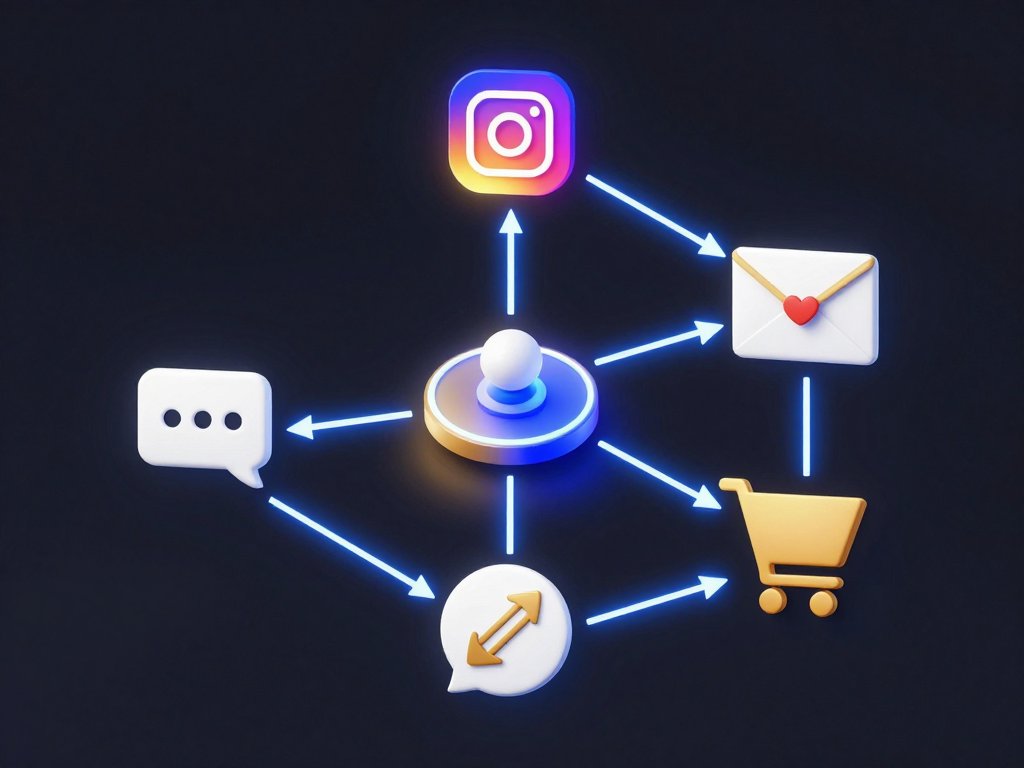
The Lead Magnet DM Funnel (Comment Keyword → DM → Download)
The lead magnet DM funnel is the highest-performing automation template in the creator toolkit: post content that promises a free resource (a PDF guide, a template, a checklist, a discount code), ask followers to comment a keyword to receive it in their DMs, and deliver the resource automatically via an instant DM with the download link. This funnel is effective because it aligns incentives perfectly: the follower gets something they genuinely want (the lead magnet), the creator gets an engaged DM conversation and a verified lead contact. The comment also generates algorithmic engagement signal, increasing the post's reach and compounding the campaign's value.
Implementation in QuickDM (or any compliant tool) follows a how to set up comment triggers on Instagram workflow: connect your account via OAuth, navigate to Automations, create a new Comment Trigger flow, set the keyword (e.g., "GUIDE"), configure the DM template with the download link, and activate on the target post. The DM template should be conversational and warm rather than purely transactional — automate DMs without sounding like a robot by using the recipient's first name ({first_name}), including a brief personal note alongside the link, and asking an open-ended question that invites a reply ("Let me know what you think of the guide!").
Template:
"Hey {first_name }! 🎉 Here's your [resource name ]: [link ]. This covers [ 2-3 specific things the resource helps with ]. Drop me a reply if you have questions — I read every DM! P.S. Did you also see the [related content ] I posted last week?"
Expected results for a creator with 5,000–20,000 followers: 15–40% of qualifying commenters will click the link within 24 hours; 5–15% will take the next action (email opt-in, product page visit, etc.). These conversion rates significantly outperform email campaign benchmarks for equivalent audience sizes, which is why this funnel has become standard practice for creator launches.
The Affiliate Offer DM Funnel (Story View → DM → Product Link)
The affiliate offer DM funnel uses Story engagement as the trigger: a creator posts a Story promoting an affiliate product, includes a call-to-action asking viewers to reply with a keyword or swipe up (for accounts with link stickers), and delivers the affiliate link automatically via DM to anyone who responds. This funnel is particularly effective for Instagram DM automation for affiliate marketing because it creates a high-intent audience segment — anyone who bothers to reply to a Story or use a link sticker is actively expressing interest, making them significantly more likely to convert than passive Story viewers.
The automation flow: Story posted → viewer replies with keyword (e.g., "LINK") → automated DM delivers affiliate URL with personalized copy → follow-up message 24 hours later for non-clickers (optional, via time-delayed DM in the automation flow). Monetize Instagram DMs with affiliate offers most effectively by using product-specific keywords that match the Story content — "SHOES" for a sneaker affiliate, "SKIN" for a skincare affiliate — rather than generic keywords like "LINK" that don't reinforce the product category in the commenter's mind.
For Indian creators working with domestic affiliate programs (Myntra, Meesho, Amazon.in, Flipkart), DM-delivered affiliate links in the user's preferred language (Hindi, Tamil, Bengali, etc.) significantly outperform English-only link delivery. QuickDM's Unicode support enables full regional language DM templates, making localized affiliate funnels fully operational without any workarounds.
The Launch Waitlist Funnel (Post Comment → DM → Waitlist Opt-In)
The launch waitlist funnel is designed for product launches, course drops, or content releases where building anticipatory demand before launch is more valuable than immediate sales. The mechanism: post teaser content for an upcoming launch, ask followers to comment a keyword to "get on the waitlist, " and deliver a DM that captures their email address or directs them to a waitlist landing page. By launch day, the creator has a warm list of explicitly interested contacts — dramatically outperforming cold-launch announcements to an un-segmented audience.
The most effective waitlist funnels include a "VIP" element: early waitlist members receive a special discount, first access, or bonus content not available to general launch buyers. This VIP positioning increases comment keyword conversion rates (more people want to comment if there's a real benefit) and creates genuine urgency. Template structure: "Comment 'EARLY' below for VIP early access + [specific bonus ] when [product ] drops on [date ]." The DM then delivers: "You're on the VIP list! 🔥 You'll get first access + [bonus ] before anyone else. Watch your DMs on [launch date ]. In the meantime, [engaging question about the product category ]?"
For a complete walkthrough of this funnel built in QuickDM, the set up DM flows from post comments guide covers every step from trigger configuration to multi-message sequence setup.
The Course or Challenge Funnel (Bio Link Click → DM Sequence)
The course or challenge funnel leverages Instagram's bio link as an entry point into a DM sequence — a powerful alternative to traditional email-based course funnels. The mechanism: a creator updates their bio link to a landing page that prompts visitors to DM a specific keyword to the creator's account (or uses a "Click to Message" button in the bio link page). When the keyword DM arrives, the automation responds with the course enrollment link, challenge registration form, or welcome sequence.
This funnel structure has a unique advantage: unlike landing page funnels that send visitors to email forms, the DM funnel captures engagement on Instagram itself, keeping the conversion journey within the platform where the creator's relationship with the audience is strongest. Creators offering coaching programs, online courses, or paid challenges have reported significantly higher completion rates for DM-based enrollment sequences compared to email-based equivalents — likely because DM interactions feel more personal and immediate. Earn commissions through Instagram DMs for course affiliate programs works through the same funnel structure, with the affiliate link delivered at the enrollment stage of the DM sequence.
The Support Auto-Reply Template (DM "price" / "link" → Instant Answer)
The support auto-reply template is the simplest and most immediately valuable DM automation for brands with established products: configure keyword triggers for the most common DM inquiries — "price, " "how much, " "link, " "buy, " "available, " "shipping" — and deliver instant automated responses with the relevant information. This eliminates the need for manual DM monitoring for routine inquiries, freeing the creator or brand team for higher-value conversations.
Effective support auto-reply templates are specific rather than generic. A bad template: "Thanks for your message! Visit our website for more info." A good template: "Hey {first_name }! Our [Product Name ] is ₹1, 499 with free shipping across India. Grab yours here: [link ]. Orders placed before 5pm ship same day. Any questions?" The specificity of the second template answers the actual question, removes friction from the purchase decision, and creates urgency — all in an automated response that arrives within seconds of the inquiry. For brands looking to write DMs that don't feel robotic, support auto-replies are actually the easiest category to optimize — because the answer to "what's the price?" is always the same, there's no variance to manage, just clarity and warmth to maximize.
[CTA: Build Your First DM Funnel Free on QuickDM — No Credit Card Needed → https://quickdm.app/signup]
QuickDM for India — The Only INR-Priced Instagram Automation Tool
Why Indian Creators and D2C Brands Overpay for Dollar-Priced Tools
Instagram India has 362M+ users — one of the platform's top three markets globally by user count [Source: statista.com, verify current figure before publication]. Despite this enormous user base, the Instagram automation tool market is almost entirely designed and priced for Western markets. ManyChat charges $15–$65/mo in USD — at current USD/INR rates of approximately ₹83–84, that translates to ₹1,245–₹5,395/mo — pricing that is genuinely prohibitive for most Indian creators and small D2C brands operating on rupee-scale revenues and margins.
CreatorFlow at $15/mo is ₹1,245/mo; LinkDM at $19/mo is ₹1,577/mo; InstantDM at $12/mo is ₹996/mo; Inrō at €12.99/mo is approximately ₹1,170/mo at current EUR/INR rates. None of these tools invoice in INR, meaning Indian users also pay international transaction fees (typically 1.5–3.5% per charge from Indian bank cards on foreign currency transactions) and face GST complications — since these vendors are not GST-registered in India, buyers cannot claim GST Input Tax Credit on the subscription cost. For a registered Indian business, this is a direct financial loss on top of the already-high dollar-rate pricing. The why QuickDM beats CreatorFlow for India analysis quantifies this cost difference with specific examples.
QuickDM Pro at ₹399/mo — Real Pricing Breakdown
At ₹399/mo, QuickDM Pro costs approximately $4.75 at current exchange rates — less than half of ManyChat's $15/mo entry price and below even the most budget-friendly dollar-priced alternative. To put this in tangible terms: ₹399 is less than the price of a single espresso at most Mumbai cafés. ManyChat's equivalent plan — covering comparable automation features — would cost ₹1,245/mo or more in rupee terms, plus international transaction fees, plus the GST ITC loss.
The ₹399/mo price delivers QuickDM's full Pro feature set: 185 DMs/hour (sufficient for virtually all Indian creator accounts and small D2C brands), unlimited automation flows and keyword triggers, comment-to-DM automation, all platform features without artificial restrictions, and INR-denominated billing that produces GST-compliant invoices. The Mumbai-headquartered support team operates in Indian Standard Time, meaning support inquiries receive responses during Indian business hours rather than being routed to time-zone-mismatched global support queues. For any Indian user comparing QuickDM vs CreatorFlow on India-specific criteria, the pricing differential alone typically makes the decision straightforward.
Indian D2C Use Cases: Fashion, Beauty, Food, and Coaching Brands
India's creator-economy and D2C boom has produced a vibrant ecosystem of Instagram-native brands across four primary verticals that are ideal fits for DM automation.
Fashion D2C (ethnic wear, sarees, western wear): Post a Reel showcasing new collection pieces, caption: "Comment 'PRICE' to get our full lookbook + price list in your DMs." Trigger: keyword "PRICE" on post comments. DM flow: automated message with catalogue link + "Reply 'ORDER' to connect with our styling team." This 24/7 automated sales flow replaces the equivalent of a part-time customer service employee — at ₹399/mo vs. minimum ₹8,000–12,000/mo for a part-time hire. Setting up DM flows from post comments for this use case takes under 15 minutes.
Beauty/Skincare D2C: Story with skin quiz prompt: "Reply with your skin type (OILY/DRY/COMBO) to get your personalized routine." Trigger: story keyword reply. DM flow: product recommendation sequence based on keyword variant, with add-to-cart links for each recommended product. The personalization element — even keyword-based, pre-scripted personalization — drives significantly higher click-through than generic product link DMs.
Coaching/Ed-Tech creators: Reel or carousel teasing free content from a paid program. Caption: "Comment 'WEBINAR' to reserve your free seat." DM delivers registration link + 24-hour reminder. For coaches whose programs are priced at ₹5,000–₹25,000, converting even 2 additional registrations per webinar through DM automation covers the annual QuickDM Pro subscription cost in the first month.
Food/Cloud Kitchen: Bio link → DM funnel with today's menu + ordering link. Comment "ORDER" on post → DM with direct order link for delivery platforms. Affiliate link in DM funnel strategies work particularly well for food creators promoting affiliate cooking products, equipment, or ingredient subscription services.
Hindi and Regional Language DM Templates That Convert
QuickDM's full Unicode support enables DM templates in any Indian language — Hindi, Tamil, Bengali, Marathi, Telugu, Kannada, Gujarati, and others — without any special configuration. The same automation flows that deliver English DMs can deliver regional language DMs; the only change required is the message content itself. This is significant because it means Indian creators can serve their audience in their audience's preferred language — a factor that meaningfully increases engagement and conversion rates for regional audiences.
Keyword triggers themselves can be in any language: a Hindi-speaking audience can be prompted to comment "कीमत" (price) or "लिंक" (link) in Devanagari script, and QuickDM's trigger matching handles Unicode character sets. Alternatively, using Roman-script keywords (PRICE, LINK) works across all language communities and reduces configuration complexity. Example Hindi DM template that converts: "नमस्ते {first_name }! 🙏 आपका message मिल गया। हमारी price list यहाँ है: [link ]. कोई सवाल हो तो बस 'HELP' reply करें — हम 24 घंटे में जवाब देंगे।" Personalization tokens like {first_name} work correctly for Hindi-script first names without any special handling.
GST-Compliant Invoicing and INR Billing — No Forex Surprises
For Indian businesses registered under GST, vendor invoice compliance is not just an administrative nicety — it directly affects tax liability. Purchases from foreign vendors (dollar-priced SaaS tools) are classified as import of services under Indian GST law, subject to Reverse Charge Mechanism (RCM) — meaning the buyer owes GST at 18% on the invoice value, without the ability to claim Input Tax Credit if the vendor has no GST registration in India. For a business paying $15/mo (₹1,245) for ManyChat, the effective cost after RCM GST is approximately ₹1,469/mo — and the ₹224 GST paid cannot be reclaimed.
QuickDM's INR billing produces GST-compliant tax invoices as a GST-registered Indian vendor, meaning subscriptions are treated as domestic purchases. The ₹399/mo subscription generates an invoice that allows GST-registered businesses to claim 18% Input Tax Credit — effectively reducing the net cost to approximately ₹338/mo for businesses claiming ITC. This brings the effective cost of QuickDM Pro for a GST-registered Indian business to approximately $4.02 — less than one-third of ManyChat's entry price for a similar automation capability. No forex fees, no RCM complications, no CA conversations about vendor registration status.
[CTA: Get QuickDM Pro for ₹399/mo — GST Invoice Included, No Forex Fees → https://quickdm.app/signup]
Decision Framework — Which Tool Is Right for You?

Solo Creator (Under 150 Comments/Post) — Your Best Options
Solo creators receiving under 150 qualifying comments per post are in the ideal sweet spot for QuickDM's free plan. At 20 DMs/hour, processing 150 DMs takes 7.5 hours — entirely within the engagement window for most content types, and the DMs arrive while the post is still active in followers' feeds. The unlimited automation flows on the free tier mean you can build and test multiple funnel types without any financial commitment, making QuickDM Free the logical starting point for any solo creator exploring DM automation for the first time.
Alternative options for this profile: CreatorFlow's free tier (500 DMs/month) works well if you post 1–2 times per week; Hypello's free tier (2,000 DMs/month) provides more monthly headroom if you post frequently and want buffer room. However, neither alternative offers the unlimited-automation architecture of QuickDM Free — you will eventually hit a monthly DM cap with both, while QuickDM's hourly rate allows continuous operation without a monthly ceiling. For monetize Instagram DMs with affiliate offers at this scale, QuickDM Free enables full affiliate funnel deployment from day one.
Growing Creator (150–1,000 Comments/Post) — When to Upgrade
Creators in the 150–1,000 qualifying comments per post range are approaching the point where QuickDM's free 20 DMs/hour limit begins to create meaningful delays in DM delivery. At 500 qualifying comments, the free plan takes 25 hours to deliver all DMs — past the optimal engagement window. This is the signal to upgrade to QuickDM Pro ($7/mo | ₹399/mo), which processes 500 DMs in approximately 2.7 hours. The upgrade ROI is immediate: faster DM delivery consistently outperforms delayed delivery on conversion rate metrics.
At this growth stage, the $7/mo Pro cost is almost certainly covered by the first additional conversion it generates. A creator with a product priced at ₹2,000 needs just one additional monthly conversion attributable to faster DM delivery to cover a full year of QuickDM Pro. For creators in India specifically, the ₹399/mo price point makes this upgrade decision trivially easy — it is the most cost-effective performance investment available for Instagram monetization at this scale. For a ManyChat vs QuickDM comparison at this scale, QuickDM Pro consistently comes out ahead on cost-efficiency without material capability gaps for the solo creator use case.
Agency or Multi-Account Manager — What You Actually Need
Agencies managing multiple client Instagram accounts need several capabilities that differentiate from solo creator requirements: per-account automation management (separate flows, triggers, and content for each client), usage reporting by account, and rate management that prevents any single high-volume client from affecting other accounts in the portfolio. For agencies with 3–10 client accounts, the tool comparison becomes more nuanced than for solo creators. The agency guide to Instagram automation provides the detailed operational framework for this decision.
QuickDM Pro at $7/mo per account (verify multi-account pricing directly with QuickDM) is cost-competitive for agencies with any size client roster. LinkDM's Pro at $19/mo for 3 accounts ($6.33/account) and Platinum+ at $99/mo for unlimited accounts may offer better per-account economics at larger scales. ManyChat's agency pricing is available but significantly more expensive and scales with contact counts across all connected accounts. For agencies where managing client Instagram accounts at scale is the core service, evaluating QuickDM and LinkDM in parallel with a real client account test is the most reliable evaluation methodology.
D2C Brand or SaaS — Compliance, CRM Integration, and Scale
D2C brands and SaaS companies have requirements that differ from pure creator use cases: CRM integration (connecting DM leads to HubSpot, Salesforce, or Klaviyo), higher automation complexity (branching flows based on purchase history or behavior), team access (multiple team members managing DM conversations), and volume scalability that accommodates campaign peaks without per-unit cost spikes. These requirements push the evaluation toward more enterprise-capable tools.
For Indian D2C brands at early to mid scale (under ₹5Cr annual revenue), QuickDM Pro covers the core use case at ₹399/mo — comment-to-DM lead generation, support auto-reply, and campaign automation. CRM integration can be achieved through Zapier or webhook connections even with simpler tools. At larger scale (above ₹5Cr), ManyChat's enterprise features, multi-channel support, and CRM integrations may justify the higher cost. For SaaS companies specifically, Inrō's AI agent for lead qualification through DM conversations is worth evaluating if your DM volume includes significant numbers of product-qualified leads requiring conversational screening. The human-sounding DM automation principles are especially important for D2C brands where brand voice consistency across automated interactions affects customer trust.
Risk Tolerance Matrix: Zero-Risk vs. Aggressive Growth
The risk tolerance matrix distills the fundamental choice in Instagram automation: how much account risk are you willing to accept in exchange for potential growth acceleration? At zero-risk tolerance — appropriate for any creator or brand for whom an account suspension would be a significant business or personal setback — the only acceptable choice is a tool using Meta's official Graph API with conservative rate limits. QuickDM, ManyChat, CreatorFlow, and LinkDM all qualify; browser bots and unofficial API tools do not, regardless of claimed growth benefits.
At moderate risk tolerance — where the account is a secondary channel rather than a primary revenue driver, or where potential growth benefits are worth a limited risk of temporary restriction — some creators evaluate grey-market tools with a fallback plan if restrictions occur. This guide does not recommend this approach, and the risk/reward calculus has shifted significantly against grey-market tools as Meta's detection has improved. For any creator or brand whose Instagram presence represents their primary audience and revenue channel, zero-risk tolerance is the only rational posture — and the official API tool ecosystem is robust enough that no meaningful growth capability requires accepting any additional risk. See stacking DM automation tools risk for additional risk scenarios beyond tool choice alone.
Decision Framework by Profile | ||
Profile | Recommended Tool | Why |
|---|---|---|
Solo creator, free forever | QuickDM Free | Unlimited automations, no caps, no credit card |
Budget creator (India) | QuickDM Pro ₹399 | INR billing, 185 DMs/hr, GST invoice |
Mid-volume creator (global) | CreatorFlow Pro $15 | 5,000 DMs/mo, transparent DM-volume cap |
High-volume agency | LinkDM Pro/Platinum+ | 25k–300k DMs/mo, multi-account, Slow Down Mode |
Enterprise / multi-channel | ManyChat Elite | Custom; Meta Business Partner, FB+IG+WhatsApp |
AI-first lead gen | Inrō Pro | AI Agent, CRM integration, smart inbox |
Frequently Asked Questions
Q: Which is the cheapest Instagram DM automation tool in 2026?
QuickDM is the cheapest paid option at $7/mo globally and ₹399/mo for India — less than half the price of ManyChat ($15/mo) or LinkDM ($19/mo). For users who need only basic automation, QuickDM's free plan (unlimited automations, 20 DMs/hour) costs nothing at all, with no credit card required.
Q: Is there a truly free Instagram DM automation tool that never expires?
Yes — QuickDM offers a free plan that is genuinely free forever, with unlimited automations and 20 DMs/hour, no trial period, and no credit card required. Competing tools like CreatorFlow cap free users at 500 DMs/month, while ManyChat limits free accounts to 1,000 contacts with heavily restricted features.
Q: Are Instagram DM automation tools against Instagram's Terms of Service?
Tools that use Meta's official Graph API — including QuickDM, ManyChat, CreatorFlow, and LinkDM — are fully TOS-compliant and approved by Meta. Tools that use browser automation, unofficial APIs, or web scraping (like Instamber or Phantombuster) violate Instagram's TOS and have caused documented account suspensions in 2026.
Q: What is the difference between a DM automation tool and an Instagram chatbot?
DM automation tools trigger predefined message flows based on user actions (like commenting a keyword), while chatbots use AI or decision trees to hold multi-turn conversations inside DMs. Some tools like Inrō and ManyChat include chatbot-style features; QuickDM and CreatorFlow focus on trigger-based automation flows.
Q: How many DMs per day is safe on Instagram in 2026?
Meta's Graph API enforces hourly and daily limits that vary by account age, activity, and API plan. On QuickDM Pro, the default is 185 DMs/hour — which translates to approximately 4,440 DMs/day if sustained, though real-world safe volumes are lower and depend on your account's history. Tools with built-in slowdown mode automatically stay within Meta's safe thresholds.
Q: Can DM automation tools help me grow Instagram followers?
Yes, indirectly — comment-to-DM flows increase engagement signals (comments trigger DMs, DMs increase reply rates), which Instagram's algorithm rewards with more reach. Tools like ReplyRush explicitly market follower growth funnels; QuickDM's comment-to-DM automation achieves similar results within Meta's rate limits.
Q: What happens if I use an unsafe Instagram DM bot?
Instagram's automated systems detect irregular messaging patterns and can issue warnings, temporary restrictions, or permanent account bans. Users of tools like Instamber and Phantombuster have reported documented account suspensions in 2026, as noted in community reviews and tool comparison articles.
Q: What is "comment to DM" automation and how does it work?
Comment-to-DM automation sends a private DM to anyone who comments a specific keyword on your post — for example, commenting "LINK" triggers an automatic DM with your product URL. This is one of the most effective Instagram growth tactics in 2026 and is available in all major compliant tools including QuickDM, ManyChat, CreatorFlow, and LinkDM.
Q: Does ManyChat work in India?
ManyChat works in India but charges in USD ($15–$435+/mo), which means Indian users pay forex conversion fees and cannot claim GST Input Tax Credit. QuickDM is the only Instagram DM automation tool with INR pricing (₹399/mo Pro), making it the preferred option for Indian creators, D2C brands, and agencies.
Q: What is the best free Instagram DM automation tool in 2026?
QuickDM offers the most generous free plan: unlimited automations with 20 DMs/hour, no trial expiry, and no credit card. Hypello offers 2,000 DMs/month free (higher monthly volume but an hourly cap), and ReplyRush offers 1,500 DMs/month free — both good alternatives depending on your use case.
Q: Can I use Instagram DM automation for my small business or D2C brand?
Absolutely — DM automation is especially powerful for D2C brands using the comment-to-DM flow to deliver product catalogues, discount codes, and order links automatically. Indian D2C brands in fashion, beauty, and food can run these funnels on QuickDM's free or ₹399/mo Pro plan without needing a dedicated customer support team.
Q: Is ManyChat's "Follow to DM" feature reliable?
No — multiple Reddit users have reported that ManyChat's follow-to-DM feature is inconsistent because it relies on a webhook that exists in Meta's API schema but is not fully publicly subscribed. This means the trigger can fail silently, missing potential new followers without any notification.
Q: What is the difference between ManyChat and QuickDM?
ManyChat charges per contact ($15/mo for 500 contacts, scaling to $435+/mo for 100,000 contacts), making it expensive at scale; QuickDM charges a flat $7/mo regardless of contact count. ManyChat is better for large enterprises needing complex multi-channel flows; QuickDM is better for creators, small businesses, and Indian users who need cost-effective, straightforward Instagram DM automation.
Q: Does Instagram DM automation cause shadowbanning?
Shadowbanning is more commonly associated with hashtag overuse or post-level spam signals, not DM automation itself — provided the tool uses Meta's official API. However, sending excessive unsolicited DMs, using unofficial bot tools, or triggering Instagram's spam filters through repetitive message content can contribute to reach restrictions. Read our full does DM automation cause Instagram shadowban? analysis for the complete picture.
Q: Which Instagram DM automation tool is best for India?
QuickDM is unambiguously the best Instagram DM automation tool for India. It is the only tool priced in INR (₹399/mo Pro), headquartered in Mumbai, and offers GST-compliant invoicing. Its free plan (unlimited automations, 20 DMs/hour) is ideal for Indian creators and D2C brands exploring automation for the first time.
Key Takeaways and Next Steps
The 3 Rules of Safe Instagram DM Automation in 2026
Rule 1: Only use tools that connect through Meta's official OAuth flow and Graph API. If a tool asks for your Instagram password directly, install a browser extension, or claims to work through "your own Instagram session, " it is using unauthorized automation methods. Every tool reviewed in this guide as a recommended option uses official API access — verify this independently before connecting any account. For anyone uncertain about a tool's legitimacy, the will using multiple Instagram automation tools get you banned? guide provides a complete checklist for evaluating any tool's safety profile.
Rule 2: Stay within your account's rate limits — and use a tool that manages this automatically. The 185 DMs/hour Pro cap on QuickDM and the explicit Slow Down Mode on LinkDM are examples of safety infrastructure built into compliant tools. Do not use tools that offer unlimited, uncapped sending without any rate management — these tools are either misrepresenting their capabilities or using unauthorized API access to bypass Meta's limits. Either way, the risk to your account is real. Understanding avoid Instagram shadowban with automation starts with rate compliance.
Rule 3: Never use multiple automation tools simultaneously on the same account without understanding the compounding rate risk. Each additional authorized application adds to your account's total API activity. One safe tool is safe; two safe tools running simultaneously may collectively approach rate limits faster than either would alone. One safe tool plus one unsafe tool is categorically unsafe regardless of how conservative the safe tool is. Review multi-tool Instagram automation ban risk before combining any tools.
How to Start Free with QuickDM Today (Step-by-Step)
Getting started with QuickDM's free plan takes under 10 minutes from a standing start. Step 1: Visit quickdm.app and click "Get Started Free" — no credit card required. Step 2: Connect your Instagram account through the official OAuth authorization flow (you will be redirected to Instagram's own permissions screen to authorize the connection). Step 3: Navigate to Automations and create your first comment-to-DM flow — choose a keyword, configure your DM template, and activate on your target posts. Step 4: Post content and prompt your audience to comment the keyword. Step 5: Monitor the automation from the QuickDM dashboard, review DM delivery stats, and iterate on your message template based on reply and click-through rates.
The entire setup process — from account creation to first live automation — is documented step-by-step in the comment to DM automation setup guide. For creators who want to ensure their automated messages feel genuinely personal rather than robotic, the automate DMs without sounding like a robot guide covers template design, personalization token usage, and conversation design principles that maximize reply rates and conversion. QuickDM's free plan has no expiration — you can build, test, and iterate your automation strategy at your own pace before deciding whether the Pro upgrade makes sense for your volume.
Further Reading — QuickDM Blog Resources
Deepen your Instagram DM automation knowledge with these guides from the QuickDM blog:
ManyChat vs QuickDM: Complete 2026 Comparison — detailed feature, pricing, and use-case comparison
Instagram Automation: Will Multiple Tools Get Your Account Banned?