Pricing last verified: April 2026 — directly from each tool’s pricing page. Meta API limits last verified: April 2026 — from developers.facebook.com. Prices change — if you spot an error, email us.
Best ManyChat Alternatives for Instagram Auto DMs (2026) — Safe, Cheap & Meta-Compliant
Quick Answer (AEO): The best ManyChat alternatives for Instagram DMs in 2026 are QuickDM (free forever, INR pricing), CreatorFlow (flat-rate caps), LinkDM (strong free tier), and InstantDM (cheapest paid plan). All four use Meta’s official API, unlike ManyChat’s contact-based billing that punishes you for list growth.
Key Takeaways
ManyChat charges per contact — not per DM sent — so your bill grows even when engagement drops.
Meta officially caps Instagram comment-triggered DMs at 750/hour per account. Any tool claiming higher is violating API rules.
QuickDM is the only major tool priced in ₹ (INR) with GST invoicing — Pro is ₹399/month.
Free tiers compared: QuickDM (unlimited automations, 20 DMs/hour), CreatorFlow (500 DMs/month), LinkDM (1,000 DMs/month), InstantDM (500 automations/month).
Contact-based billing can cost 5–10× more than flat-rate DM tools at 30k+ follower counts.
Indian creators save up to 60% vs dollar-priced competitors at current exchange rates.
If you’ve landed here, you’re probably tired of watching your ManyChat invoice climb every time a Reel goes viral. You’re not alone. Thousands of Indian creators and global Instagram-first brands are searching for a better Instagram DM automation tool that doesn’t penalise them for growing their audience. This guide covers everything you need to know — what Instagram DM automation actually is, how Meta’s official rate limits work, and a head-to-head comparison of the six best tools available in 2026. We also go deep on Instagram DM automation for India, where pricing in INR and GST invoicing change the decision entirely. Whether you’re a D2C founder, coach, affiliate marketer, or agency, this is the complete guide to Instagram automation in 2026.
Why Creators Are Quitting ManyChat in 2026
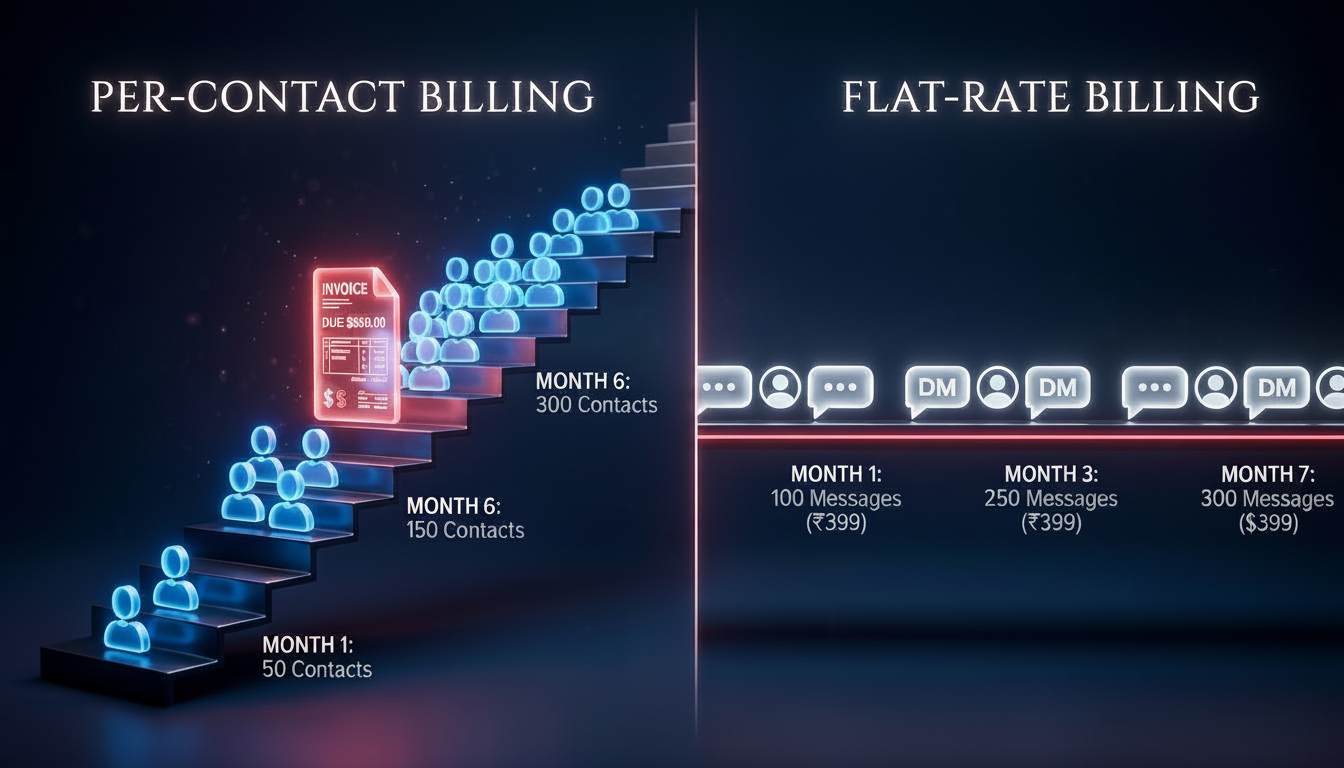
ManyChat built one of the most recognisable names in chat automation. But a growing wave of Instagram-first creators are quietly cancelling their subscriptions — and the reasons are consistently the same. Before we get into alternatives, it’s worth understanding exactly how ManyChat’s contact-based billing works and why it creates structural problems for creators whose audience is always growing.
[CTA: Switch to flat-rate DM pricing — no surprise bills → https://quickdm.app/auth/login]
The “Success Tax” — You Pay for Contacts, Not Conversations
ManyChat’s pricing model charges you based on the number of contacts in your database — not the number of DMs you actually send. The Pro plan starts at $15/month for 500 contacts, rising to approximately $25/month at 2,500 contacts [Source: manychat.com/pricing, verified April 2026]. On the surface, that sounds manageable. In practice, it creates a perverse incentive structure where your biggest successes cost you the most money.
Consider a real scenario: a creator posts a Reel that goes viral. Three thousand new followers DM the keyword “LINK” overnight. Every single one of those people is now a contact in ManyChat’s system — and ManyChat bills you for every one of them, whether they ever interact with you again or not. Your monthly invoice can double before you’ve made a single rupee from that viral moment. Creators across Reddit and Trustpilot describe this as one of the top reasons they leave ManyChat — the sensation of paying for followers who never engage with their DMs again. It’s a success tax: the better you perform on Instagram, the more ManyChat charges you for the privilege.
Flat-rate alternatives like QuickDM, CreatorFlow, LinkDM, and InstantDM don’t work this way. You pay for DM throughput capacity — how fast you can send — not the size of your list. Your price stays the same whether you have 200 contacts or 20,000. That structural difference is why understanding DM automation pricing properly is the most important decision you’ll make before signing up to any tool.
Billing Horror Stories from Real ManyChat Users
Review aggregators like Trustpilot [Source: trustpilot.com/review/manychat.com, verified April 2026] paint a consistent picture of ManyChat’s billing experience. Users frequently report charges continuing after cancellation, surprise invoices triggered by contact count jumps they didn’t initiate, and a refund policy that offers very little recourse once you’ve been charged. The most common pattern: a creator cancels their subscription, but the cancellation doesn’t take effect until the next billing cycle — and if their contact count crossed a pricing threshold during that period, they get charged at the higher tier for a month they never intended to pay for.
Perhaps more frustrating is how ManyChat counts contacts. The system includes anyone who has ever messaged your account, even if that interaction was years ago and the person has no intention of buying from you. A creator with 500k followers who ran one viral campaign eighteen months ago might find ManyChat counting 8,000 “contacts” — most of whom are long-cold audience members from a campaign that ran and ended. The billing reflects your historical reach, not your active engaged audience. When support tickets are filed about these issues, users consistently report slow response times and resolution replies that read as generic or automated — a support experience that feels mismatched with a premium price point.
If you’re already experiencing these issues, the ManyChat cancellation guide on the QuickDM blog walks you through the exact steps to cancel cleanly without getting charged an extra cycle. We also have a full honest summary of ManyChat user reviews for anyone doing deeper due diligence.
The Learning Curve Nobody Warns You About
ManyChat was originally built for Facebook Messenger, then expanded to include WhatsApp, Instagram, SMS, and email under one roof. That multi-platform architecture makes it genuinely powerful for large agencies managing several brands across multiple channels. But it also means the interface carries a significant complexity overhead for anyone who just wants to run Instagram comment-to-DM automations.
Solo creators, coaches, and D2C brand founders consistently describe the ManyChat setup experience as overwhelming. The flow builder has deep conditional logic capabilities — which is great if you need them — but the same complexity that serves enterprise agencies makes it harder for a creator who just wants to trigger a DM when someone comments “LINK” on their Reel. Competitors in this space openly describe ManyChat as a “clunky giant” (InstantDM’s own marketing language) and “time-consuming to configure for basic Instagram use cases” (CreatorFlow’s positioning). These aren’t unfair characterisations — they reflect the genuine experience of Instagram-first creators who don’t need 80% of ManyChat’s feature set.
The learning curve has a real cost. Time spent learning a complex tool is time not spent creating content, testing funnels, or engaging with your audience. Instagram DM automation for beginners should not require a 3-hour onboarding session — and with the right tool, it doesn’t.
When ManyChat Actually Makes Sense (Be Fair)
This comparison would lose all credibility if it pretended ManyChat has no legitimate use cases. There are specific scenarios where ManyChat is genuinely the right choice — and recommending an alternative when ManyChat is actually better for someone’s situation doesn’t serve anyone. The full honest ManyChat assessment on the QuickDM blog covers this in detail, but the short version is this:
ManyChat makes clear sense for multi-platform brands that run Facebook Messenger campaigns, WhatsApp broadcasts, and Instagram DMs from a single dashboard. If you’re an agency managing 10 or more clients, ManyChat’s unified inbox and multi-account management can genuinely justify the pricing overhead. Similarly, any business where WhatsApp broadcast capability is a core revenue channel alongside Instagram should seriously consider whether a WhatsApp-capable tool like ManyChat is worth the premium. For everyone else — solo creators, coaching businesses, D2C brands, affiliate marketers working primarily or exclusively on Instagram — the contact-based billing model creates more problems than the multi-platform capability solves.
How Instagram’s Official DM Limits Actually Work

⚠️ Section differentiator: This is the section no competitor article gets right. Every number below is anchored to Meta’s official developer documentation — not marketing copy from tool vendors.
Before you evaluate any Instagram DM automation tool, you need to understand the rules of the road. Meta publishes official rate limits for every API endpoint used by compliant Instagram automation tools. Knowing these numbers helps you separate genuine technical limitations from marketing spin — and it helps you plan your DM funnels around what’s actually possible. This complete guide to Meta API rate limits and the Private Replies API explainer on the QuickDM blog go deeper if you need the full technical picture.
The Four Numbers Every Creator Must Know
Meta’s Graph API documentation [Source: developers.facebook.com/docs/graph-api/overview/rate-limiting/, verified April 2026] establishes four rate limits that define what any compliant Instagram DM tool can actually do. Understanding these numbers will save you from being misled by “unlimited DM” marketing claims and from planning campaigns that your tool physically cannot execute at the volume you’re expecting.
The first and most important number for creators is 750 private replies per hour — this is the ceiling on comment-triggered DMs sent via the Private Replies API. When someone comments on your post and your tool sends them a DM in response, that’s a Private Reply. During a viral spike, this is the number that matters most. The second number is 100 calls per second via the Send API for direct text and link DMs — this applies to direct outbound messages, not comment replies. The third is 10 calls per second for audio and video DMs via the Send API. The fourth is the Conversations API limit of 2 calls per second for reading and managing conversations. Any tool claiming to send more than 750 comment-triggered DMs per hour on a single Instagram account is either misrepresenting its capability or operating outside Meta’s published terms.
Meta Official Rate Limits — Instagram API (April 2026) | ||
API Endpoint | Official Limit | What It Means for Your Account |
|---|---|---|
Private Replies (comment → DM) | 750 calls/hour | Max 750 triggered DMs/hour during viral spikes |
Send API (text/link/reaction) | 100 calls/second | Direct DM sends, not comment-triggered |
Send API (audio/video) | 10 calls/second | Voice notes, video DMs |
Conversations API | 2 calls/second | Reading/managing conversations |
Content (Impressions API) | 4,800 × impressions/day | Dashboard data reads |
Source: Meta Graph API documentation — developers.facebook.com/docs/graph-api/overview/rate-limiting/ (verified April 2026)
What “Unlimited DMs” Actually Means (And Doesn’t)
Several tools in this comparison market “unlimited DMs” as a headline feature. InstantDM is the most prominent example, but the claim appears in various forms across the category. Here’s what it actually means: unlimited monthly volume — no monthly cap on the total number of DMs you can send across the entire month. What it does not mean is an absence of all limits. The 750 comment-triggered DMs per hour ceiling is not a tool limitation — it’s Meta’s own API limit, and every compliant tool in the market operates under it identically.
InstantDM’s own documentation self-discloses the 750/hour cap, which is precisely what you’d expect from a Meta-compliant tool. This is actually a mark of transparency, not a weakness. The more important question — and the one “unlimited” marketing language obscures — is what happens when you hit that ceiling during a viral post. Does the tool manage queuing, holding overflow DMs in a queue and sending them in the next hour? Or does it silently drop DMs for comments beyond the hourly cap, with no visibility in your dashboard? This is a genuine quality differentiator between tools, and it’s worth asking any tool’s support team directly before you commit. Our guide on what happens when you hit the DM cap explains the queuing mechanics in detail.
Why Viral Posts Are the Real Test
For most creators in steady-state usage, Meta’s rate limits will never be a practical concern. A creator with 15,000 followers running a standard comment-to-DM campaign might see 50–200 comments on a typical post — well within any tool’s hourly capacity. The rate limits matter when something unexpected happens: a Reel gets shared by a large account, a celebrity reposts your content, or a topic you covered goes culturally viral. In these moments, a post that normally gets 80 comments might receive 2,000 in the first two hours. That’s the real test.
In a 2,000-comment, 2-hour viral spike scenario, the 750/hour ceiling means a maximum of 1,500 comment-triggered DMs can be sent in those two hours. Comments 1,501 through 2,000 need to be queued for hour three. A well-engineered tool handles this gracefully — the overflow queue processes systematically, your dashboard shows you how many are pending, and no DMs are silently lost. A poorly-engineered tool drops those 500 DMs with no record and no retry. The Instagram DM limits per day and per hour guide walks through exactly how to plan campaign volume around these ceilings.
Cold DMs vs Comment-Triggered DMs — The Compliance Line
The single most important safety distinction in Instagram DM automation is whether a user initiated contact or whether you initiated it. Comment-triggered DMs — where your tool responds to a comment a user left on your post — are fully compliant with Meta’s API and Instagram’s terms of service, because the user took an action first. Keyword DMs where a user sends you a specific word in a DM are also compliant, for the same reason. Story reply triggers are compliant. These are all inbound-initiated interactions where you’re responding to a user, not cold-approaching a stranger.
Cold outbound DMs — sending unsolicited messages to Instagram users who have not interacted with your account — are where compliance breaks down. Reddit consensus on this is correct: cold mass DMs are a high ban-risk activity, regardless of which tool you use, because the behaviour itself violates Meta’s platform policies. The compliance line between cold DMs and triggered DMs is the key distinction that separates legitimate Instagram DM automation from the “bot” activity Instagram actively penalises. Every tool in this comparison is designed for triggered DMs — none of them should be used for cold outbound blasting.
The “My Account Got Shadowbanned” Myth vs Reality
One of the most persistent fears in the Instagram automation space is the shadowban — the belief that using any DM automation tool will cause Instagram to suppress your reach without warning. This fear is widespread on Reddit and in creator communities, but the data tells a more nuanced story. QuickDM’s own shadowban myth-busting analysis goes deep on this, but the short version is: correlation is not causation. Reach fluctuations are normal, algorithm-driven, and happen to creators who don’t use any automation tools at all.
What Meta’s systems do detect and respond to is repetitive content behaviour — specifically, sending identical message copy to large numbers of people in a short window. If 2,000 people comment on your Reel and every single one receives the exact same word-for-word DM with no variation, Instagram’s content quality systems may flag the pattern. The solution is simple: use personalisation tokens (first name, comment keyword), vary your message slightly across A/B tests, and avoid copy-pasting an identical 200-word DM to thousands of people simultaneously. The tool itself — when it’s using Meta’s official API correctly — is not what causes reach suppression. The content behaviour is. Any tool making reach-guarantee claims is significantly overselling. Be sceptical of anyone promising your analytics will improve simply by switching to their platform.
Quick Comparison — TL;DR Tool Table
Before diving into the full per-tool analysis, here’s the complete feature matrix so you can find your answer at a glance. Every data point has been verified directly from vendor pricing pages in April 2026.
Full Feature Comparison — Best ManyChat Alternatives (April 2026) | ||||||
Feature | QuickDM | ManyChat | CreatorFlow | LinkDM | InstantDM | Inrō |
|---|---|---|---|---|---|---|
Free plan | ✅ Unlimited automations | ✅ Limited | ✅ 500 DMs/mo | ✅ 1,000 DMs/mo | ✅ 500 automations/mo | ✅ 100 contacts/mo |
Free DM rate | 20 DMs/hour | Not stated | ~17 DMs/day | ~33 DMs/day | ~17 DMs/day | 100 contacts total |
Paid entry price | ₹399/mo (~$4.70) | $15/mo | $15/mo | $19/mo | $9.99/mo | €12.99/mo |
Paid DM capacity | 185 DMs/hour | Contact-based | 5,000/mo | 25,000/mo | 750/hour* | 500+ contacts |
Pricing model | Flat-rate DMs/hr | Per-contact | Flat-rate DMs/mo | Flat-rate DMs/mo | Flat-rate DMs/hr | Per-contact |
INR pricing | ✅ Yes | ❌ No | ❌ No | ❌ No | ❌ No | ❌ No |
GST invoices | ✅ Yes | ❌ No | ❌ No | ❌ No | ❌ No | ❌ No |
Instagram-only | ✅ Yes | ❌ Multi-platform | ✅ Yes | ✅ Yes | ✅ Yes | ✅ Yes |
Meta official API | ✅ Yes | ✅ Yes | ✅ Yes | ✅ Yes | ✅ Yes | ✅ Yes |
Comment → DM | ✅ Yes | ✅ Yes | ✅ Yes | ✅ Yes | ✅ Yes | ✅ Yes |
Story reply trigger | ✅ Yes | ✅ Yes | ✅ Yes | ✅ Yes | ✅ Yes | ✅ Yes |
❌ No | ✅ Yes | ❌ No | ❌ No | ❌ No | ❌ No | |
AI reply | ✅ Controlled | ✅ Yes | ❌ No | ❌ No | ✅ Yes | ✅ Yes (core) |
India DM playbooks | ✅ Yes | ❌ No | ❌ No | ❌ No | ❌ No | ❌ No |
HQ location | 🇮🇳 Mumbai | 🇺🇸 US | 🇺🇸 US | 🇺🇸 US | 🇺🇸 US | 🇪🇺 EU |
The 6 Best ManyChat Alternatives for Instagram in 2026
[CTA: Start free with QuickDM — no credit card required → https://quickdm.app/auth/login]
#1 QuickDM — Best for Indian Creators & Flat-Rate Simplicity
Best for: Indian creators, D2C brands, coaches, and affiliate marketers who want Instagram-only automation priced in INR.
QuickDM is the only major Instagram DM automation tool built specifically for the Indian market. Headquartered in Mumbai, it offers flat-rate pricing in rupees, GST-compliant invoicing, and a free plan that puts most paid competitors to shame. The QuickDM free plan gives you unlimited automations and unlimited comment-to-DM campaigns running simultaneously, capped at 20 DMs per hour — which is more than sufficient for any creator with under 20,000 followers in steady-state operation. No credit card required. No artificial expiry. Free forever.
The Pro plan at ₹399/month (approximately $4.70 at April 2026 exchange rates, or $7/month for international billing) unlocks 185 DMs/hour — that’s just under Meta’s 200-call API ceiling, meaning you’re operating at near-maximum compliant velocity. The pricing model is pure flat-rate: your monthly cost does not change regardless of how many contacts are in your system. A creator with 50,000 engaged followers pays the same ₹399 as a creator with 500 followers. You can set up your first QuickDM automation in under ten minutes, and the 10-minute setup guide walks you through every step.
Core features include comment-to-DM automation for Reels, posts, and stories; keyword trigger DMs; story reply automations; a DM funnel builder for multi-step sequences; controlled AI reply assistance (you define the parameters — the AI doesn’t go rogue); and INR pricing with GST invoices issued automatically. What’s deliberately absent: WhatsApp and Facebook integration (Instagram-only by design), and “black box” AI replies where you can’t see exactly what’s being sent. This is a considered product choice that keeps you in control of your brand voice. The full QuickDM vs ManyChat comparison breaks down every capability difference in detail, and we’ve also done deep dives on QuickDM vs CreatorFlow, QuickDM vs LinkDM, and QuickDM vs InstantDM.
Who should choose QuickDM: Any Indian creator or brand where Instagram is the primary monetisation channel. Anyone tired of dollar pricing, GST invoice headaches, or paying for a contact list they didn’t choose to build. And anyone who wants to understand when to upgrade from free to Pro — the honest answer is: when your hourly DM volume regularly approaches 20/hour.
#2 CreatorFlow — Best Flat-Rate DM Caps for Solo Creators
Best for: Solo content creators and small teams who want predictable monthly DM budgets and a polished mid-market experience.
CreatorFlow [Source: creatorflow.so/pricing, verified April 2026] positions itself squarely against ManyChat’s complexity and contact-based billing, offering clean flat-rate monthly DM caps instead. The free plan covers 500 DMs per month across one Instagram account — roughly 17 DMs per day in steady-state operation, which works for micro-creators and those testing the platform. The Pro plan at $15/month (or $12/month on annual billing) unlocks 5,000 DMs/month across two Instagram accounts, which is genuinely useful for creators running simultaneous campaigns across a personal and a brand account.
What sets CreatorFlow apart from simpler tools is its analytics depth. The platform tracks email gates, follow gates (requiring a follow before receiving a DM), link click-through rates, geographic analytics, and CSV export — making it the most feature-complete option in the mid-market tier. The Growth plan at $30/month ($24 annual) adds 10,000 DMs/month across five accounts, which covers most mid-sized creator operations. Agency pricing is available on custom terms with multi-workspace management.
The main watch-out on CreatorFlow is the monthly cap arithmetic. 5,000 DMs/month on Pro sounds generous, but that’s approximately 167 DMs per day — a viral week where you receive 1,000 comments per day could exhaust your monthly budget in five days. If you’re a creator prone to viral spikes, you’ll want to either budget for the Growth plan or choose a tool with hourly rather than monthly caps. Dollar-only pricing is also a real friction point for Indian creators — $15/month translates to approximately ₹1,260 at April 2026 rates, more than three times QuickDM Pro. Read the full CreatorFlow review for a complete breakdown of its pros, cons, and best-fit scenarios.
#3 LinkDM — Best Free Tier for Affiliate & Link Creators
Best for: Affiliate marketers and link-in-bio creators who primarily need comment-to-DM for link delivery at high volume.
LinkDM [Source: linkdm.com/pricing, verified April 2026] distinguishes itself with the strongest free tier in the market for link-delivery use cases — 1,000 DMs per month, covering the last 10 posts, with auto-reply functionality included. For affiliate marketers whose primary workflow is “comment LINK → receive DM with affiliate URL,” the free plan covers a substantial amount of monthly volume without requiring a paid subscription. The Pro plan at $19/month unlocks 25,000 DMs/month across three Instagram accounts, which is a significant jump in capacity relative to CreatorFlow’s 5,000 DMs Pro cap.
Where LinkDM truly differentiates is the Platinum+ plan at $99/month, which offers 300,000 DMs/month across 10 Instagram accounts with an overflow queue for viral spikes. This is the highest published monthly DM cap in the market and the only plan where high-volume affiliate creators running multiple simultaneous Reel campaigns can operate without monthly volume anxiety. The analytics layer is focused heavily on link click tracking and affiliate revenue attribution — well-suited to the performance marketing mindset of affiliate creators but less useful for coaches or D2C brands building relationships rather than tracking clicks.
The entry price of $19/month is the highest paid entry point among the tools in this comparison, making LinkDM the wrong choice for budget-conscious creators who don’t need high monthly volume. The LinkDM review on the QuickDM blog goes into depth on where this tool makes sense and where it doesn’t. For affiliate marketing with Instagram DMs, LinkDM Platinum+ and QuickDM Pro are the two strongest options depending on your monthly volume and geographic billing preference.
#4 InstantDM — Cheapest Paid Plan, But Read the Small Print
Best for: Budget-conscious creators on tight margins who want paid features at the lowest dollar price point.
InstantDM [Source: instantdm.com/pricing, verified April 2026] leads the market on entry-level paid pricing with its Legend Pro plan at $9.99/month — half the price of ManyChat and CreatorFlow, and roughly $5 less than LinkDM. For dollar-market creators who need more than a free tier but can’t justify $15–19/month, $9.99 is a genuinely compelling price point. The plan description includes “unlimited” automation, which as discussed above means no monthly DM cap — the 750/hour Meta API ceiling still applies universally. A notable bonus: InstantDM includes built-in content scheduling for carousels and standard posts within the same dashboard, which saves creators from needing a separate scheduling tool.
The Trendsetter plan at $24.99/month adds “advanced safety mode,” email support, and WhatsApp support — making it more appropriate for business accounts where DM reliability is mission-critical. The five-minute setup claim in InstantDM’s marketing appears to be genuine for basic comment-to-DM use cases, which is a legitimate advantage for creators who want speed over depth of configuration.
The critical watch-out is the “unlimited” framing. During a viral spike on a post that receives 3,000 comments in an hour, the 750/hour ceiling means 2,250 people don’t receive their DM immediately. The question is whether those DMs enter a queue and are delivered in hours two and three, or whether they’re silently lost. Ask InstantDM’s support team specifically about overflow queue management before committing if viral-scale campaigns are in your future. Read the full InstantDM review with unlimited DMs explained for the complete picture. If you’re comparing on price alone, the QuickDM vs InstantDM comparison shows why ₹399 beats $9.99 for Indian creators even at a higher dollar equivalent.
#5 Inrō — AI-First, But Watch the Black Box
Best for: Tech-comfortable creators who prioritise conversational AI and have a small, high-value contact list.
Inrō [Source: inro.social/pricing, verified April 2026] takes a fundamentally different approach from every other tool in this comparison: instead of pre-written message flows triggered by keywords, Inrō uses AI to generate contextually appropriate DM replies that are designed to sound like the account owner. User reviews consistently praise the non-spammy feel of these interactions and the quick initial setup. The free plan covers 100 active contacts per month with 3 automations, 3 campaigns, and 50 AI credits — enough to test the concept meaningfully before committing.
The Pro plan at €12.99/month supports 500+ active contacts with unlimited automations and campaigns. For larger lists, Inrō’s annual pricing scales from €1,249 to €1,800/year for 10,000+ active contacts — and this is where the “success tax” problem reappears. Like ManyChat, Inrō charges per contact rather than per DM sent, meaning your bill grows automatically as your engaged audience grows. At scale, the math becomes similar to ManyChat’s contact trap. There’s also the “black box” AI risk to consider: you’re trusting an AI system to respond in your brand’s voice inside one-to-one DM conversations. For most scenarios this works well, but edge cases where the AI generates an unexpected or off-brand reply inside a high-stakes business DM are a real possibility, with limited visibility until after the fact. EUR pricing also adds foreign exchange friction for both Indian and US creators. The Inrō review covering AI DM automation risks goes into depth on when this tradeoff is worth it.
#6 ManyChat — Still the Best for Multi-Platform Agencies
Best for: Agencies or brands running Facebook, WhatsApp, AND Instagram from one unified tool.
Despite being the tool this entire article is positioning against, ManyChat [Source: manychat.com/pricing, verified April 2026] earns its place in this comparison as the legitimate recommendation for a specific use case. The Pro plan starts at $15/month for 500 contacts, rising to approximately $25/month at 2,500 contacts, with Elite tier custom pricing for larger contact databases. The contact-based billing is a genuine structural problem for Instagram-first creators — but for agencies and multi-platform brands, it represents the cost of operating the most mature, feature-rich automation ecosystem in the market.
ManyChat’s real competitive advantage is the unified inbox across Instagram, Facebook Messenger, and WhatsApp — with broadcast capability to WhatsApp lists, which no other tool in this comparison offers. For brands where WhatsApp is a primary customer communication channel in addition to Instagram, the alternative is running separate tools for each platform, which creates its own complexity and cost. If your business genuinely needs all three channels managed centrally, ManyChat is the honest recommendation even accounting for its billing model’s weaknesses. The full honest ManyChat assessment and the QuickDM vs ManyChat comparison both acknowledge this clearly. For Instagram DM automation agencies managing mixed-platform client portfolios, ManyChat remains the default choice despite its pricing model’s shortcomings.
Pricing Reality Check — What You Actually Pay at 3k, 30k & 300k Followers
Abstract pricing comparisons are one thing. Real-money scenarios are another. This section maps actual cost to actual audience size, so you can see exactly where each tool’s billing model starts hurting you. All calculations use April 2026 exchange rates (₹84/USD). For a deeper dive, the Instagram DM automation cost guide and the DM automation cost calculator let you run your own numbers.
Scenario A — 3,000 Followers, 200 Active DM Contacts
At 3,000 followers, you’re in the early growth phase. Your DM volume is low and relatively predictable — a few dozen comments per post, maybe 200 people who’ve ever messaged you. Every tool in this comparison offers a free tier that covers this volume comfortably. QuickDM’s free plan at 20 DMs/hour handles this audience size with room to spare. CreatorFlow’s 500 DMs/month free tier is sufficient. LinkDM’s 1,000 DMs/month free tier is more than sufficient. InstantDM’s 500 automations/month free tier covers it. There is no scenario where a 3,000-follower creator needs to pay for any of these tools.
Winner at 3k followers: Any free tier. The only reason to pay at this stage is if you want to test Pro features before you need them — in which case QuickDM’s ₹399/month is the lowest-risk experiment.
Scenario B — 30,000 Followers, 2,000 Active DM Contacts/Month
At 30,000 followers, you’re likely posting consistently and running at least occasional comment-to-DM campaigns. Two thousand active DM contacts per month means a campaign that generates meaningful volume — you’re probably pushing or exceeding free tier limits regularly. This is where tool selection starts to have real financial consequences.
Tool | Monthly Cost | DM Capacity | Fits? |
|---|---|---|---|
QuickDM Pro | ₹399 (~$4.70) | 185 DMs/hour = ~4,440/day | ✅ Yes |
ManyChat Pro | ~$25 (2,500 contacts tier) | Contact-based | ✅ Technically |
CreatorFlow Pro | $15 | 5,000 DMs/month | ✅ Yes |
LinkDM Pro | $19 | 25,000 DMs/month | ✅ Yes |
InstantDM Legend | $9.99 | 750 DMs/hour | ✅ Yes |
Winner at 30k followers: QuickDM Pro at ₹399 — the lowest absolute price in the market, no contact-based exposure, and a DM/hour rate that covers typical mid-tier creator campaigns without monthly cap anxiety.
Scenario C — 300,000 Followers, Viral Post (8,000 Comments in 2 Hours)
At 300,000 followers, you’re operating at a scale where viral events are genuinely possible and their financial consequences are real. An 8,000-comment spike in 2 hours is the stress test that separates tools designed for scale from those that technically work but weren’t built for it.
Tool | Monthly Cost | Viral Spike Handling | Risk Level |
|---|---|---|---|
QuickDM Pro | ₹399 | 185 DMs/hour × 2hr = 370 in spike, queuing needed | 🟡 Some queuing |
ManyChat | Contact-based × scale | No stated hourly cap | 🟡 Depends on tier |
CreatorFlow Growth | $30 | 10,000/month — spike may exhaust budget | 🟡 Monitor cap |
LinkDM Platinum+ | $99 | 300,000/month cap, overflow queue | ✅ Best for spikes |
InstantDM Trendsetter | $24.99 | 750/hour Meta cap, advanced safety mode | 🟡 Meta cap applies |
Key insight: At 300k+ followers and genuinely viral content, LinkDM Platinum+ at $99/month is the only tool with both the monthly DM volume capacity and an explicit overflow queue. However, Meta’s 750/hour Private Replies ceiling applies universally — no tool can exceed it on a single account.
The Contact Billing Trap — When ManyChat Costs Explode
The contact billing model creates a financial cliff that Instagram-first creators don’t see coming until they fall off it. At 10,000 contacts, ManyChat Pro is estimated at $65–80/month depending on your exact tier [Source: manychat.com/pricing, verified April 2026]. At 50,000 contacts, you’re in Elite tier territory with custom pricing negotiations. These contacts include people who DM’d you once from a viral post three months ago and have never engaged since. The Instagram DM automation pricing guide for India and the true cost of Instagram DM automation both break down this math in detail with current FX calculations.
Is Instagram DM Automation Safe? Will It Get My Account Banned?
[CTA: Read our full Instagram DM safety guide before you automate → https://quickdm.app/auth/login]
This question deserves a direct, evidence-based answer. The short answer: using Meta’s official API tools correctly is low risk. Our comprehensive guide on whether Instagram DM automation is safe covers this in full.
Will Using These Tools Get My Account Suspended?
Direct answer: using Meta’s official API tools as intended does not get your account suspended. All six tools in this comparison use Meta’s official Graph API. They are not bots, scrapers, or grey-market tools. The suspension risk comes from specific behaviours, not from the tool itself. Three safe behaviours: send DMs only to users who have taken a triggering action, use personalised or varied message copy, and stay within the 750/hour Private Replies ceiling. Three risky behaviours: cold outbound DMs to strangers, sending identical copy to large volumes of people in a short window, and using unofficial grey-market tools that don’t use Meta’s API.
What Reddit Gets Right (and Wrong) About DM Automation Risk
Reddit’s consensus on Instagram DM automation risk [Source: reddit.com/r/smallbusiness/comments/1plv58u/, verified April 2026] is both correct and incomplete. Reddit correctly flags grey-market tools that scrape Instagram data or operate outside Meta’s API as high-risk. Where Reddit’s analysis is incomplete is the failure to distinguish between grey-market tools and Meta-API-compliant platforms. Every tool in this comparison uses Meta’s official Messenger API — they are categorically different from the “bots” that Reddit correctly warns against.
Multiple Tools on the Same IG Account — The Real Ban Risk
One of the most commonly overlooked safety risks is running multiple tools simultaneously on the same Instagram account. When two separate tools authenticate to the same Instagram account via OAuth, they’re competing for the same API quota allocation. The rule is simple: pick one tool and use only that tool for DM automation. Disconnect and remove the existing tool’s OAuth permission before connecting the new one.
The Shadowban Fear — What the Data Actually Shows
The Instagram shadowban narrative confuses correlation with causation. Reach fluctuations are normal and happen constantly to creators who never use any automation tool. What the data does support is that repetitive content behaviour — specifically, identical copy sent to large volumes of people simultaneously — can cause Instagram’s content quality filters to flag account activity. The solution: use personalisation tokens, vary your message copy across A/B tests, and design your DM sequences so that follow-up messages feel conversational rather than broadcast.
Copy-and-Paste DM Funnels for 2026

[CTA: Set up your first DM funnel in QuickDM — free forever → https://quickdm.app/auth/login]
Funnel 1 — The Affiliate Link Drop
Trigger: Comment contains keyword “LINK”
DM 1 (instant): “Hey [First Name]! Here’s the link you asked for → [affiliate URL with UTM tracking]. Let me know if you have any questions!”
DM 2 (24-hour follow-up): “Did you get a chance to check this out? Happy to answer any questions before you decide.”
Meta compliance: ✅ Comment-triggered, within 24-hour messaging window.
Funnel 2 — The Lead Magnet Delivery
Trigger: Story reply contains keyword “FREEBIE” or “GUIDE”
DM 1 (instant): “Your free [guide/template/checklist] is ready! Here’s the link: → [link]. It’s yours, no strings attached.”
DM 2 (48-hour follow-up): “Quick check — did the guide help you with [specific problem it solves]? Would love to know what you thought.”
Meta compliance: ✅ Story reply-triggered, within 24-hour window.
Funnel 3 — The Booking Funnel
Trigger: Comment or DM keyword “BOOK”
DM 1 (instant): “Great — I’d love to chat! Here are my available slots: → [Calendly/Tidecal link]. Pick a time that works for you.”
DM 2 (post-booking): Confirmation message + 2–3 prep questions to qualify the session.
DM 3 (24 hours before session): Reminder message with meeting link.
Meta compliance: ✅ User-initiated, fully compliant.
Funnel 4 — The Product Launch Waitlist
Trigger: Keyword “WAITLIST” in comments on product teaser Reels
DM 1 (instant): “You’re officially on the list! We’ll DM you first when [product] drops. Want to lock in early bird pricing? Reply YES.”
DM 2 (launch day): “It’s live — here’s your exclusive early access link: → [URL]”
DM 3 (24hr urgency): “Just 24 hours left on early bird pricing — here’s the link again: → [URL]”
Meta compliance: ✅ Comment-triggered, all messages within 24-hour windows.
Funnel 5 — The Quiz Funnel
Trigger: Keyword “QUIZ” in comments or story reply
DM 1: “Let’s find the perfect [product/plan] for you! Quick question — which best describes your situation? Reply A or B: [Option A] vs [Option B]”
DM 2A (Answer A path): Follow-up question specific to segment A.
DM 2B (Answer B path): Follow-up question specific to segment B.
DM 3 (both paths): Personalised recommendation + direct purchase/booking link.
Meta compliance: ✅ Fully compliant — every DM is a response to direct user input.
India-Specific: Why Indian Creators Need a Different Tool
[CTA: Get QuickDM Pro for ₹399/month — built for India → https://quickdm.app/auth/login]
The Dollar Pricing Problem Is Bigger Than You Think
At ₹84/USD (April 2026 rate): ManyChat Pro at $15/month equals ₹1,260 per month. CreatorFlow Pro at $15/month is the same ₹1,260. LinkDM Pro at $19/month is ₹1,596. InstantDM Legend at $9.99/month is ₹839. QuickDM Pro at ₹399/month is approximately $4.70 — priced in INR from the ground up, specifically for the Indian market. For a creator earning ₹50,000/month from Instagram, ManyChat at ₹1,260 consumes 2.5% of revenue. QuickDM at ₹399 consumes 0.8%. Over a 12-month year, the difference is ₹15,120 vs ₹4,788 — a saving of ₹10,332 per year.
GST Invoices — Why They Matter for D2C Brands
For registered Indian businesses, GST invoicing is a significant financial consideration. Indian businesses can claim GST input tax credit on software subscriptions purchased from GST-registered vendors. ManyChat, CreatorFlow, LinkDM, and InstantDM are all foreign companies with no Indian GST registration. QuickDM is headquartered in Mumbai, GST-registered in India, and issues proper GST tax invoices automatically with every subscription payment.
QuickDM’s India-First Features at a Glance
Feature | QuickDM | Nearest Competitor |
|---|---|---|
INR pricing | ₹399/mo | ~₹1,260/mo (dollar tools) |
GST invoice | ✅ Auto-issued | ❌ Not available |
India support hours | ✅ IST business hours | ❌ US/EU timezone |
India-specific blog content | ✅ Extensive | ❌ None |
Mumbai HQ | ✅ Yes | ❌ No |
How to Choose the Right Tool for Your Instagram Strategy

Choose by Revenue Stage
At the early stage (under 10,000 followers), free tiers of QuickDM, CreatorFlow, or LinkDM cover virtually every use case. At the mid stage (10,000–100,000 followers), paid tiers become relevant — QuickDM Pro at ₹399 or InstantDM at $9.99 are the most cost-efficient entries. At the growth stage (100,000+ followers), the conversation shifts to viral spike handling and monthly cap ceilings — where LinkDM Platinum+ ($99) or a custom CreatorFlow Agency arrangement become worth evaluating.
Choose by Use Case
Affiliate marketers should evaluate LinkDM’s analytics layer seriously. Coaches and course creators will find QuickDM’s funnel builder and India support hours more relevant. D2C brands running product launches benefit from QuickDM Pro’s hourly rate capacity. For agencies managing multiple client accounts, CreatorFlow’s Growth or Agency tier offers the cleanest multi-account management experience outside of ManyChat.
The One Question That Decides Everything
Do you pay for your list size or your DM activity? If you want to pay for what you actually do, not for how many people have ever messaged you, every flat-rate tool in this comparison is right for you and ManyChat is wrong. For 90% of Instagram-first creators, the most cost-efficient flat-rate tool for India is QuickDM, while the strongest dollar-market flat-rate option at entry price is InstantDM or CreatorFlow depending on your volume profile.
Switching from ManyChat — Step-by-Step Migration Guide

Step 1 — Export Your ManyChat Flows and Contacts
Before touching anything in ManyChat’s settings, document your existing automation setup. ManyChat allows you to export your contact list as a CSV from the Audience section. Take screenshots or written notes of your top three performing automations. Allow 30–60 minutes for a thorough documentation session.
Step 2 — Recreate Your Top 3 Flows in QuickDM
Identify your top three highest-performing automations and rebuild those first. In QuickDM’s interface, setting up a comment-to-DM automation takes under five minutes for a single-step flow and under fifteen for a multi-step sequence. Test each flow after creation by commenting the trigger keyword yourself from a secondary account.
Step 3 — Test on a Low-Volume Post First
Before pointing your new tool at your highest-performing Reel, test it on a deliberately low-stakes post. Verify that the DM arrives within the expected window, that personalisation tokens are populating correctly, and that any links are correctly formatted. Run this test for at least 24 hours to confirm that scheduled follow-up DMs also trigger correctly.
Step 4 — Cancel ManyChat (And Watch the Billing)
Time your cancellation to happen immediately before your next billing date. The ManyChat cancellation guide covers the exact steps, including how to revoke ManyChat’s OAuth access to your Instagram account in Meta’s app permissions settings. Revoking OAuth access is important to do before connecting any new tool.
Common Mistakes to Avoid With Instagram DM Automation

Sending the Exact Same DM to Everyone
When a post receives 500 comments and all 500 people receive the exact same word-for-word DM within an hour, Instagram’s content quality systems flag the pattern as inauthentic broadcast behaviour. Fix: use personalisation tokens so every DM opens with the recipient’s first name, vary your message copy across A/B tests, and avoid using copy longer than 150 words for mass-trigger DMs.
Enabling Multiple Tools on the Same Account
Running two DM automation tools simultaneously on the same Instagram account causes unpredictable API behaviour, potential rate limit violations, and unusual access patterns. Always disconnect your existing tool completely (including revoking OAuth permissions) before connecting your new tool.
Ignoring the 750/Hour Ceiling During Campaign Launches
For a launch post receiving 2,000 comments in the first hour, 1,250 people did not receive their DM immediately. Before running any high-volume campaign launch, confirm with your tool’s support team exactly how overflow is handled, and check your dashboard during the campaign’s first hour to verify the queue count.
Buying Contact Lists and Cold DMing
Cold DMing strangers who have not interacted with your account is a high-confidence path to account suspension or permanent ban. Meta’s API does not support sending unsolicited DMs to users who have no existing interaction with your account. All DM automation in this guide operates exclusively through triggered interactions.
Forgetting the 24-Hour Messaging Window Rule
After a user initiates contact, you have a 24-hour window to send automated follow-up messages. Problems arise when creators design three-day or seven-day drip sequences and expect automated DMs on day 3 to deliver to users who haven’t re-engaged. Design your sequence to invite continued user engagement — a question that prompts a response restarts the window.
What Real Users Say — Reviews from Trustpilot, G2 & Reddit

What ManyChat Users Are Complaining About in 2026
ManyChat’s Trustpilot profile [Source: trustpilot.com/review/manychat.com, verified April 2026] reveals a consistent pattern: billing experience is the dominant theme. Users report charges after cancellation, surprise invoice amounts following contact count jumps, and difficulty obtaining refunds. The negative reviews overwhelmingly come from solo creators and small Instagram-first brands who describe the tool as overkill and the billing as unpredictable.
What CreatorFlow and LinkDM Users Actually Praise
CreatorFlow’s review profile [Source: trustpilot.com/review/creatorflow.so, verified April 2026] shows users consistently praising setup simplicity relative to ManyChat, predictability of flat-rate monthly billing, and the quality of the analytics dashboard. LinkDM [Source: linkdm.com/user-reviews, verified April 2026] receives consistent praise from affiliate marketers — the link tracking analytics and high monthly volume caps at Platinum+ are frequently cited as the deciding factor.
Reddit’s Honest Take on DM Automation Risk
Reddit’s DM automation discussions [Source: reddit.com/r/smallbusiness/comments/1nx1e75/, verified April 2026] surface a nuanced picture. The consensus among experienced users is that Meta-API tools used correctly for triggered interactions carry low risk, while any form of cold outbound automation carries high risk. The quality of DM content matters more than the tool used to send it.
The Bottom Line — Our Honest Recommendation
[CTA: Start free with QuickDM — no credit card, no time limit → https://quickdm.app/auth/login]
For Indian Creators: QuickDM, No Contest
If you’re an Indian creator, D2C brand, coach, or affiliate marketer with Instagram as your primary channel, the recommendation is unambiguous: QuickDM is the right tool. The INR pricing at ₹399/month Pro removes the dollar-conversion overhead. The GST invoicing covers tax compliance that every other tool ignores for Indian businesses. The free plan with unlimited automations at 20 DMs/hour covers the majority of Indian creators at early and mid growth stages without requiring a rupee of investment.
For Dollar-Market Solo Creators: CreatorFlow or InstantDM
For solo creators operating in dollar markets who want predictable billing, CreatorFlow and InstantDM are the strongest alternatives to ManyChat. CreatorFlow at $15/month offers the most polished mid-market experience with the best analytics depth. InstantDM at $9.99/month is the right choice for price-sensitive creators whose monthly DM volume stays well under the 750/hour ceiling during normal operation.
For High-Volume Affiliate Creators: LinkDM Platinum+
Affiliate creators running multiple simultaneous Reel campaigns with high monthly comment volumes should evaluate LinkDM Platinum+ at $99/month. The 300,000 monthly DM cap eliminates budget anxiety during good campaign weeks. The overflow queue management handles viral spikes. The click analytics and revenue attribution features are unmatched for performance marketers.
For Multi-Platform Agencies: ManyChat (Reluctantly)
For agencies that genuinely need Instagram, Facebook Messenger, and WhatsApp managed from a single unified interface — and whose client portfolio includes brands for whom WhatsApp broadcast is a primary revenue channel — there is no meaningful alternative. ManyChat remains the most mature multi-platform automation ecosystem for this specific use case.
For AI-Curious Creators: Inrō (With Eyes Open)
Inrō earns a recommendation for tech-comfortable creators with a small but highly engaged contact list (under 2,000 active contacts before billing becomes expensive) who prioritise conversational authenticity over message control precision. The tradeoffs are real: contact-based billing creates the same exposure as ManyChat at scale, EUR pricing adds friction, and the black box AI risk requires a higher tolerance for message unpredictability.
FAQ
Which is the cheapest Instagram DM automation tool in 2026?
QuickDM is the cheapest option for paid plans at ₹399/month in India ($7/month globally), making it 50–75% cheaper than ManyChat ($15+), CreatorFlow ($15), and LinkDM ($19) [Source: manychat.com/pricing, creatorflow.so/pricing, linkdm.com/pricing, verified April 2026]. No other major tool offers INR pricing.
Is there a truly free Instagram DM automation tool?
Yes — QuickDM’s free plan offers unlimited automations with 20 DMs/hour, forever free with no credit card required. CreatorFlow (500 DMs/month), LinkDM (1,000 DMs/month), and InstantDM (500 automations/month) also offer free tiers. ManyChat’s free plan is heavily restricted with forced branding on all messages.
Which Instagram automation tool is best for India?
QuickDM is the only major Instagram DM automation tool priced in INR (₹399/month Pro), with GST-compliant invoicing and a Mumbai-based team. Every other major competitor charges in USD or EUR, adding 40–60% extra cost at current exchange rates.
Will using Instagram DM automation get my account banned?
Not if you use Meta-API compliant tools correctly. Ban risk comes from cold outbound DMs to strangers, identical copy sent to thousands of people, or grey-market non-API tools. All six tools in this comparison use Meta’s official API and are safe when used as intended.
What is Meta’s official Instagram DM rate limit?
Meta officially limits comment-triggered DMs (Private Replies API) to 750 per hour per Instagram professional account [Source: developers.facebook.com/docs/graph-api/overview/rate-limiting/, verified April 2026]. Direct DM sends via the Send API are capped at 100 calls per second for text and links.
What is the difference between flat-rate and per-contact DM pricing?
Flat-rate tools (QuickDM, CreatorFlow, LinkDM, InstantDM) charge a fixed monthly price regardless of audience size. Per-contact tools (ManyChat, Inrō) charge based on your contact list size, so your bill rises automatically every time your audience grows — even if those contacts never engage again.
Can I run two Instagram DM tools on the same account simultaneously?
No — this is strongly discouraged. Both tools compete for the same OAuth connection and API quota, creating unpredictable behaviour and potential rate-limit violations. Always disconnect and revoke the existing tool’s OAuth permissions before connecting a new one.
Is InstantDM’s unlimited DMs claim accurate?
Partially. Unlimited means no monthly volume cap — but Meta’s 750 comment-triggered DMs per hour ceiling still applies, as it does to every compliant tool. It’s a marketing term referring to monthly cap absence, not absence of all limits.
How does the Instagram 24-hour messaging window affect automation?
After a user initiates contact (comment, keyword DM, story reply), you have 24 hours to send automated follow-up messages. After that window closes, the conversation requires new user input to reopen. Design your DM funnels to deliver all key messages within this initial 24-hour window.
Does QuickDM support Hindi and regional Indian language DMs?
Yes — QuickDM supports full Unicode, so DM messages can be written in Hindi, Tamil, Telugu, Kannada, Marathi, Bengali, and other Indian languages. Keyword triggers work most reliably with English keywords even for regional-language audiences. Delivering the DM itself in any regional language is fully supported.
What happens if I post a viral Reel and thousands of people comment at once?
Meta’s 750 comment-reply DMs/hour limit applies regardless of viral spikes. A well-designed tool will queue overflow DMs and send them in the next hour(s); a poorly-designed tool may silently drop DMs for comments beyond the hourly cap. Before signing up to any tool, ask their support specifically how they handle viral spike overflow.
Why is ManyChat more expensive than alternatives like QuickDM or InstantDM?
ManyChat charges per contact in your database, not per DM sent. At 2,500 contacts, ManyChat costs ~$25/month. At 10,000+ contacts, you’re on custom Elite pricing. Flat-rate alternatives like QuickDM ($7/month) or InstantDM ($9.99/month) charge a fixed price regardless of how large your audience grows.
Can I get a GST invoice for Instagram DM automation tools?
Only from QuickDM. As a Mumbai-headquartered, QuickDM automatically issues GST-compliant tax invoices with every subscription payment. foreign companies with no Indian GST registration and cannot issue GST-compliant invoices.
Can I automate Instagram DMs for free without violating Instagram’s terms?
Yes — QuickDM’s free plan offers 20 DMs/hour of comment and keyword-triggered automation using Meta’s official API, fully compliant with Instagram’s terms. Free tiers from CreatorFlow, LinkDM, and InstantDM are also officially compliant. The key is using trigger-based DMs rather than unsolicited cold DMs to strangers.
How does Instagram’s 24-hour messaging window affect DM automation?
Instagram’s 24-hour messaging window means you can send automated follow-up DMs within 24 hours of a user initiating contact. After 24 hours, the conversation window may close. Good DM funnel design accounts for this by triggering all key messages within the initial 24-hour window.
Is Inrō’s AI DM automation safe for business accounts?
With caveats. Inrō’s AI generates contextually appropriate replies praised for feeling non-spammy, but the black box risk means you don’t always know exactly what the AI will send until after the fact. For high-stakes business accounts, tools with fully pre-written, transparent message flows offer more control. Inrō’s contact-based billing also creates the same scaling cost exposure as ManyChat.
About This Comparison — Data Sources & Methodology
Every pricing figure in this article was collected by visiting each tool’s live pricing page directly in April 2026. Pricing pages visited: manychat.com/pricing, creatorflow.so/pricing, linkdm.com/pricing, instantdm.com/pricing, inro.social/pricing [all verified April 2026]. Meta API compliance claims are sourced directly from Meta’s Graph API developer documentation at developers.facebook.com/docs/graph-api/overview/rate-limiting/ [verified April 2026]. We did not receive sponsored placement, gifts, or payments from any tool in this comparison in exchange for editorial coverage. If you notice a pricing discrepancy, email admin@quickdm.app with subject line “Pricing update: [tool name]”.