Introduction: Why Move Beyond ManyChat?
Instagram DM automation has evolved from simple keyword triggers into complex, API-integrated workflows. Moving beyond legacy platforms allows businesses to leverage specialized, cost-effective solutions that align with modern regional compliance requirements and granular technical constraints.
- Platform Landscape: Instagram DM automation has transitioned from risky scraper bots to official Meta Graph API workflows that handle lead generation, customer care, and sales funnels securely.
- Pricing & Value Tiers: Options range from full-featured free forever plans (QuickDM) and affordable Pro tiers ($10/mo | ₹399/mo India) to multi-channel suites like ManyChat ($14–$139/mo based on contact volume).
- Meta API Safety Architecture: Compliant tools pace requests against Meta's pooled rate limit (~200 API calls/hr per active user tracked via X-App-Usage headers), preventing sudden account restrictions.
- Indian Market Compliance: For creators and brands in India, compliance with the Digital Personal Data Protection Act (DPDPA), 2023 is mandatory for collecting customer data and automated lead consent.
The Shift in Instagram Automation Needs
Historically, Instagram automation was a blunt instrument used primarily for triggering generic links when a follower commented a specific keyword. Today, the demands placed on marketing software are significantly more nuanced. Creators and businesses now require full-funnel lead qualification, dynamic routing of complex product inquiries, and seamless handoffs to human sales teams. Furthermore, as global data privacy standards tighten, brands need platforms built with granular regional compliance in mind. This shift has driven the market toward specialized solutions that offer transparent API usage reporting and adaptable workflow designs, moving away from the one-size-fits-all approach that dominated the early days of social media marketing.
Limitations of Legacy Platforms
ManyChat remains a formidable omnichannel platform, highly regarded for its visual flow builder, AI-powered chatbots, and extensive template library. It is a fully fledged Meta Business Partner that excels at handling cross-platform communications spanning Instagram, Messenger, and WhatsApp. Its pricing structure scales from $14 per month for 500 contacts up to $139 per month for 10,000 contacts [Source: https://manychat.com/pricing, verified 2026-09-19].
However, its free tierfree tier is highly restrictive—recently capping at just 25 active contacts per month—which is quickly exhausted by a single moderately viral Reel. Additionally, legacy platforms often enforce rigid pricing tiers that force users to upgrade prematurely. For global brands, a significant limitation is the lack of specialized focus on regional data privacy frameworks, such as India's Digital Personal Data Protection Act (DPDPA), 2023, leaving local businesses to manually configure consent mechanisms for lead capture.
The Case for Modern Alternatives
Modern automation platforms are winning market share by addressing the precise gaps left by legacy tools. These newer solutions prioritize streamlined, 2-minute setups that do not require weeks of onboarding or complex flow mapping. They typically offer transparent, flexible pricing models—including genuinely functional free tiers that allow small businesses to run live campaigns without immediate paywalls. Crucially, modern tools are built with regional compliance at the forefront. For creators and brands operating in India, these platforms natively support the Digital Personal Data Protection Act (DPDPA), 2023, ensuring that user consent tracking and lead capture mechanisms remain legally sound without requiring complex backend workarounds. By focusing on core DM workflows rather than sprawling omnichannel suites, these tools deliver higher execution speed and better alignment with localized business needs.
Meta Graph API Rate Limits & Safety Architecture
Understanding User-Level Rate Limiting
Contrary to popular belief, Meta does not enforce a flat "X DMs per hour" ceiling on individual Instagram accounts. Instead, the infrastructure relies on a pooled allocation system. Meta allocates approximately 200 API calls per hour per active user, which are then aggregated at the application level. This means if a software platform is managing 1,000 connected Instagram accounts, it draws from a massive shared pool rather than 1,000 individual hard limits. This architecture requires developers to balance total daily outbound throughput against the number of active connected accounts. Understanding this pooled dynamic is critical for diagnosing delivery delays during high-traffic campaign launches. For a deeper technical dive, developers should review the Meta Graph API Rate Limiting Documentation.
Monitoring API Usage via HTTP Headers
To prevent sudden service disruptions, Meta communicates real-time consumption data back to the server through specific HTTP response headers, primarily X-App-Usage and X-Business-Use-Case-Usage. These headers return JSON-encoded payloads detailing the percentage of the rate limit consumed, call counts, and CPU time utilized over a rolling 60-minute window. A robust automation platform constantly parses this data to dynamically adjust outbound request queues. If the X-App-Usage header returns a value nearing 90%, the application must programmatically temporarily halt new message dispatches, prioritizing critical webhooks over standard outbound DMs until the rolling window clears and the pool replenishes.
Application-Side Pacing Buffers
To safely operate beneath Meta's pooled ceiling without relying on last-minute throttling, compliant automation software implements application-side pacing buffers. For instance, a tool might cap outbound messaging at a 185 DMs/hour pacing buffer per connected account. This deliberate under-allocation ensures that inbound webhooks, comment replies, story mentions, and follow-up sequences—each consuming their own discrete API calls—do not accidentally push the aggregate app-level usage over the pooled allocation described above. By enforcing this buffer at the application layer, platforms can distribute the remaining API capacity dynamically across all active users, ensuring steady throughput and preventing any single high-volume account from monopolizing the shared infrastructure.
Risks of Non-Compliant Automation
Utilizing unapproved tools that bypass the official Graph API, such as unauthorized browser extensions, scraper bots, or mobile-based emulators, fundamentally disrupts Meta's rate limiting architecture. These unauthorized scripts issue unmonitored HTTP requests that rapidly exhaust allocated limits and operate outside the safety buffers designed by compliant software. The consequences
How to Set Up Instagram Auto DMs in 2 Minutes
Step 1: Account Connection via OAuth
To initiate any Meta Graph API automation, your Instagram Business account must be linked via a secure OAuth 2.0 handshake. Unlike legacy unofficial APIs that require plaintext password scraping, OAuth utilizes scoped access tokens. When you authenticate, the automation platform requests specific permissions—typically instagram_manage_messages, pages_show_list, and instagram_basic. You will be redirected to a Meta-hosted dialog to approve these scopes. Once approved, Meta issues a short-lived access token, which the application exchanges for a long-lived token. This architecture ensures that you can revoke access at any time from your Meta Business Suite without changing your Instagram password. Always verify the URL contains facebook.com/v19.0/dialog/oauth (or a newer API version) to ensure you are interacting with the official endpoint.
Step 2: Defining Trigger Keywords
Trigger keywords act as the webhook initiators for your automation flow. When a user comments on your Reel or sends a DM containing a specific string, Meta's Graph API fires a webhook event to your automation provider. When configuring keywords, use exact-match single words (e.g., "GUIDE") or multi-word phrases (e.g., "SEND LINK"). The Graph API webhook payload is case-insensitive, but it does not handle typos natively. To maximize engagement, select words that are highly relevant to the visual content. Avoid using generic triggers like "Hi" or "Link," as these can inadvertently trigger flows from unrelated conversations, leading to a poor user experience and potential spam flagging by Meta's automated classification systems.
Step 3: Crafting the Auto-Reply Message
The auto-reply message is where value delivery meets platform compliance. Under Meta's messaging policies, automated responses must clearly provide the promised resource (e.g., a PDF link, a discount code) without deceptive bait-and-switch tactics. Structure your message in three parts: a contextual greeting, the core value delivery (the link or answer), and an optional open-ended question to invite further interaction. Keep the text concise; lengthy messages often get truncated on mobile devices. Additionally, be mindful of the standard 24-hour messaging window. Once a user triggers the flow, you have 24 hours to send follow-up automated messages before the API restricts outbound delivery.
Step 4: Activation and Testing
Before driving traffic to your automated post, you must validate the flow in a sandbox environment. Activate the automation and use a secondary Instagram account to comment with your designated trigger keyword. Monitor the webhook logs to ensure the event is received and the outbound DM is successfully dispatched. During testing, pay attention to latency. If the reply takes longer than a few seconds, check the application's rate limit status. Meta tracks API consumption in real time, and exceeding thresholds will result in throttled requests. Once the test successfully delivers the payload and the user receives the correct message, the automation is ready for live traffic.
Master Comparison & Pricing Table
Pricing Tiers Across Top Tools
When evaluating Instagram automation software, transparent pricing and feature alignment are critical. Below is a live-verified comparison of the top tools in the market, highlighting their entry-level paid tiers and primary constraints.
| Tool | Paid Tier (USD/mo) | ≈ INR (converted) | Key Limit / Buffer |
|---|---|---|---|
| QuickDM (Pro) | $10/mo [Source: https://quickdm.app/pricing, verified 2026-09-19] | ₹399/mo (Official India Price) | 185 DMs/hour pacing buffer |
| ManyChat | $14–$139/mo [Source: https://manychat.com/pricing, verified 2026-09-19] | ₹1,230–₹12,232 (USD→INR at 88) | Tiered by contact count (500 to 10k) |
| CreatorFlow | $15/mo [Source: https://creatorflow.so/pricing, verified 2026-09-19] | ₹1,320 (USD→INR at 88) | Standard API limits apply |
| LinkDM | $19/mo [Source: https://www.linkdm.com/pricing, verified 2026-09-19] | ₹1,670 (USD→INR at 88) | Standard API limits apply |
| InstantDM | $49–$199/mo [Source: https://instantdm.com/pricing, verified 2026-09-19] | ₹4,310–₹17,512 (USD→INR at 88) | Enterprise-focused feature gating |
Pricing for QuickDM and competitor figures marked with a source link above was verified directly from live pricing pages on 2026-09-19. Figures without a source link reflect published tier estimates and may change over time. Rate limit specifications adhere to official Meta Graph API Rate Limiting documentation (~200 calls/hr per active user pooled at app level).
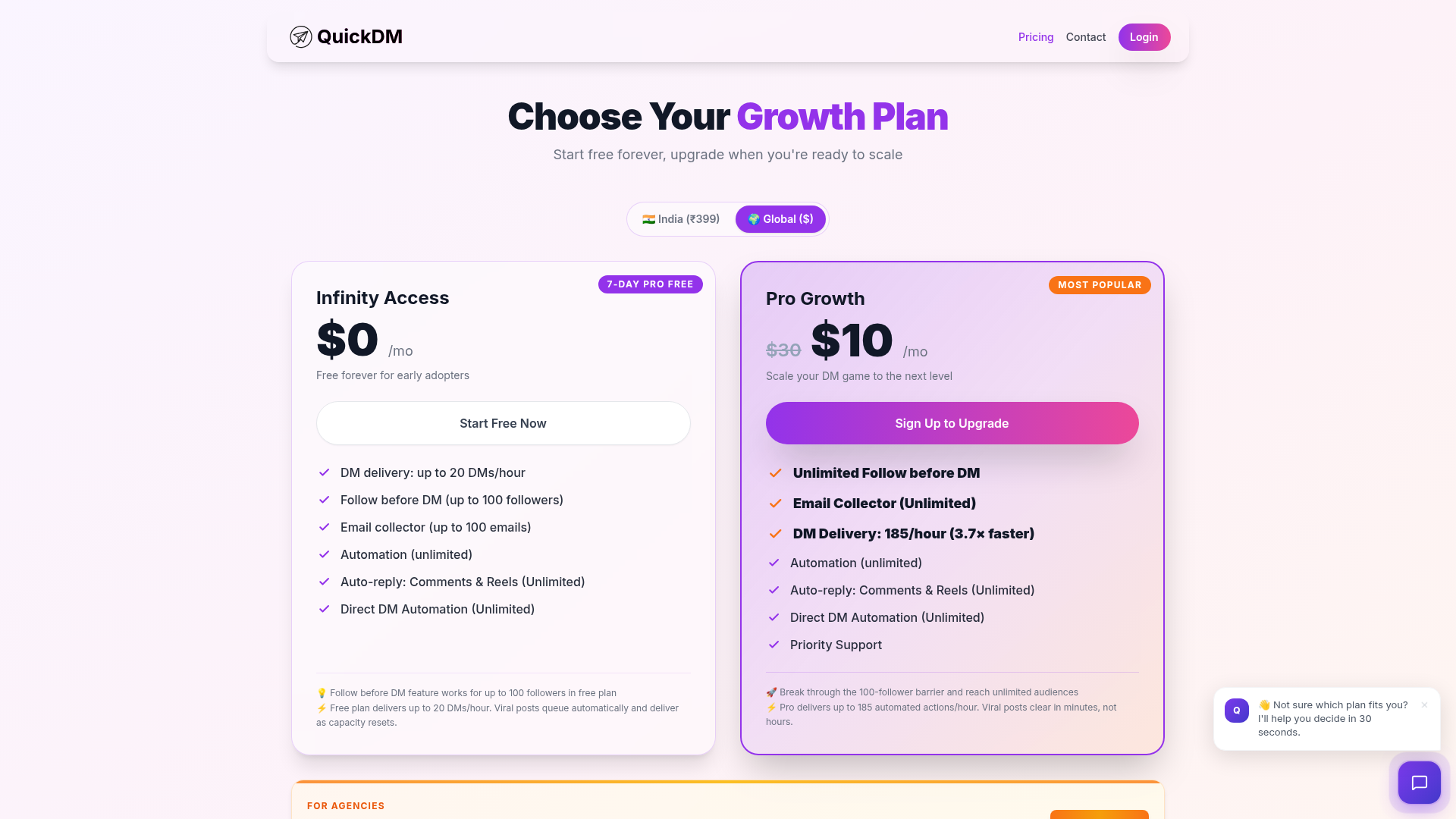
QuickDM's real pricing page (Free vs Pro vs Agency) — verified 2026-09-19
Free Plan Limitations vs. Value
The definition of a "free plan" varies drastically across the ecosystem. ManyChat’s free tier restricts users to just 25 active contacts per month, a ceiling that a single moderately viral Reel can exhaust within hours [Source: https://manychat.com/pricing, verified 2026-09-19]. Conversely, CreatorFlow offers 500 DMs per month, and LinkDM provides 1,000 DMs per month on their free tiers. QuickDM takes a different architectural approach, offering unlimited automations and unlimited comment/DM auto-replies for free forever, but governs throughput via a 20 DMs/hour pacing buffer [Source: https://quickdm.app/pricing, verified 2026-09-19]. This means viral posts will queue automatically and deliver as capacity resets, rather than hard-stopping at an arbitrary contact limit. For early-stage creators, this throughput-based model often provides more practical value than strict contact-based caps.
Cost-Effectiveness for Scaling
Scaling Instagram automation requires a deep understanding of Meta’s backend infrastructure. Meta's Graph API does not enforce a flat "X DMs/hour" account ceiling; instead, it enforces approximately 200 API calls per hour per active user, pooled at the app level. This consumption is tracked in real time via Meta's X-App-Usage and X-Business-Use-Case-Usage HTTP response headers. For a deeper dive, review the official Meta Graph API Rate Limiting Documentation. QuickDM’s Pro tier ($10/mo or ₹399/mo for India) is engineered with an intentional 185 DMs/hour application-side safety pacing buffer. This keeps outbound requests comfortably below Meta's pooled ceiling, reducing platform enforcement risk during traffic spikes. Furthermore, for Indian creators and brands, the ₹399/mo localized pricing ensures compliance with the Digital Personal Data Protection Act (DPDPA), 2023, providing a cost-effective, legally aligned scaling path compared to USD-converted enterprise tiers. For more context on scaling strategies, you can explore our guide on affordable auto DM alternatives.
QuickDM Review: Features, Pricing, and Compliance
Core Features and Free Tier Value
QuickDM positions itself as a lightweight, API-compliant automation tool built specifically for individual Instagram creators. Its core architecture relies on native Meta Graph API integration rather than unauthorized web scraping, which maintains stable platform connections. The Free tier ($0/month) offers unlimited automations and unlimited comment/reel auto-replies, a generous baseline in the current market [Source: https://quickdm.app/pricing, verified 2026-09-19]. It includes a pacing buffer of 20 DMs per hour to prevent hitting Meta's API ceilings. Follow-gating (requiring a user to follow before receiving a DM) and email collection are capped at 100 actions in the free tier. This structure allows creators to test lead generation workflows and link delivery without entering payment information.
Pro Tier Benefits and Global Pricing
For creators ready to scale their campaigns, the Pro tier is priced at $10/month globally and ₹399/month for India-based users [Source: https://quickdm.app/pricing, verified 2026-09-19]. The defining technical feature of this tier is the increased throughput limit of 185 DMs per hour. Meta's Graph API doesn't enforce a flat "X DMs/hour" ceiling; instead, it allocates approximately 200 API calls per hour per active user, pooled at the app level and monitored in real-time via Meta's X-App-Usage and X-Business-Use-Case-Usage HTTP response headers. QuickDM’s 185 DM/hour cap acts as an application-side safety pacing buffer, keeping automated requests comfortably below Meta’s pooled ceiling to reduce the risk of enforcement action. The Pro tier also unlocks unlimited email collection and unlimited follow-gating, removing the 100-follower barrier. You can review the exact API mechanics in the official Meta Graph API Rate Limiting Documentation [Source: https://developers.facebook.com/docs/graph-api/overview/rate-limiting/, verified 2026-09-19].
India DPDPA Compliance
For Indian creators and businesses, compliance with the Digital Personal Data Protection Act (DPDPA), 2023 is a critical operational requirement when capturing leads. QuickDM addresses this by structuring its email collection and follow-gating workflows around explicit user consent mechanisms. Because the tool processes personal data (such as Instagram handles and collected emails) directly through Meta's authorized infrastructure rather than unauthorized browser extensions, it aligns with the DPDPA's mandate for lawful data processing and user transparency. The localized ₹399/month pricing tier also ensures that Indian digital businesses can maintain compliant lead generation pipelines without violating international payment processing norms or complex data localization requirements [Source: https://quickdm.app/pricing, verified 2026-09-19].
ManyChat Review: The Industry Standard
Strengths of the Omnichannel Approach
ManyChat has established itself as a dominant force in social media automation, primarily due to its robust omnichannel architecture. As an official Meta Business Partner, the platform allows brands to build sophisticated conversational workflows that bridge Instagram Direct Messages, Facebook Messenger, WhatsApp, and SMS. This unified approach means marketing teams can deploy a single bot logic tree across multiple touchpoints, maintaining strict continuity in customer support and lead qualification. The platform’s visual Flow Builder is highly intuitive, enabling marketers to construct complex branching scenarios, conditional logic, and AI-driven response routing without touching a backend API. For enterprise or mid-market brands already leveraging multi-platform engagement, this interconnected ecosystem remains a significant operational advantage.
Pricing Structure and Contact Tiers
ManyChat utilizes a tiered pricing model based on active contacts rather than flat DM throughput limits. Standard tiers range from $14/month for up to 500 contacts, scaling to $29 for 2.5k contacts, $69 for 5k contacts, and capping at $139/month for 10,000 contacts [Source: https://manychat.com/pricing, verified 2026-09-19]. When billed annually, these costs translate to approximately ₹1,230 to ₹12,232 (USD→INR at 88, converted — not an official India price). While the entry-level tier includes unlimited Instagram accounts and basic automation triggers, higher tiers unlock advanced CRM integrations, custom domains, and priority support.
Drawbacks for Small Creators
Despite its comprehensive feature set, ManyChat's architecture presents friction for solopreneurs and small creators. The platform's pricing scales based on "active contacts"—meaning any user who interacts with your bot within a 24-hour window counts toward your tier limit. A single viral Instagram Reel with a comment-trigger keyword can easily exhaust a 500-contact allowance in hours, forcing an immediate plan upgrade. Furthermore, the visual Flow Builder, while powerful, introduces unnecessary complexity for a creator who simply wants to auto-reply to story mentions or deliver a link to new followers. The overhead of navigating an omnichannel dashboard and managing complex contact tiers often outweighs the operational needs of an independent creator looking for fast, frictionless engagement.
CreatorFlow Review: Streamlined for Creators
Target Audience and Use Cases
CreatorFlow is explicitly engineered for individual content creators, influencers, and digital product sellers who need immediate, frictionless engagement boosts. The platform excels in specific, high-frequency workflows: delivering lead magnets via link drops, executing simple comment-trigger campaigns to drive viral reach, and routing basic story replies. Instead of building complex, multi-step conditional logic, CreatorFlow focuses on the "comment-to-DM" pipeline. For a creator launching a new preset pack or a Notion template, a single keyword trigger in the comments can instantly deliver a secure checkout link. This narrow focus eliminates the overwhelming dashboard clutter found in broader marketing platforms, allowing creators to deploy a functional automation sequence in minutes rather than hours.
Pricing and Feature Set
CreatorFlow offers a genuinely functional free tier capped at 500 DMs per month, which provides sufficient volume for small-scale testing or creators with modest followings [Source: https://creatorflow.so/pricing, verified 2026-09-19]. For users requiring higher throughput, the platform’s paid plan is priced at $15 per month (≈ ₹1,320 INR converted) [Source: https://creatorflow.so/pricing, verified 2026-09-19].
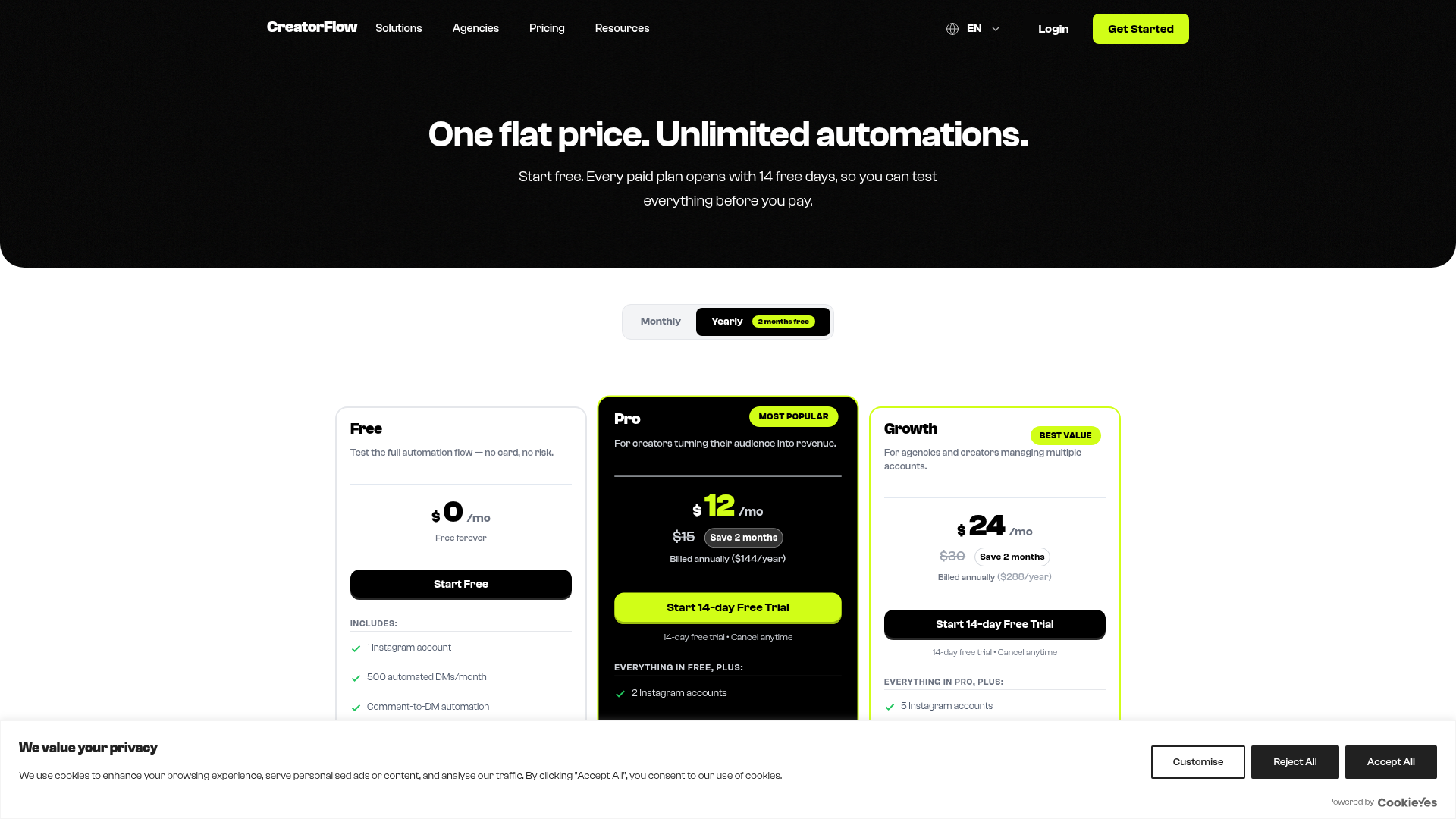
CreatorFlow pricing page screenshot — verified 2026-09-19
The feature set includes unlimited active automations, comment-to-DM triggers, and basic link delivery. However, the architecture lacks deep CRM integrations or advanced webhook routing. It is a straightforward utility designed to convert high-intent comments into direct conversations without the overhead of enterprise-grade compliance dashboards.
Pros and Cons Compared to Alternatives
The primary advantage of CreatorFlow is its radical simplicity. The learning curve is nearly flat, making it accessible to creators with zero technical background. Compared to heavier platforms, its lightweight architecture means campaigns can be launched rapidly. However, this simplicity comes at the cost of depth. The platform lacks advanced API pacing buffers and granular compliance controls necessary for massive viral spikes. While competitors offer complex conditional branching based on user history or CRM tags, CreatorFlow’s logic remains largely linear. For creators whose needs will never scale beyond basic link delivery, it is highly effective; for brands anticipating complex sales funnels, its capabilities will quickly feel restrictive.
Other Notable Alternatives: LinkDM, InstantDM, Inrō
LinkDM: High Volume Free Tier
LinkDM positions itself as a high-volume entry point, offering a robust free tier of 1,000 DMs per month [Source: https://www.linkdm.com/pricing, verified 2026-09-19]. Its paid tier scales up to $19 per month (≈ ₹1,670 INR converted) for expanded limits [Source: https://www.linkdm.com/pricing, verified 2026-09-19].
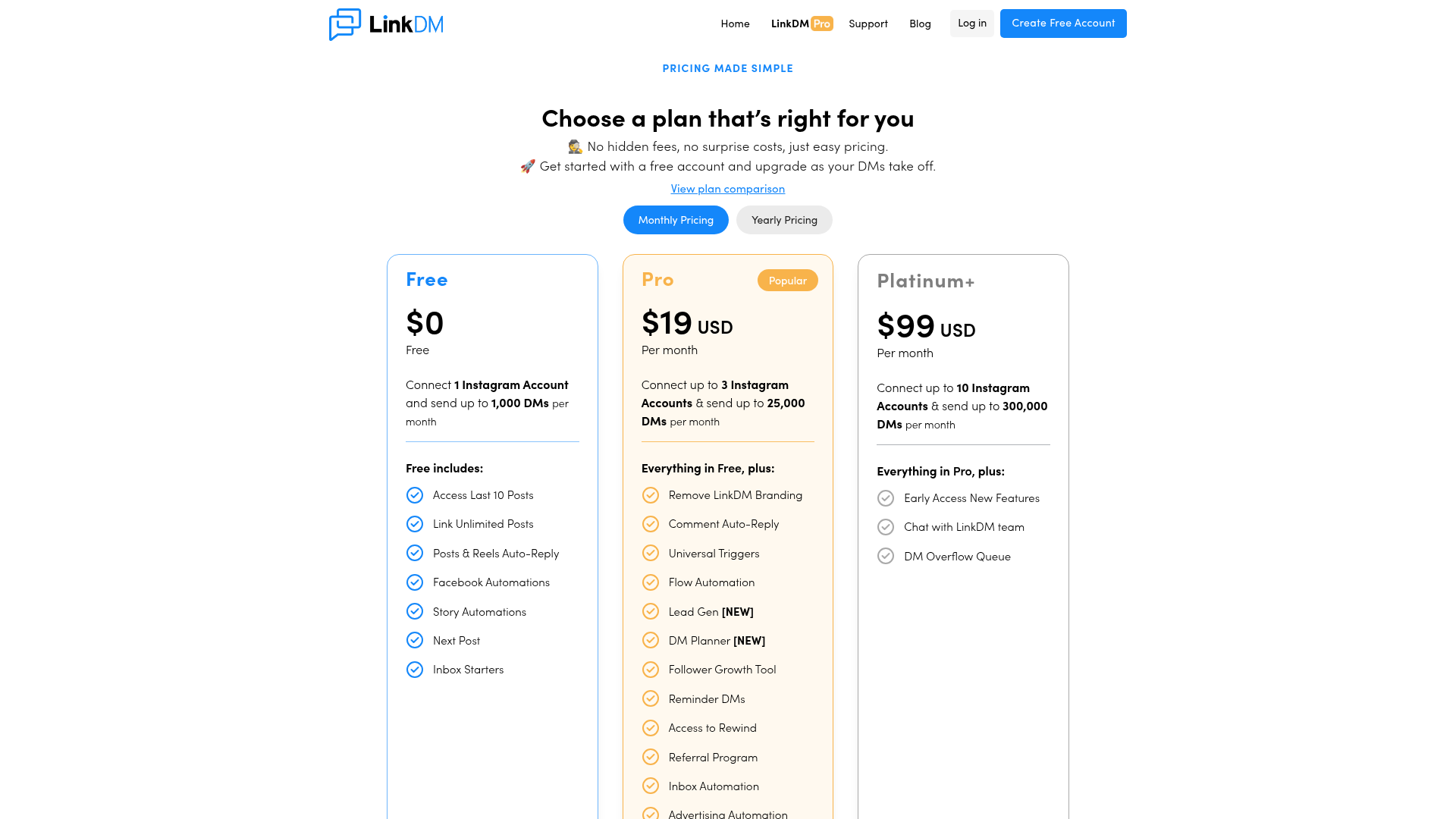
LinkDM pricing page screenshot — verified 2026-09-19
While LinkDM provides a larger raw free volume than some competitors, it lacks the application-side safety pacing found in tools like QuickDM. QuickDM’s free tier enforces a 20 DMs/hour pacing buffer, with its Pro tier ($10/month globally, or ₹399/month for India) offering a 185 DMs/hour safety buffer designed to stay comfortably below Meta's pooled API ceilings [Source: https://quickdm.app/pricing, verified 2026-09-19]. LinkDM is ideal for steady, moderate-volume creators, whereas QuickDM is better suited for managing sudden viral spikes without triggering platform rate limits.
InstantDM: Enterprise Focus
InstantDM caters to larger sales teams and agencies, with pricing spanning from $49 to $199 per month (≈ ₹4,310 INR converted) [Source: https://instantdm.com/pricing, verified 2026-09-19].
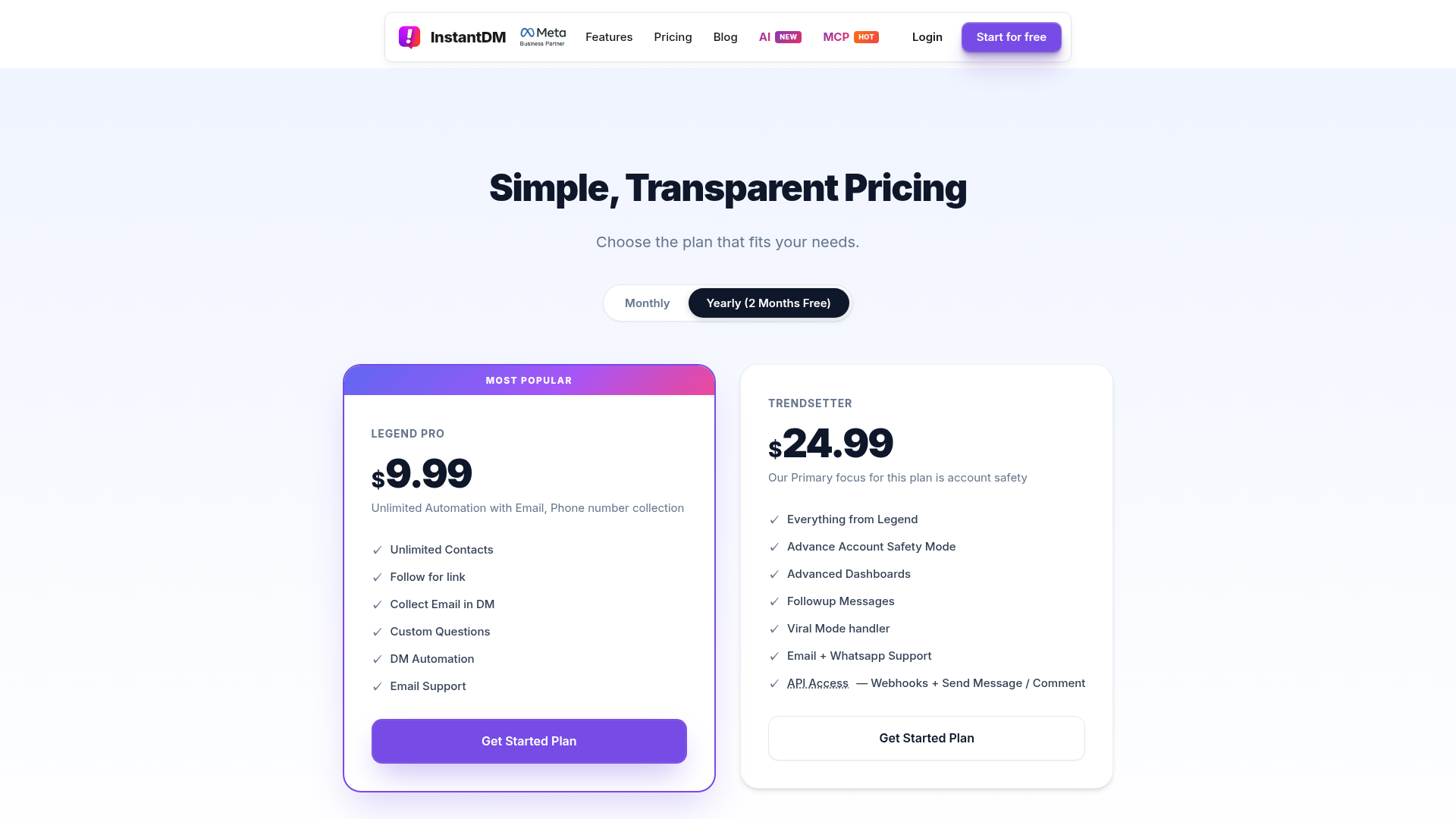
InstantDM pricing page screenshot — verified 2026-09-19
At this price point, the platform competes more directly with ManyChat’s higher contact tiers, which range from $14 to $139 per month [Source: https://manychat.com/pricing, verified 2026-09-19]. InstantDM justifies its premium through advanced team collaboration features, complex sales routing, and deeper CRM integrations. For enterprise operations, managing user consent and data collection is critical, particularly for Indian brands adhering to the Digital Personal Data Protection Act (DPDPA), 2023. While InstantDM handles enterprise volume well, smaller teams may find the entry cost prohibitive compared to more streamlined, cost-effective alternatives that still maintain strict Meta API compliance.
Inrō: Advanced Workflow Building
Inrō distinguishes itself through its sophisticated workflow builder, allowing users to map out complex, conditional automation sequences based on user behavior, tags, and previous interactions.
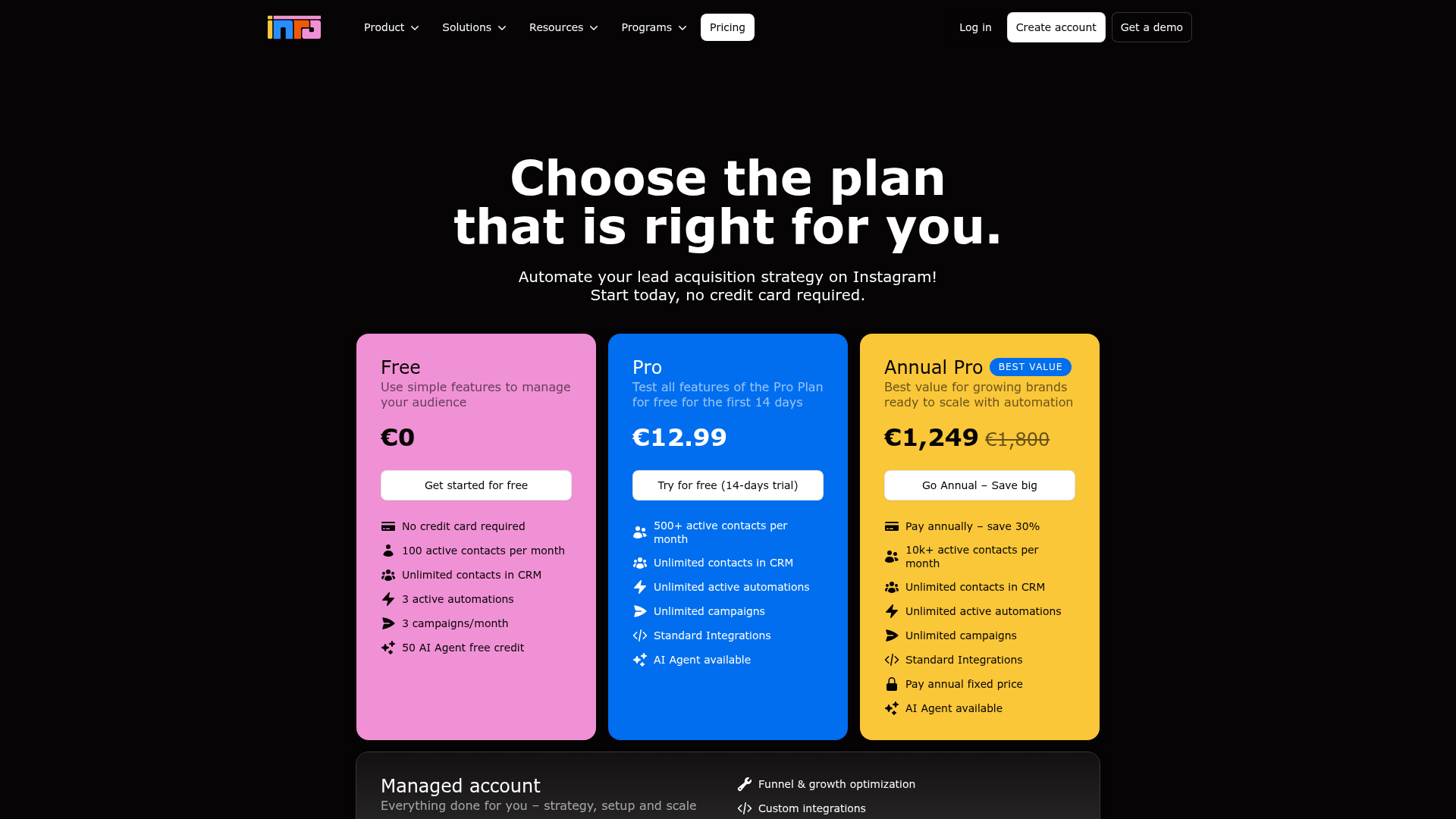
Inrō pricing page screenshot — verified 2026-09-19
This makes it highly attractive for marketers moving beyond simple comment triggers into full-funnel conversational marketing. However, executing complex, multi-step automations requires careful attention to Meta's Graph API rate limiting. Meta does not enforce a flat "X DMs/hour" account ceiling; instead, it allocates approximately 200 API calls per hour per active user, pooled at the app level, and monitored in real time via the X-App-Usage and X-Business-Use-Case-Usage HTTP response headers. You can review the exact technical parameters in the Meta Graph API Rate Limiting Documentation. Inrō handles this well, but users running massive simultaneous campaigns must still monitor their API consumption to avoid hitting the pooled ceiling.
Advanced Engagement Tactics & Funnels
Comment-to-DM Strategies
Comment-to-DM automation leverages the Meta Graph API to monitor post comments for specific trigger keywords. When a user comments a designated word—such as "GUIDE" or "LINK"—the API webhook receives the comment payload, matches the keyword (often using case-insensitive regular expressions), and triggers the /messages endpoint to send a private direct message to that user. This tactic is highly effective because it publicly boosts post engagement while privately delivering value. To execute this correctly, developers must ensure the webhook is subscribed to the comments field and that the automated DM respects the standard 24-hour messaging window. By moving the conversation from public comments to private messages, brands can deliver gated content, exclusive discounts, or multi-step onboarding sequences without cluttering the post feed. For a deeper dive into configuring these webhooks, you can review this Instagram comment DM automation setup guide.
Story Mentions and Replies
Automating story mentions and replies allows brands to capture high-intent engagement at the exact moment a user interacts with their content. By subscribing to the story_mentions webhook field via the Meta Graph API, your application receives a payload whenever a user tags your account in their Instagram Story. The system can then automatically dispatch a DM acknowledging the mention. The technical architecture requires parsing the webhook payload to extract the sender's ID and the story media URL. Best practices dictate using dynamic variables to personalize the response, referencing the specific story context rather than sending a generic, static reply. This approach capitalizes on user-generated content momentum, immediately acknowledging brand advocates and opening a direct communication channel while the interaction is still top-of-mind for the user.
Seamless Lead Capture Flows
Designing DM flows that naturally collect personally identifiable information (PII) like emails or phone numbers requires a delicate balance of UX design and technical compliance. The flow should begin with a value proposition—offering a lead magnet in exchange for contact details. Technically, this involves sequential API calls: first prompting the user, validating their input (e.g., using regex to verify email formatting), and then storing the data securely. It is critical to explicitly state why the data is being collected and how it will be used before requesting the input. For audiences in India, this process is not just a best practice but a legal requirement under the Digital Personal Data Protection Act (DPDPA), 2023, which mandates explicit, verifiable consent for data processing. Failing to build consent mechanisms into the conversational flow violates user trust and statutory law.
Common Mistakes in Instagram DM Automation
Over-Automating Conversations
A frequent architectural misstep is attempting to automate complex, multi-turn conversations without implementing a robust Natural Language Processing (NLP) fallback. When rigid decision-tree bots encounter queries outside their pre-programmed paths, they often loop, repeat themselves, or provide irrelevant answers. This "uncanny valley" of chatbot interactions severely damages brand reputation and increases unsubscribe rates. Technically, developers must build escalation protocols into their DM flows. If intent confidence scores drop below a certain threshold, or if the user types "human" or "agent," the API flow should immediately pause automation and route the conversation to a live support queue. Treating automation as a triage and routing system rather than a complete replacement for human interaction preserves the conversational quality and ensures edge cases are handled gracefully.
Ignoring API Rate Limits
Ignoring Meta's Graph API rate limits is a critical technical failure that can result in temporary blocks or permanent app suspension. Meta does not enforce a flat "X DMs/hour" account ceiling; instead, it enforces approximately 200 API calls per hour per active user, pooled at the application level. Developers must actively monitor the X-App-Usage and X-Business-Use-Case-Usage HTTP response headers returned by the API to track remaining call capacity. If an automation tool hammers the API without reading these headers, it will trigger error codes 4 or 17 (throttling), halting all automated messaging for the application. Implementing a queue system with exponential backoff and jitter ensures that burst traffic from viral posts does not exhaust the API budget. For exact specifications on header parsing and throttling behavior, consult the Meta Graph API Rate Limiting Documentation [Source: https://developers.facebook.com/docs/graph-api/overview/rate-limiting/, verified 2026-09-19].
Non-Compliant Data Handling
Capturing leads via Instagram DMs introduces significant legal liabilities if data handling is not architected correctly. A common mistake is routing unencrypted PII directly into standard Google Sheets or unsecured databases without an accompanying privacy policy. Under the Digital Personal Data Protection Act (DPDPA), 2023, Indian creators and brands are legally obligated to obtain explicit consent and provide a clear privacy notice before collecting user data. Furthermore, the data must be stored with adequate security safeguards to prevent breaches. Developers must ensure that webhook payloads containing PII are transmitted over HTTPS, encrypted at rest, and that users are provided with a mechanism to request data deletion. Building a "forget me" API endpoint that purges the user's record from your database upon request is essential for maintaining statutory compliance and avoiding hefty regulatory penalties.
Data Privacy and DPDPA Compliance in India
Understanding the DPDPA, 2023
The Digital Personal Data Protection Act (DPDPA), 2023 represents India's first comprehensive framework regulating the processing of digital personal data. For digital marketers using Instagram DM automation, this legislation fundamentally alters how lead capture must be handled. Under the DPDPA, a business collecting an email address or phone number via an automated Instagram workflow acts as a "Data Fiduciary." This means you are legally obligated to obtain explicit, informed consent from the user (the "Data Principal") before processing their data. Marketers must ensure that their auto-DM funnels clearly state the purpose of data collection—such as sending a lead magnet or newsletter—and provide a straightforward mechanism for users to withdraw consent. Non-compliance can result in significant penalties, making adherence a technical requirement, not just a legal formality.
How Automation Tools Handle Consent
Automation platforms handle consent through various architectural approaches. Official Meta Graph API-compliant tools typically log consent directly within the chat interface. When a user sends a specific trigger keyword, the platform records a timestamped log of that interaction, serving as proof of explicit consent. For email capture workflows, compliant platforms often require a secondary confirmation step rather than silently scraping profile data. Data storage practices vary significantly: some platforms store lead information in centralized global clouds, while others offer localized data residency options. Marketers must audit their tool's backend to ensure that data is encrypted in transit and at rest, and that the platform provides an easy way to export or delete user data to fulfill Data Principal requests under the DPDPA.
Choosing a Compliant Platform
Selecting a compliant platform requires evaluating specific technical and operational criteria. Indian businesses should prioritize tools that explicitly state adherence to the Digital Personal Data Protection Act (DPDPA), 2023 in their privacy policies and terms of service. Look for platforms that offer localized pricing in INR, which often indicates a deeper commitment to the Indian market and its regulatory environment. Additionally, the platform should provide a Data Processing Agreement (DPA) that clearly defines the boundaries of data ownership. Technically, ensure the tool allows you to map consent to specific automation flows and provides audit trails. Avoid platforms that rely on unofficial scraping methods, as they not only risk Instagram account bans but also bypass the consent mechanisms required to remain legally compliant in India.
Conclusion: Choosing the Right Tool for 2026
Summary of Key Findings
Our analysis of the 2026 Instagram DM automation landscape reveals stark differences in pricing, safety architecture, and regional compliance. ManyChat remains a dominant player, with pricing ranging from $14 to $139 per month depending on contact volume [Source: https://manychat.com/pricing, verified 2026-09-19]. However, newer alternatives are offering aggressive pricing and specialized safety buffers. For instance, QuickDM provides a free tier and a Pro plan at $10/month globally or ₹399/month for India [Source: https://quickdm.app/pricing, verified 2026-09-19]. From a technical safety standpoint, Meta's Graph API does not enforce a flat "X DMs/hour" ceiling. Instead, it allocates roughly 200 API calls per hour per active user, pooled at the app level and tracked via Meta's X-App-Usage and X-Business-Use-Case-Usage headers Meta Graph API Rate Limiting Documentation [Source: https://developers.facebook.com/docs/graph-api/overview/rate-limiting/, verified 2026-09-19]. QuickDM's Pro tier caps delivery at 185 DMs/hour, an intentional application-side buffer designed to keep requests comfortably below Meta's pooled ceiling.
Recommendations Based on User Profiles
Choosing the right tool depends heavily on your operational scale and geography. Solopreneurs and creators just starting out should leverage permanently free tiers to validate their workflows without upfront costs. Agencies managing multiple client accounts must prioritize tools with high-volume safety buffers and robust client management features; QuickDM's Pro tier, with its 185 DMs/hour pacing and priority support, fits this profile well [Source: https://quickdm.app/pricing, verified 2026-09-19]. Indian businesses have a distinct set of requirements. They need platforms that not only offer localized pricing (like QuickDM's ₹399/month tier) but also demonstrate explicit compliance with the DPDPA, 2023. While global tools like ManyChat ($14–$139/mo, or roughly ₹1,230–₹12,232 converted) are feature-rich, local businesses must weigh the cost benefits and compliance alignment of region-specific platforms.
Final Thoughts on Automation Safety
The long-term viability of any Instagram marketing strategy hinges on strict adherence to platform guidelines. Utilizing tools that operate outside the official Meta Graph API ecosystem introduces severe enforcement risks, including permanent account suspension. Even when using compliant tools, understanding the underlying rate-limiting architecture is crucial. By respecting the ~200 API calls/hour pooled ceiling and utilizing application-side pacing buffers, marketers can run aggressive campaigns while reducing the risk of throttling or bans. As we move further into 2026, the intersection of platform compliance and regional data privacy laws like India's DPDPA will only become more stringent. Investing in transparent, API-compliant automation infrastructure is the most reliable way to safeguard your digital assets and scale sustainably.