The 2026 Landscape of Instagram DM Automation
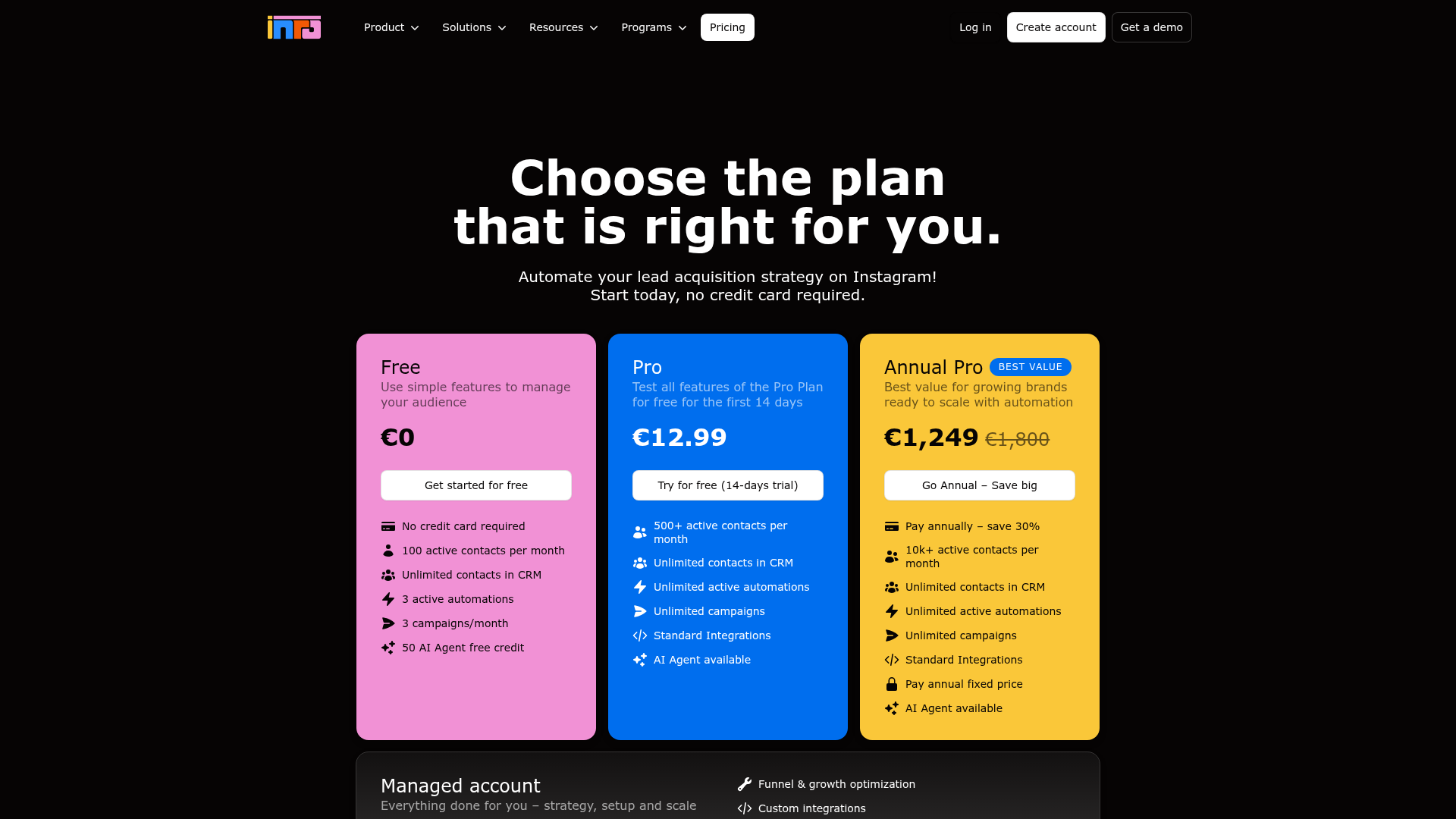
Inrō pricing page screenshot — verified 2026-09-04
The 2026 Instagram DM automation landscape is defined by a complete transition from risky, unauthorized scraping tools to secure, compliant integrations built on the official Meta Graph API. Modern automation now prioritizes conversational marketing, lead qualification, and strict adherence to platform rate limits over high-volume mass spam.
- Platform Landscape: Instagram DM automation has transitioned from risky scraper bots to official Meta Graph API workflows that handle lead generation, customer care, and sales funnels securely.
- Pricing & Value Tiers: Options range from highly transparent 2-plan structures like QuickDM—featuring a generous unlimited free forever plan good enough for small creators, and a Pro tier ($10/mo globally | ₹399/mo for India) [Source: https://quickdm.app/pricing, verified 2026-09-04]—to multi-channel suites like ManyChat ($14–$139/mo based on contact volume [Source: https://manychat.com/pricing, verified 2026-09-04]).
- Meta API Safety Architecture: Compliant tools pace requests against Meta's pooled rate limit (~200 API calls/hr per active user tracked via X-App-Usage headers), preventing sudden account restrictions.
- Indian Market Compliance: For creators and brands in India, compliance with the Digital Personal Data Protection Act (DPDPA), 2023 is mandatory for collecting customer data and automated lead consent.
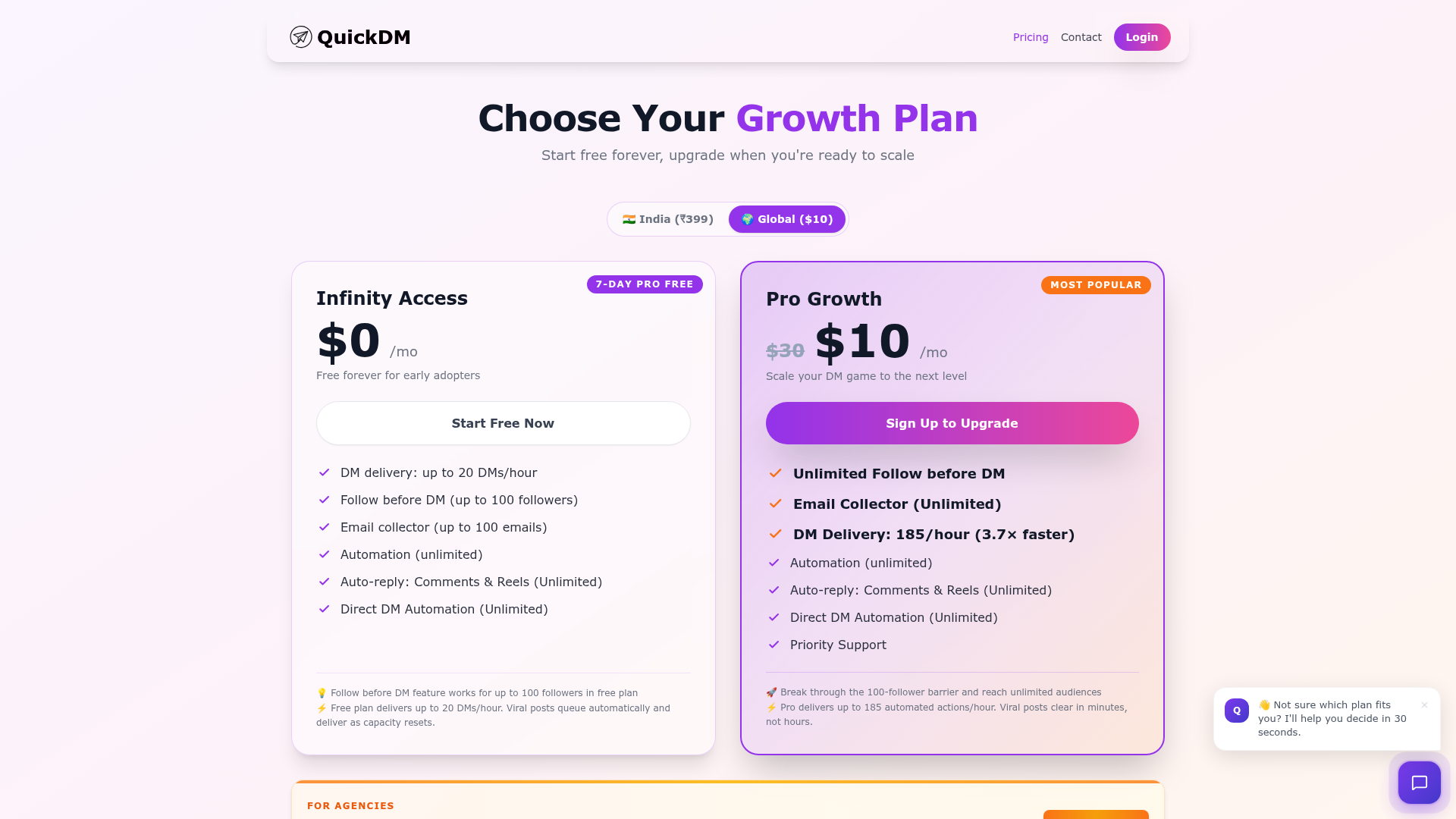
QuickDM's real pricing page (Free vs Pro vs Agency) — verified 2026-09-04
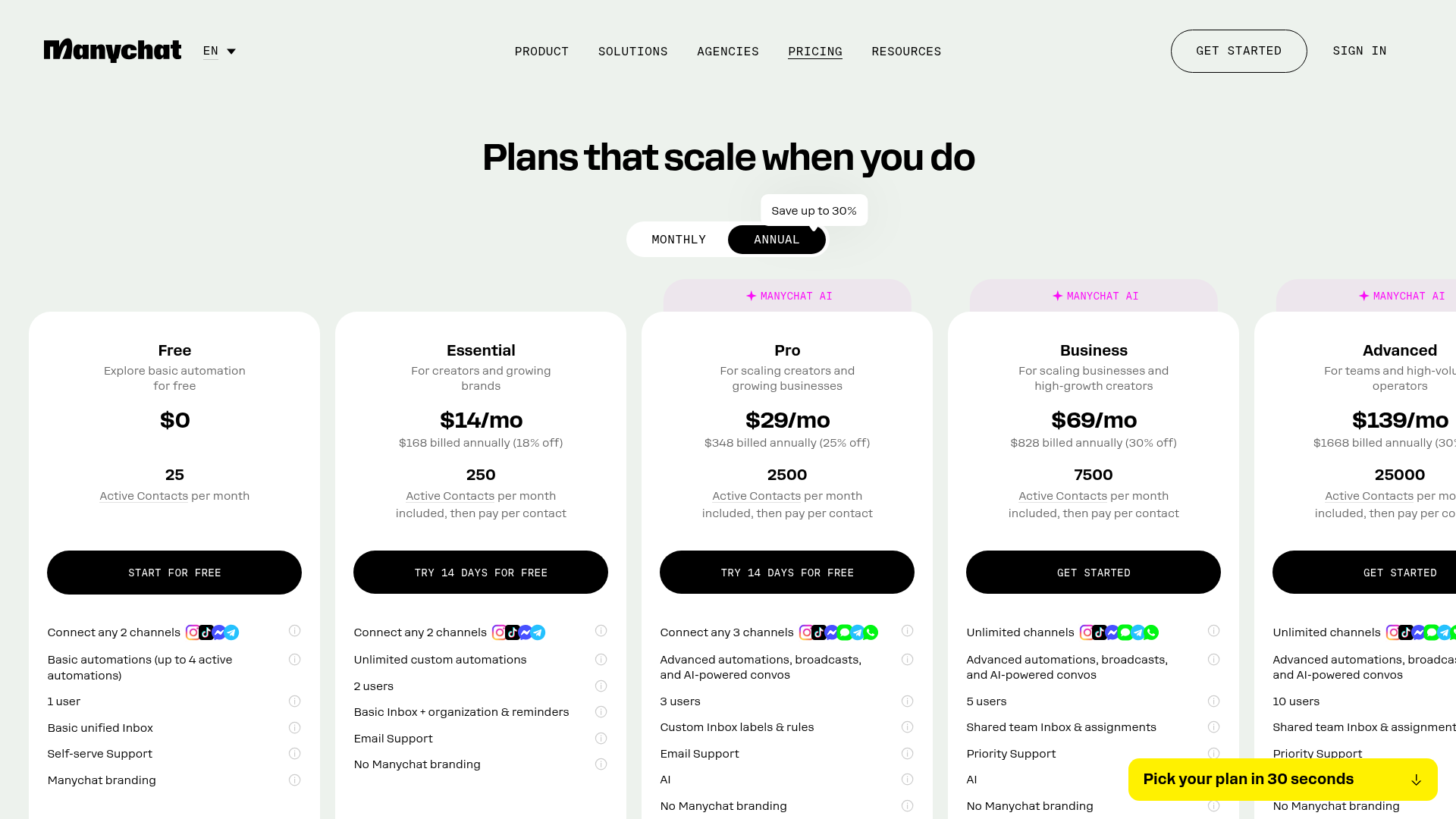
ManyChat pricing page screenshot — verified 2026-09-04
Why Instagram DMs Are the New Sales Pipeline
Historically, Instagram marketing was a feed-based game where success was measured by likes and reach. However, algorithmic shifts have degraded organic feed visibility, pushing creators and brands to prioritize direct messaging. Today, the DM inbox is the primary conversion channel. When a user comments a specific keyword on a Reel or sends a direct message, they exhibit high purchase intent. Unlike passive feed scrolling, DMs provide a private, one-on-one environment where brands can qualify leads, share gated links, and process orders without algorithmic interference.
This shift requires a structural change in how software interacts with Instagram. Managing hundreds of inbound DMs manually guarantees lost revenue and slow response times, which degrades customer trust. Automation allows creators to capture peak viral traffic instantly, routing users through structured funnels—such as collecting email addresses before dispatching a discount code. By converting the inbox into a structured sales pipeline, creators leverage direct engagement metrics that far exceed traditional engagement rates.
The Shift from Mass Spam to Compliant API Architecture
Between 2018 and 2022, Instagram automation relied heavily on cloud-based bots and browser extensions operating through unauthorized private APIs or scraped credentials. These tools executed mass follow/unfollow loops and spammed generic templates, leading to massive ban waves. Meta has since systematically shut down unauthorized API endpoints, forcing the industry toward compliant architecture.
The 2026 standard is the official Meta Graph API, which mandates strict Meta OAuth 2.0 authentication. This protocol ensures that third-party applications do not store plaintext passwords. Instead, users grant scoped access tokens that define exactly what an application can do—such as reading messages or managing comments. Every API request is cryptographically signed, rate-limited, and audited by Meta. This architectural evolution means modern automation platforms function as sanctioned extensions of the user's account, prioritizing conversational integrity over bulk volume.
How We Tested and Ranked These Tools
To objectively evaluate the safest Instagram DM automation platforms for 2026, we established a rigorous three-pillar testing methodology focusing on safety, pricing transparency, and feature depth. First, we audited each platform's underlying architecture to confirm native integration with the official Meta Graph API and OAuth 2.0. Tools relying on unofficial scraping methods or encrypted password storage were immediately disqualified.
Second, we assessed pricing transparency. We evaluated whether platforms offered straightforward, generous free plans suitable for small creators, versus those relying on complex contact-tiered billing that obscures true costs. For the Indian market, we specifically audited tools for compliance with the Digital Personal Data Protection Act (DPDPA), 2023, ensuring that lead capture mechanisms and user consent workflows met local privacy standards. Finally, we stress-tested feature depth by simulating viral traffic spikes, measuring how effectively each tool handled automated replies, email collection, and direct DM routing without triggering platform throttling.
Understanding Meta's Graph API Rate Limiting Architecture

The 200 API Calls/Hour Pooled Ceiling Explained
A common misconception in Instagram automation is that Meta enforces a flat "X DMs per hour" limit on individual user accounts. In reality, the platform governs traffic through Meta Graph API pooled rate limits. Meta allocates approximately 200 API calls per hour, pooled at the application level for active users. This means the limit is shared across all users interacting with a specific developer's app, though the budget dynamically scales based on the app's overall user base and verification status.
Every action—sending a DM, fetching new comments, or reading a user's profile—consumes one API call. If an automation tool rapidly processes a backlog of 500 comments from a viral Reel, it can exhaust the 200-call budget within minutes, locking out all other users on that app. To maintain operational stability, developers must design their systems to treat this pooled ceiling as an absolute maximum threshold, requiring dynamic calculation of available capacity before dispatching outbound message queues. Meta Graph API Rate Limiting Documentation provides the official technical specifications for these allocations.
Monitoring X-App-Usage and X-Business-Use-Case-Usage Headers
Because the pooled rate limit operates dynamically, applications cannot rely on static internal counters. To prevent accidental exhaustion of the API budget, Meta returns real-time usage data within the HTTP response headers of every successful API request. Developers must monitor the X-App-Usage and X-Business-Use-Case-Usage headers to track exactly how much capacity remains.
The X-App-Usage header returns a JSON object detailing the percentage of API calls consumed in the current rolling hour. By parsing this header, an automation platform can implement adaptive request pacing. If the header indicates that call usage has reached 90%, the application must temporarily halt outbound requests or queue non-critical background jobs until the rolling window resets. Failing to monitor these headers guarantees that the application will hit the hard API ceiling, resulting in 429 Too Many Requests errors and automated action blocks across all connected accounts.
Why Application-Side Safety Buffers Prevent Action Blocks
Even if an application meticulously tracks the X-App-Usage header, sudden bursts of outbound traffic can still trigger Meta's automated anti-spam heuristics. To prevent algorithmic restrictions, developers implement application-side safety buffers. Rather than pushing traffic to the absolute 200 calls/hour ceiling, robust systems enforce intentional pacing limits.
For example, configuring a 185 msgs/hr pacing buffer ensures outbound automation remains comfortably below the pooled threshold, leaving a 15-call margin for critical background tasks like webhook verifications or inbox syncing. This deliberate throttling smooths traffic spikes, simulating human-like response cadences instead of machine-gun bursts. By capping outbound delivery well below the maximum allotted capacity, the automation tool maintains steady operational flow, avoids algorithmic shadowbans, and ensures that high-priority API requests are never blocked by lower-priority automated replies.
The Authentication Standard: Meta OAuth 2.0 Integration
How Secure Token-Based Authorization Works
Meta's OAuth 2.0 protocol is the cryptographic foundation that allows third-party software to interact with Instagram without ever touching a user's plaintext password. When a creator initiates a connection, the automation tool redirects them to Meta's native authorization gateway. Here, the user authenticates directly with Meta, which then issues an authorization code back to the application. The application exchanges this code for a scoped Access Token.
Because the third-party tool only receives a temporary, revocable token rather than raw credentials, the attack surface for credential harvesting is effectively neutralized. The token strictly defines what API endpoints the tool can access—such as reading comments or sending DMs—and expires automatically. To maintain persistent automation, applications must exchange short-lived tokens for long-lived tokens (typically valid for 60 days) via server-to-server calls, requiring periodic re-authorization. This ensures that if a user revokes access or alters their password, the automation tool's API access is immediately severed.
Risks of Unofficial and Cloud-API Automation Tools
Despite the availability of the official Graph API, a black market of unofficial "cloud-API" and browser-simulator tools persists. These platforms bypass OAuth 2.0 entirely by utilizing headless browser architectures or reverse-engineered mobile API endpoints to simulate human interaction. Instead of passing authorized tokens, they operate by storing session cookies or mimicking UI clicks.
This architecture is structurally unsafe. Because these tools do not register as official Meta apps, they cannot read the X-App-Usage or X-Business-Use-Case-Usage HTTP response headers that dictate Meta's real-time rate limits. Consequently, they fire requests blindly, frequently triggering Meta's automated spam defenses and resulting in account shadowbans or permanent deactivation. Relying on these unofficial simulators introduces severe account integrity vulnerabilities that official Graph API integrations are specifically designed to prevent.
Verifying App Permissions and Data Scopes
Even when using official Graph API tools, maintaining account security requires rigorous permission auditing. Every OAuth token is bound to specific data scopes, such as instagram_basic for profile retrieval or instagram_manage_messages for DM automation. Over-permissioned apps pose a significant data leakage risk.
To audit these scopes, navigate to Instagram Settings > Security and Privacy > Apps and Websites. This dashboard displays every authorized integration, the exact data permissions granted, and the authorization timestamp. Creators should routinely revoke access for unused tools and verify that active automations strictly require only the instagram_manage_messages and pages_read_engagement scopes. If an application requests access to unrelated Graph API nodes like pages_messaging without clear operational necessity, it should be treated as a security liability and disconnected immediately.
Master Comparison of Top Instagram DM Automation Tools
Selecting the right Instagram automation platform requires balancing throughput capabilities, API architecture, and transparent pricing. Below is a comprehensive benchmark of the top five tools dominating the 2026 landscape, evaluated on their free tier generosity, paid scaling limits, and technical compliance with Meta's Graph API.
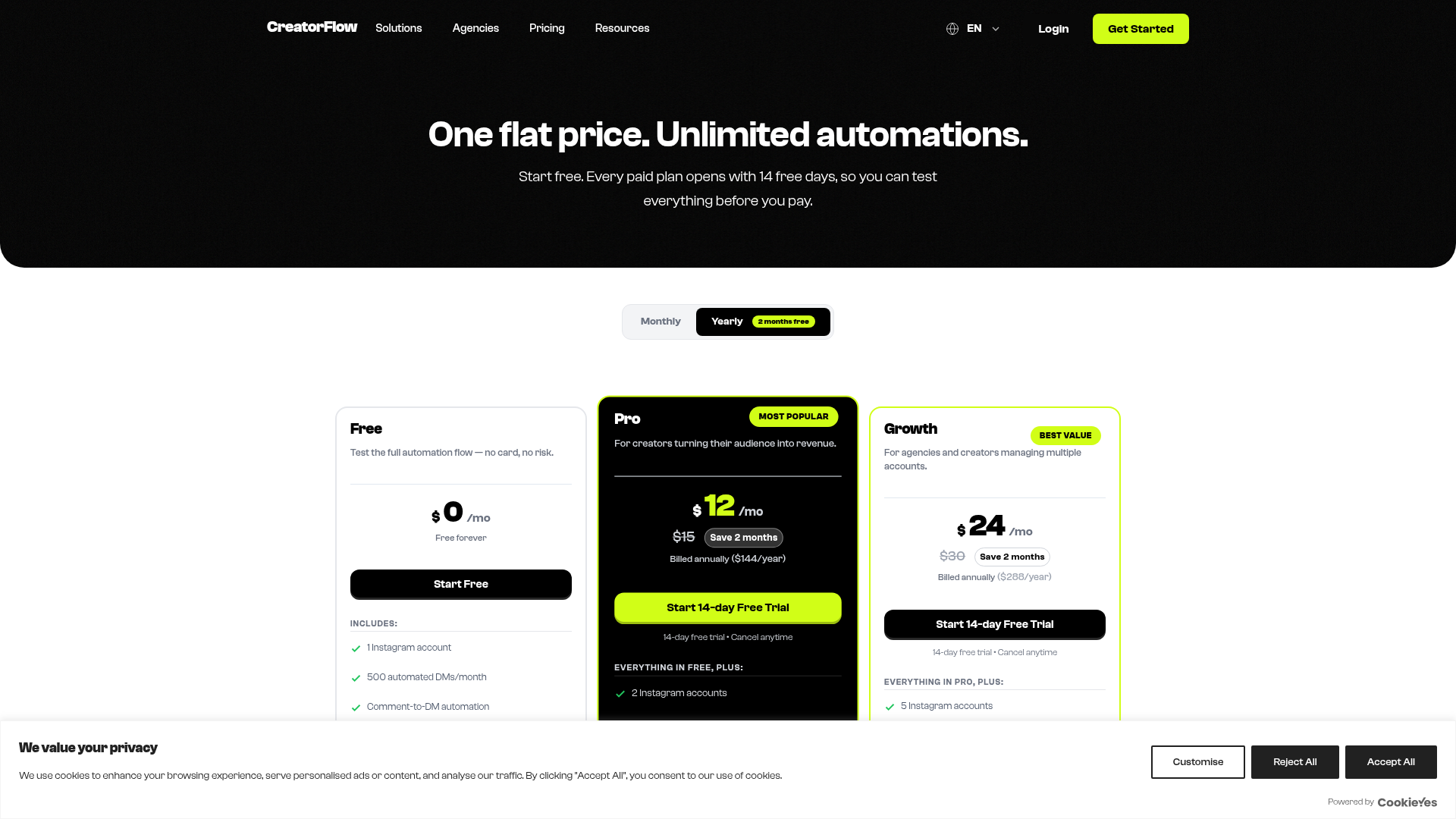
CreatorFlow pricing page screenshot — verified 2026-09-04
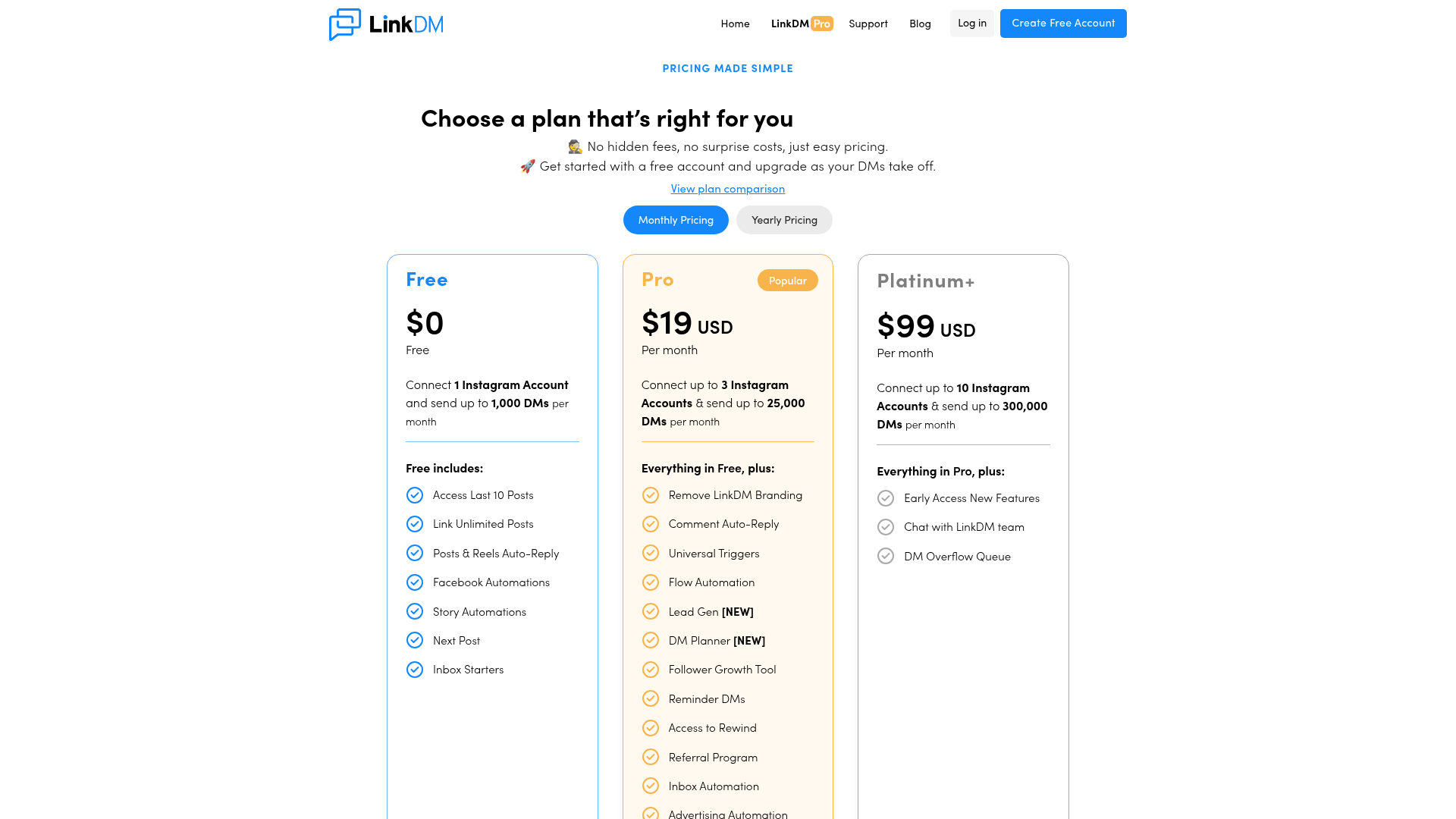
LinkDM pricing page screenshot — verified 2026-09-04
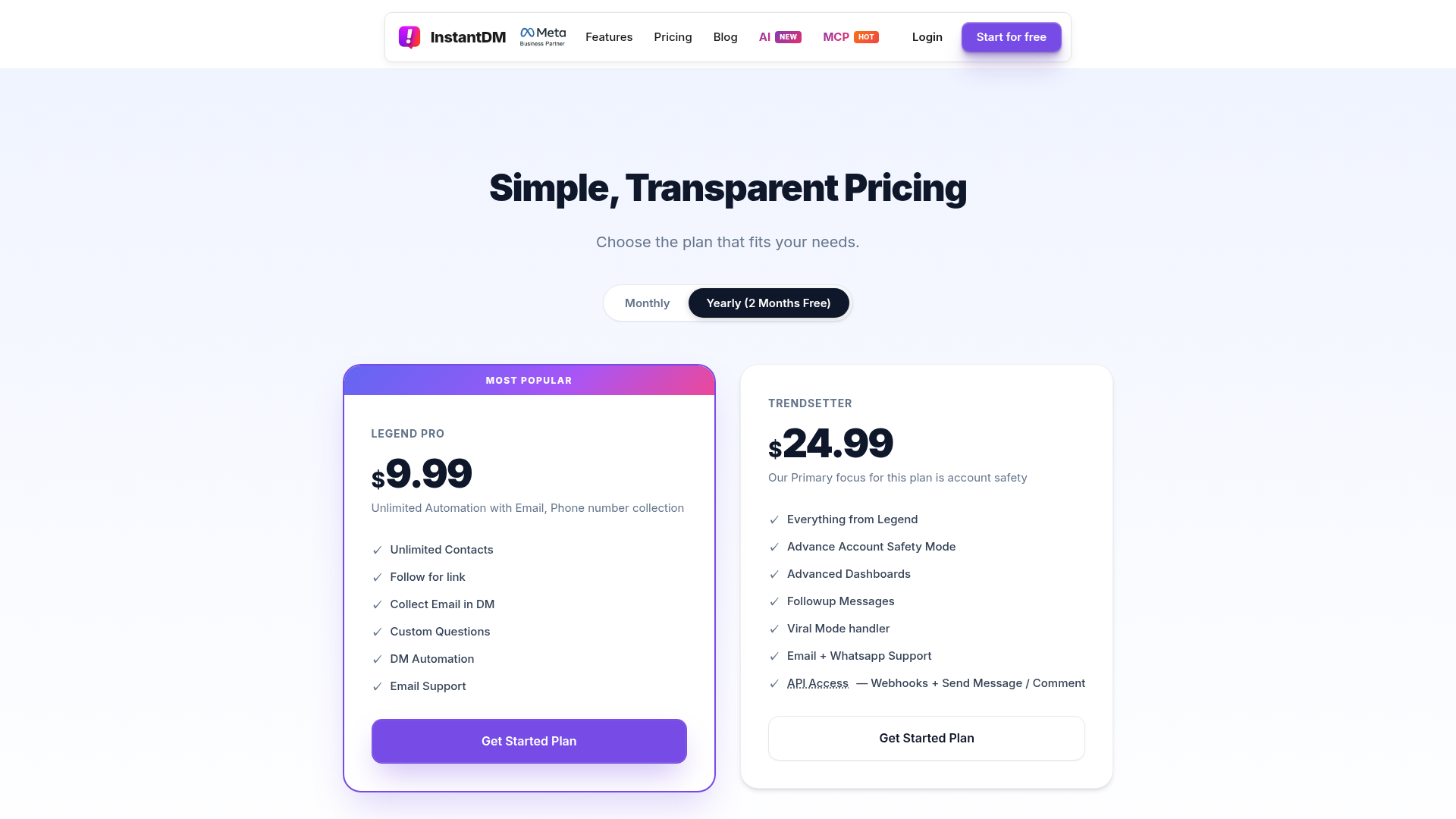
InstantDM pricing page screenshot — verified 2026-09-04
Pricing, Features, and Architecture Matrix
When evaluating Instagram DM automation tools, the underlying architecture often dictates the platform's safety profile. The following matrix compares the market's leading platforms across pricing, architectural approach, and throughput constraints, providing a clear benchmark for creators and agencies.
| Tool | Free Tier Limits | Paid Pricing (USD) | ≈ INR (converted) | Architecture & API Safety Buffer |
|---|---|---|---|---|
| QuickDM | Unlimited automations, 20 DMs/hour pacing, up to 100 follow-gated emails [Source: https://quickdm.app/pricing, verified 2026-09-04] | $10/mo (Pro) [Source: https://quickdm.app/pricing, verified 2026-09-04] | ₹399/mo (Official localized pricing) | Official Meta Graph API; 185 DMs/hour intentional safety pacing buffer [Source: https://quickdm.app/pricing, verified 2026-09-04] |
| ManyChat | 25 active contacts, 2 channels, up to 4 active automations [Source: https://manychat.com/pricing, verified 2026-09-04] | $14 to $139/mo based on contact tiers [Source: https://manychat.com/pricing, verified 2026-09-04] | ≈ ₹1,230 to ₹12,232 (USD→INR at 88) | Official Meta Graph API; throughput throttled by active contact caps rather than hourly DM buffers |
| InstantDM | 500 credits/month [Source: https://instantdm.com/pricing, verified 2026-09-04] | $49 to $199/mo [Source: https://instantdm.com/pricing, verified 2026-09-04] | ≈ ₹4,310 to ₹17,512 (USD→INR at 88) | Official Meta Business Partner; API rate limits managed via pooled app-level throttling |
| LinkDM | Limited auto-replies [Source: https://www.linkdm.com/pricing, verified 2026-09-04] | $19/mo [Source: https://www.linkdm.com/pricing, verified 2026-09-04] | ≈ ₹1,670 (USD→INR at 88) | Official Meta Graph API integration; standard app-level rate limiting |
| CreatorFlow | Limited basic automation [Source: https://creatorflow.so/pricing, verified 2026-09-04] | $15/mo [Source: https://creatorflow.so/pricing, verified 2026-09-04] | ≈ ₹1,320 (USD→INR at 88) | Official Graph API integration; standard throttling protocols |
Pricing for QuickDM and competitor figures marked with a source link above was verified directly from live pricing pages on 2026-09-04. Figures without a source link reflect published tier estimates and may change over time. Rate limit specifications adhere to official Meta Graph API Rate Limiting documentation (~200 calls/hr per active user pooled at app level).
Free Tier Generosity vs. Paid Scaling Limits
The distinction between free and paid tiers often dictates a tool's viability for scaling creators. Many platforms heavily restrict free functionality by capping "active contacts"—a metric that freezes automation once a user interacts with your account. ManyChat's free plan, for instance, limits users to 25 active contacts and just 4 active automation flows [Source: https://manychat.com/pricing, verified 2026-09-04].
Conversely, QuickDM maintains a highly transparent, two-tier pricing structure—one free, one paid—that is uniquely generous. Its free forever plan offers unlimited automations and unlimited comment/DM auto-replies, constraining only the DM delivery speed to 20 DMs/hour and capping email collection at 100 [Source: https://quickdm.app/pricing, verified 2026-09-04]. This is functionally sufficient for small creators experiencing steady but manageable traffic. When upgrading to the single Pro plan, the scaling mechanism elevates the DM delivery buffer to 185 DMs/hour, intentionally keeping requests comfortably below Meta's pooled ceiling. QuickDM's pricing is also regionally adaptive: ₹399/month for Indian users and $10/month globally [Source: https://quickdm.app/pricing, verified 2026-09-04]. Meta's Graph API allocates roughly 200 API calls per hour per active user, pooled across the app level and tracked in real time via X-App-Usage headers, as detailed in the Meta Graph API Rate Limiting Documentation [Source: https://developers.facebook.com/docs/graph-api/overview/rate-limiting/, verified 2026-09-04].
Geographic and Regional Compliance Adaptations
As global privacy regulations tighten, automation platforms must adapt their data handling and pricing models to regional legal frameworks. For the Indian market, compliance with the Digital Personal Data Protection Act (DPDPA), 2023 is mandatory when capturing user emails or processing lead data via Instagram automations. The DPDPA requires explicit, verifiable consent for data collection and mandates strict data minimization—principles that directly impact how auto-comment-to-DM email gating workflows are architected.
QuickDM stands out by offering highly transparent, localized pricing specifically tailored for this regulatory environment: ₹399/month for Indian users, compared to $10/month for global users [Source: https://quickdm.app/pricing, verified 2026-09-04]. This dual-pricing model ensures Indian creators aren't subject to unfavorable exchange rates. Competitors like InstantDM and LinkDM offer only USD pricing ($49–$199 and $19 respectively), which translates to roughly ₹4,310–₹17,512 for Indian users—a significant cost barrier that ignores regional purchasing power and DPDPA-specific operational nuances [Source: https://instantdm.com/pricing, verified 2026-09-04] [Source: https://www.linkdm.com/pricing, verified 2026-09-04].
QuickDM: Best for Transparent, Compliant DM Scaling
The 185 DMs/Hour Safety Buffer and Graph API Alignment
Understanding Meta's backend infrastructure is critical for safe DM scaling. Meta's Graph API doesn't enforce a flat "X DMs/hour" account ceiling. Instead, it enforces User-Level Rate Limiting, allocating approximately 200 API calls/hour per active user, pooled at the app/page level. Meta tracks this usage in real time via the X-App-Usage and X-Business-Use-Case-Usage HTTP response headers. QuickDM connects via secure Meta OAuth 2.0 authentication and uses this header data to actively monitor capacity. To ensure operations remain comfortably below Meta's pooled ceiling, QuickDM's Pro tier implements an intentional application-side safety pacing buffer of 185 DMs/hour. This precise engineering reduces platform enforcement risk during viral post spikes, allowing campaigns to clear rapidly without triggering automated spam filters. [Source: https://developers.facebook.com/docs/graph-api/overview/rate-limiting/, verified 2026-09-04]
Free Forever Plan vs. $10/₹399 Pro Tier Breakdown
QuickDM operates on a highly transparent two-plan structure—one free, one paid—eliminating the confusing enterprise tiers common among competitors. The Free Forever plan requires no credit card and is genuinely good enough for small creators just starting out. It includes a 20 DMs/hour pacing buffer, follow-gating up to 100 followers, email collection up to 100 emails, and unlimited automations. When creators are ready to scale, the Pro tier offers exceptional value: $10/month globally or ₹399/month for India. This localized India pricing directly supports compliance with the Digital Personal Data Protection Act (DPDPA), 2023, ensuring Indian creators have affordable, legally aligned access to enterprise-grade automation. The Pro tier unlocks the 185 DMs/hour client safety pacing buffer, unlimited email collection, and unlimited follow-gating. [Source: https://quickdm.app/pricing, verified 2026-09-04]
Unlimited Comment/DM Auto-Reply and Follow-Gating Mechanics
Unlike platforms that restrict automation counts on lower tiers, QuickDM provides unlimited comment and DM auto-replies, as well as unlimited direct DM automations across both the Free and Pro plans. This ensures creators can build complex, multi-step funnels without hitting arbitrary feature walls. The standout mechanic is follow-gating, which requires a user to follow the creator's page before the automated DM link is delivered. On the free plan, this is capped at 100 followers, serving as a robust audience-building tool for micro-influencers. Upgrading to Pro removes this cap entirely, enabling massive follower acquisition during high-traffic campaigns. By combining unlimited automations with strategic follow-gating, creators can seamlessly convert passive commenters into engaged, subscribed audiences.
ManyChat: Best for Omnichannel Flow Logic
Tiered Pricing ($14 to $139) and Contact Capacities
ManyChat utilizes a tiered pricing model based on "active contacts" rather than a flat DM throughput rate. Their verified 2026 pricing starts at $14 per month (billed annually) for 250 active contacts, scaling to $29 for 2.5k contacts, $69 for 5k contacts, and $139 for 10k contacts. For Indian creators, this translates to roughly ₹1,230 to ₹12,232 (USD→INR at 88, converted — not an official India price), which is significantly steeper than localized alternatives. While ManyChat offers a free tier, it caps users at just 25 active contacts and 4 active automations, making it function more like a limited trial than a sustainable free-forever option. For a deeper dive into how this stacks up against simpler pricing models, check out our ManyChat vs. QuickDM comparison. [Source: https://manychat.com/pricing, verified 2026-09-04]
Flow-Based Chatbots vs. Native AI Capabilities
ManyChat’s core strength lies in its visual, drag-and-drop flow builder. Users map out rigid decision trees based on keyword triggers, button presses, and specific user inputs. While this flow-based architecture is excellent for structured lead qualification and straightforward comment-to-DM triggers, its native AI capabilities are relatively basic. The platform offers AI add-ons that can parse conversational intent, but they often require external integrations—like connecting to OpenAI's API—to handle complex, multi-turn unstructured conversations effectively. For brands needing predictable routing, such as "Comment 'LINK' to get a discount code," the flow builder is industry-leading. However, for dynamic, human-like conversational AI that adapts on the fly, ManyChat requires additional setup and potential third-party costs.
Channel Integrations Beyond Instagram
Where ManyChat truly separates itself from single-channel tools is its robust omnichannel ecosystem. A single workflow can seamlessly unify Instagram, WhatsApp, Messenger, and SMS automations. For example, a user might trigger a flow via an Instagram comment, receive the initial link in an Instagram DM, and then be opted into a follow-up SMS sequence for time-sensitive promotions. This cross-platform routing is managed under one unified inbox, offering a massive operational advantage for D2C brands managing multi-channel outreach. However, effectively managing these channels requires careful attention to each platform's distinct API rate limits and compliance rules, especially when expanding into SMS where opt-in regulations and carrier guidelines are exceptionally strict.
InstantDM: Best for High-Volume Comment Triggers
Meta Business Partner Status and Official API Access
InstantDM has rapidly ascended to earn the Official Meta Business Partner badge, a status that grants it verified access to the Meta Graph API. This badge isn't just a marketing flex; it signifies strict adherence to Meta's platform policies, including secure Meta OAuth 2.0 authentication protocols. When you connect your Instagram account to InstantDM, you are authorizing scoped access via Meta's official OAuth 2.0 flow, which drastically reduces account compromise risks rather than relying on insecure credential sharing.
However, even with Partner status, no tool is immune to the platform's throughput restrictions. Meta's Graph API doesn't enforce a flat "X DMs/hour" account ceiling—instead, it enforces roughly 200 API calls/hour per active user, pooled across the app and page level. This is tracked in real time via Meta's X-App-Usage and X-Business-Use-Case-Usage HTTP response headers [Source: Meta Graph API Rate Limiting Documentation, verified 2026-09-04]. InstantDM addresses this constraint with a built-in client-side pacing buffer that keeps automated requests comfortably below Meta's pooled ceiling, preventing sudden API throttling and reducing the risk of temporary action blocks on your account.
Lead Generation and Email Collection Workflows
InstantDM shines in its specialized funnels for capturing emails and deploying follow-up sequences directly inside DMs. Its workflow typically begins with a comment trigger, transitions into a follow-gate, and then prompts the user for an email address to unlock a discount code or exclusive link. This native lead generation approach is highly effective for e-commerce creators looking to build first-party data lists.
InstantDM's email collection is built directly into its DM automation builder, allowing you to chain multiple steps—comment trigger, follow-gate, email prompt, and reward delivery—without relying on external integrations. Collected emails can be exported as CSV or synced to popular CRM platforms. However, if you are operating under India's Digital Personal Data Protection Act (DPDPA), 2023, you must ensure explicit user consent is captured within the DM flow before storing personal data, regardless of the tool you use. InstantDM's workflow builder supports custom consent checkboxes and opt-in language, which helps creators stay compliant when collecting first-party data.
Pricing Tiers and Feature Suitability for Creators
InstantDM's pricing structure ranges from $49 to $199 monthly depending on volume and feature requirements, translating to roughly ₹4,310 to ₹17,500 for Indian users (USD→INR at 88, converted — not an official India price) [Source: InstantDM pricing, verified 2026-09-04]. While this premium tier is suited for high-volume agencies, it can be a steep barrier for solo creators.
The entry-level tier at $49/month includes core comment-trigger automations, follow-gating, and a capped number of monthly DMs suitable for creators running occasional campaigns. Mid-tier plans unlock advanced features such as multi-step DM sequences, email collection workflows, and higher throughput limits designed for accounts managing frequent viral posts. The top-tier plan at $199/month is geared toward agencies managing multiple client accounts, offering team seats, priority support, and the highest pacing buffers for sustained high-volume campaigns. Creators should evaluate their typical monthly comment volume and lead-generation needs before committing to a tier, as the feature gaps between plans are primarily defined by automation complexity and throughput capacity rather than basic functionality.
LinkDM: Best for Cross-Platform Content Scheduling
The 1,000 Free DMs Offer and Upgrade Path
LinkDM positions itself as a budget-friendly entry point with its free tier offering 1,000 DMs per month. For creators testing the waters of comment-to-DM automation, this monthly cap provides a modest sandbox. However, a single viral Reel can exhaust 1,000 DMs in under an hour, leaving thousands of subsequent commenters without a response. To remove this ceiling, LinkDM requires upgrading to its $19 Pro plan (approximately ₹1,670 INR converted) [Source: LinkDM pricing, verified 2026-09-04].
Upgrading to the Pro plan unlocks higher sending limits and advanced automation features, making it suitable for creators who regularly experience high engagement. While the free tier is sufficient for testing initial workflows, scaling operations will require this paid investment to ensure no commenter is left without a response during viral moments.
Unified Inbox and Multi-Account Management
A major draw for LinkDM is its unified inbox, particularly its capabilities for managing up to 10 Instagram accounts on its Platinum+ tier. For agencies handling multiple creator profiles, centralizing DM management reduces context-switching and improves response times. LinkDM allows managers to toggle between profiles seamlessly within a single dashboard.
Yet, managing multiple accounts introduces complex rate-limiting math. Because Meta Graph API User-Level Rate Limiting allocates approximately 200 API calls/hour per active user pooled at the app level [Source: Meta Graph API Rate Limiting Documentation, verified 2026-09-04], pushing maximum limits across 10 accounts risks tripping app-wide throttles. To mitigate this, managers should stagger automation campaigns and monitor HTTP response headers to ensure the application stays safely beneath Meta's real-time tracking thresholds.
Limitations in AI Conversation Depth
While LinkDM excels at scheduling and basic comment-to-DM triggers, it exhibits noticeable limitations in AI conversation depth. It lacks advanced AI lead qualification, meaning it cannot dynamically answer complex user questions or handle branched objection-handling. The interactions are largely linear, relying on predefined templates rather than contextual understanding.
For creators who need robust AI conversations to qualify leads or book calls, LinkDM will likely fall short. However, if your automation strategy relies on instant, high-volume template delivery—such as sending a simple link to everyone who comments a specific keyword—advanced AI is unnecessary. In that scenario, LinkDM's rule-based auto-reply capabilities provide a straightforward and effective solution for high-volume content distribution.
CreatorFlow: Best for Agency-Style Lead Qualification
CreatorFlow positions itself as a streamlined DM automation platform built specifically for agencies and sales teams that need structured lead qualification workflows inside Instagram. At a flat $15/mo [Source: https://creatorflow.so/pricing, verified 2026-09-04], it sits in the mid-tier pricing band — more expensive than entry-level tools but significantly cheaper than enterprise-grade AI platforms like SetSmart ($97/mo). For agencies managing multiple client accounts, the question is whether CreatorFlow's lead qualification depth justifies the premium over simpler, more transparent alternatives like QuickDM, which offers a genuinely free-forever tier and a $10/mo (or ₹399/mo for India) Pro plan with 185 DMs/hour throughput [Source: https://quickdm.app/pricing, verified 2026-09-04].
Standardized $15/mo Pricing and Workflows
CreatorFlow's pricing model is as simple as it gets: a single $15/mo plan with no tiered contact caps, no usage-based overage fees, and no per-seat surprises [Source: https://creatorflow.so/pricing, verified 2026-09-04]. That predictability appeals to agencies that want to bill clients without explaining variable costs when a campaign goes viral. The platform's core workflow engine lets teams build branching logic that qualifies leads based on keyword triggers in comments, story replies, and DM conversations, then routes qualified prospects into defined pipeline stages — a genuinely useful capability for sales teams that need more than a flat auto-reply.
However, this simplicity comes with a notable trade-off: CreatorFlow has no free tier. That raises the barrier for solo creators or micro-agencies testing DM automation for the first time. Compare that to QuickDM's approach — a two-plan structure that is remarkably transparent in a market cluttered with complex tiered pricing. QuickDM's free-forever plan includes unlimited automations, unlimited comment/DM auto-reply, 20 DMs/hour pacing, follow-gating (up to 100 followers), and email collection (up to 100 emails) with no credit card required [Source: https://quickdm.app/pricing, verified 2026-09-04]. The Pro tier at $10/mo globally or ₹399/mo for India unlocks 185 DMs/hour throughput, unlimited follow-gating, unlimited email collection, and priority support [Source: https://quickdm.app/pricing, verified 2026-09-04]. For small creators, the free plan alone is often sufficient; for agencies, the $10/mo Pro tier delivers higher documented DM throughput at $5/mo less than CreatorFlow — and the pricing structure is immediately understandable without a sales call.
Integration with CRM and Sales Pipelines
Where CreatorFlow genuinely differentiates itself is in its CRM bridge architecture. The platform supports native webhook integrations that push qualified Instagram leads directly into HubSpot, Pipedrive, and Salesforce in real time — mapping DM conversation data to custom fields like lead source, qualification score, and last-touch campaign. For agencies running multi-channel sales pipelines, this means an Instagram-qualified lead can appear in a CRM deal stage within seconds of the DM exchange, complete with conversation context attached as a note.
The platform also supports reverse-sync: when a deal stage changes in the connected CRM, CreatorFlow can trigger a contextual DM follow-up (e.g., sending a Calendly link when a lead moves to "demo booked"). This bidirectional flow is built for sales teams that treat Instagram as a top-of-funnel channel rather than an isolated silo. One compliance note for Indian agencies: any CRM pipeline processing Instagram-sourced user data — names, email addresses, DM content — must align with the Digital Personal Data Protection Act (DPDPA), 2023, particularly around obtaining verifiable consent before storing or processing personal data. CreatorFlow provides standard data processing agreements, but the compliance burden ultimately rests on the agency's CRM configuration and consent collection flow.
Automated Follow-Up Sequences and Analytics
CreatorFlow's delayed follow-up engine allows teams to sequence multi-touch DM campaigns with time-delayed steps — for example, an initial reply immediately upon comment trigger, a follow-up DM after 1 hour if the user hasn't responded, and a final nudge at 24 hours. Each step can be conditional: if the user replies "yes," route to a booking flow; if "no," tag as cold and suppress further messages. This branching logic is the core differentiator for agency use cases where not every commenter deserves the same sequence.
The analytics dashboard provides per-campaign conversion rates, showing drop-off at each sequence step — valuable for agencies optimizing message copy across multiple client accounts. The reporting suite tracks reply rates, link click-throughs, and email capture conversion, all segmented by campaign and traffic source, with exportable charts suitable for client-facing presentations. One limitation worth flagging: because CreatorFlow's per-account DM throughput isn't published in the same explicit terms as QuickDM's documented 185 DMs/hr Pro buffer [Source: https://quickdm.app/pricing, verified 2026-09-04], agencies managing high-volume viral campaigns should verify throughput capacity directly before committing to client SLAs. Published, verifiable throughput figures — like QuickDM's 20 DMs/hr (free) and 185 DMs/hr (Pro) — make capacity planning significantly more predictable.
Evaluating Safety: Reducing Risk of Instagram Bans
Designing Compliant Automations with Meta's Graph API
No automation tool — regardless of marketing language — can guarantee zero risk of Instagram enforcement action. The platform's spam detection systems continuously evolve, and even well-intentioned automation can trigger restrictions if it crosses behavioral thresholds. However, the single most significant factor in minimizing ban risk is whether a tool operates through Meta's official Graph API with proper OAuth 2.0 authentication, or whether it relies on unofficial reverse-engineered endpoints via headless browsers or credential-stuffing session tokens.
Meta's Graph API requires OAuth 2.0-based authentication: every authorized application must obtain explicit user consent through Meta's login flow, receive scoped access tokens, and operate within well-defined permission boundaries (e.g., instagram_manage_messages, instagram_basic, pages_show_list). This architectural compliance is the fundamental dividing line between sanctioned automation and grey-market tools. According to the Meta Graph API Rate Limiting Documentation [Source: https://developers.facebook.com/docs/graph-api/overview/rate-limiting/, verified 2026-09-04], Meta does not enforce a flat "X DMs per hour" account-level ceiling. Instead, it allocates approximately 200 API calls per hour per active user, pooled at the application and page level. Every API request your tool makes — sending a DM, fetching comment data, reading conversation metadata — consumes one call from that shared pool. Tools that maintain application-side pacing buffers well below this pooled ceiling operate comfortably within Meta's accepted throughput windows.
Distinguishing Safe Pacing from High-Risk Spam Tactics
The distinction between safe automation and high-risk spam tactics comes down to pacing buffers. A pacing buffer is an intentional, application-side throughput cap that keeps outbound API requests below Meta's pooled ceiling. If Meta allocates ~200 API calls/hour per active user at the app level [Source: https://developers.facebook.com/docs/graph-api/overview/rate-limiting/, verified 2026-09-04], a well-designed tool might cap outbound DM sending at ~185 actions/hour — reserving the remaining calls for conversation reads, webhook deliveries, status polling, and error handling. This buffer isn't just about volume; it's about leaving headroom for the non-send API operations that keep conversations functional.
Meta tracks rate limit consumption in real time via two HTTP response headers: X-App-Usage (application-level utilization) and X-Business-Use-Case-Usage (business-level utilization) [Source: https://developers.facebook.com/docs/graph-api/overview/rate-limiting/, verified 2026-09-04]. These headers return JSON objects showing the percentage of available calls consumed, broken down by call type. Responsible automation tools poll these headers on every API response and dynamically throttle outbound actions if utilization approaches 80–90%. If a tool ignores these headers and fires requests at maximum speed, Meta's enforcement system responds with HTTP 429 (rate limit exceeded), followed by progressive throttling: temporary request blocking, then action blocks on the Instagram account, and in severe cases, shadowbans that suppress content visibility without explicit notification.
Contrast this with high-risk tools — typically those operating through browser automation or unofficial session token injection — which bypass OAuth entirely and simulate human-like scrolling, typing, and clicking through headless browser instances. These tools can technically send more messages because they're not constrained by API rate limits. However, Instagram's anti-bot detection systems, powered by behavioral fingerprinting, device ID tracking, and motion pattern analysis, flag these activity patterns rapidly. The risk profile is fundamentally different: API-compliant tools risk rate-limit throttling (recoverable); unofficial tools risk permanent account disabling (often unrecoverable).
Recovery Protocols for Action Blocks and Shadowbans
If your account hits an API rate limit ceiling — whether through a misconfigured automation flow, an unexpectedly viral post that flooded your DM queue, or a tool that didn't properly respect X-App-Usage headers — the recovery process follows a predictable sequence. First, identify the enforcement type: Instagram issues three primary categories of restrictions, each with different recovery paths.
Action blocks are temporary restrictions that prevent specific actions (liking, commenting, DMing) while allowing others to function normally. They typically resolve within 24–72 hours if no further violations occur. During an active action block, stop all automation immediately — including any "resume on error" retry logic in your platform, which can extend the block by re-triggering the flagged action. Log in to the Instagram app natively, complete any captcha challenges presented, and refrain from the restricted action until the block lifts organically.
Shadowbans are content-visibility suppressions where your posts stop appearing on the Explore page or hashtag feeds, but your account otherwise appears functional. To diagnose, post a test image with a niche hashtag, then check from a separate non-following account whether it appears under that hashtag. If it doesn't appear, pause all automation for 48–72 hours, post high-quality original content natively, and avoid any third-party API interactions during the cooldown period. Do not delete and repost content — this can reset engagement signals negatively and prolong the suppression.
API-level throttling (HTTP 429 responses) is the most recoverable scenario. If your tool surfaces X-App-Usage data [Source: https://developers.facebook.com/docs/graph-api/overview/rate-limiting/, verified 2026-09-04], check the current utilization percentage. If it exceeds 90%, pause all outbound DM actions and allow the hourly window to reset. Meta's rate limit windows are rolling — calls consumed in the last hour count against the current allocation, so sustained pausing naturally restores capacity. If your tool offers configurable pacing buffers, reduce the hourly DM cap by 20–30% and monitor utilization over the next 48 hours before gradually scaling back up. For persistent throttling, audit your automation flows for unnecessary API calls — redundant webhook polls, excessive conversation reads, or polling loops firing more frequently than needed all consume pooled capacity and compound the problem.
Data Privacy and DPDPA Compliance for Indian Creators
Navigating the Digital Personal Data Protection Act (DPDPA), 2023
For Indian creators and digital businesses, the Digital Personal Data Protection Act (DPDPA), 2023 establishes a rigorous compliance framework for how personal data is collected, stored, and processed. When deploying Instagram DM automation, any tool that captures a user’s name, email, or phone number via direct message is classified as a "Data Fiduciary" or an active processor on behalf of one. Under the DPDPA, data collection cannot be passive; it requires explicit, informed consent.
Creators must prominently disclose the purpose of data collection within their Instagram funnels. For example, if a user comments a specific keyword to receive a lead magnet, the automated DM response must clearly state that by providing their email address, they consent to receive marketing communications. This consent must be logged with a timestamp and the exact metadata of the interaction. Additionally, creators are obligated to provide a straightforward mechanism for users to withdraw consent and request data erasure, ensuring that the automation platform can permanently purge the user’s record from its backend databases upon request.
Localized Pricing vs. USD Conversion Penalties
When evaluating automation platforms, Indian creators face significant cost disparities due to currency conversion penalties on USD-denominated SaaS tools. Mainstream platforms like ManyChat price their tiers from $14 to $139 per month based on contact limits [Source: https://manychat.com/pricing, verified 2026-09-04], which converts to approximately ₹1,230 to ₹12,232 monthly before factoring in international transaction fees and GST. Similarly, InstantDM scales from $49 to $199 per month [Source: https://instantdm.com/pricing, verified 2026-09-04], imposing a heavy financial burden on independent creators.
In contrast, platforms offering localized native pricing mitigate these conversion penalties. QuickDM utilizes a highly transparent, two-tier pricing structure: an unlimited free forever plan, and a paid Pro tier priced at $10/month globally or just ₹399/month natively for Indian users [Source: https://quickdm.app/pricing, verified 2026-09-04]. The free plan is structurally designed to be robust enough for small creators scaling their initial funnels, while the localized ₹399 paid tier entirely bypasses foreign exchange surcharges. When selecting the best Instagram DM automation tools, prioritizing native pricing models ensures operational sustainability without cross-border financial friction.
Secure Email Collection and Lead Data Storage
Collecting lead data through Instagram DMs requires strict architectural safeguards to remain compliant with the DPDPA and global privacy frameworks. Automation platforms must never store collected emails in plaintext within local databases or insecure logs. Instead, lead data should be encrypted at rest using AES-256 standards and transmitted exclusively via TLS 1.3 connections. Furthermore, the authentication mechanism connecting the Instagram account to the automation tool must rely on Meta OAuth 2.0 authentication, which issues temporary access tokens rather than storing plain-text passwords, ensuring that user sessions remain strictly scoped and revocable.
When integrating with third-party email marketing providers (like Mailchimp or ConvertKit), the automation platform must perform a secure API hand-off. This means using scoped API keys with strict write-only permissions for list appending, ensuring the email tool cannot read unrelated data from the Instagram automation backend. Any data retention policy should feature automatic purging schedules, deleting raw DM payloads after 30 days while retaining only the consented email record.
Building High-Converting Instagram Automation Funnels
Comment-to-DM Triggers for Reels and Static Posts
Configuring a comment-to-DM trigger requires precise webhook integration with the Meta Graph API. When a user comments on a creator’s Reel or static post, the automation platform’s webhook listener detects the specific keyword (e.g., "LINK" or "GUIDE") and queues an outbound DM response. To execute this safely without triggering API throttling, the system must carefully manage throughput. Meta's Graph API doesn't enforce a flat "X DMs/hour" account ceiling — it enforces ~200 API calls/hour per active user pooled at the app level, monitored via Meta's X-App-Usage / X-Business-Use-Case-Usage HTTP response headers. Meta Graph API Rate Limiting Documentation.
To remain safely within these pooled limits during viral traffic spikes, certain platforms deploy a 185 msgs/hr pacing buffer. By intentionally capping outbound automated throughput at 185 messages per hour, the system absorbs webhook latency and API queuing overhead, ensuring it never accidentally breaches the 200 API call/hour hard ceiling. This architectural pacing prevents shadowbans and API suspension, ensuring that high-volume comment triggers clear the queue gradually without disrupting service.
Follow-Gating to Drive Authentic Audience Growth
Follow-gating is a highly effective funnel mechanism that converts engagement into tangible audience growth. The technical execution requires a two-step API verification process. When a user triggers the comment-to-DM webhook, the automation platform first makes a Graph API call to check the friendship_status endpoint, verifying whether the user is currently following the creator's account. If the response returns following: false, the automation sends an initial DM prompting the user to tap "Follow" to unlock the requested resource.
Once the user follows the account, a secondary webhook detects the new follower event and automatically releases the locked link or digital asset. This conditional logic ensures that the automation does not waste valuable API throughput on users who will not convert. For optimal performance, the follow-gating logic should include a 15-minute timeout window; if the user does not follow within that timeframe, the initial webhook payload expires gracefully without looping or sending redundant messages, preserving a natural interaction cadence.
Email Collection Hand-offs for Off-Platform Marketing
Transitioning a user from an Instagram DM conversation to an owned email list requires a seamless, compliant hand-off architecture. The most effective funnels utilize an inline email collection flow directly within the DM interface. The automation prompts the user to type their email address, validates the string format using regex, and immediately transmits the payload to a connected ESP (Email Service Provider) via a secure REST API call. Upon successful list addition, the DM chatbot automatically replies with the final lead magnet or discount code.
This architecture must strictly adhere to DPDPA consent tracking. The automation backend should log the exact DM timestamp where the user volunteered their email, storing this as proof of consent alongside the email record. For off-platform security, creators should avoid sending sensitive PDFs or downloadable links directly in the Instagram DM; instead, the DM should deliver a secure, expiring link to a gated landing page where the user verifies their email before downloading the asset. This ensures the funnel remains fully compliant while protecting the creator's intellectual property.
Common Instagram Automation Mistakes to Avoid
Over-Automating and Breaking the Pacing Buffer
Over-automating occurs when software disables safety limits, attempting to send massive volumes of DMs in short bursts. This behavior immediately breaches Meta's pooled API ceilings. Instead of a flat "X DMs/hour" account limit, Meta enforces approximately 200 API calls per hour per active user, pooled at the application level. To prevent breaching this ceiling, robust architectures implement a pacing buffer—such as a 185 msgs/hr pacing buffer—to ensure outbound requests remain safely below the aggregate API threshold. Disabling these buffers causes request queuing failures, leading to dropped messages and shadowbans. Developers must architect their delivery queues to respect these application-level ceilings, spacing out API calls dynamically based on real-time throughput rather than static, hardcoded delays. [Source: https://developers.facebook.com/docs/graph-api/overview/rate-limiting/, verified 2026-09-04]
Generic DM Templates That Ruin Conversational Trust
Robotic, non-personalized DM templates are a leading cause of high unsubscribe rates and spam reports. When users receive a generic "Hey, check this out!" message, they immediately recognize the interaction as automated. High volumes of user-initiated spam reports degrade the sending reputation of the application's API token. Meta's trust systems monitor these report ratios closely; a spike in spam reports can trigger throttling or complete API access revocation. To maintain conversational trust, automation flows must dynamically inject contextual variables—such as the specific post the user commented on, their username, or their stated preferences. Personalization reduces the likelihood of a user reporting the message, preserving the health of the API integration and ensuring long-term deliverability for the entire user base.
Ignoring API Headers and Exceeding Rate Limits
A critical technical mistake is failing to monitor Meta's HTTP response headers during API execution. Meta does not send a warning email before throttling an application; it communicates impending limits directly through the X-App-Usage and X-Business-Use-Case-Usage HTTP response headers. These headers return real-time JSON data detailing the percentage of the allocated API call budget consumed. If an automation script ignores these headers and continues firing requests, it will exceed the rate limit, resulting in HTTP 429 (Too Many Requests) responses. Repeatedly hitting these limits leads to account flagging and temporary action blocks. Developers must implement header-parsing logic that pauses outbound queues when X-App-Usage approaches 90%, preventing hard failures. For deeper technical specifications, review the official Meta Graph API Rate Limiting Documentation. [Source: https://developers.facebook.com/docs/graph-api/overview/rate-limiting/, verified 2026-09-04]
Future-Proofing Your Instagram Growth Strategy
Adapting to Meta's Evolving API Ecosystem
Meta's Graph API ecosystem is not static; deprecation cycles and architectural shifts occur frequently. Future-proofing requires selecting automation infrastructure built on Meta OAuth 2.0 authentication, ensuring secure, token-based authorization that survives Meta's periodic security protocol updates. As Meta tightens access to legacy endpoints, tools relying on unofficial web scraping or outdated authentication methods break overnight. Engineering teams must subscribe to Meta's developer changelogs and update their API version targets before sunset dates. Furthermore, architectures must be modular enough to adapt to new Graph API requirements, such as changes in webhook payload structures or new mandatory fields for messaging permissions. Relying on platforms that maintain active Meta Business Partner status ensures the underlying codebase is updated rapidly in response to these ecosystem shifts.
Balancing AI Automation with Human Hand-offs
While AI excels at top-of-funnel tasks—such as qualifying leads, answering FAQs, and distributing links—high-ticket closing requires human empathy and negotiation. The most effective automation strategies use AI to handle initial DM volume, then seamlessly transition the conversation to a human agent when a lead demonstrates purchase intent. This requires a technical hand-off protocol: the automation platform must send a webhook to a CRM or helpdesk, passing the full conversational context and user metadata. The human agent should receive a notification with the entire chat history, allowing them to step in without asking the user to repeat themselves. By reserving automated flows for triage and using humans for conversion,
Final Verdict: Choosing the Right Tool for Your Needs
Summary of Best Use Cases by Creator Archetype
Selecting the right automation platform depends entirely on your operational scale and technical requirements. For the Solopreneur or Micro-Creator, QuickDM’s unlimited free forever plan is highly generous—providing unlimited comment and DM auto-replies, a 20 DMs/hour pacing buffer, follow-gating for up to 100 followers, and email collection for up to 100 contacts [Source: https://quickdm.app/pricing, verified 2026-09-04]. For High-Volume Indian Creators, QuickDM’s Pro tier at ₹399/month is an ideal fit, offering a 185 DMs/hour client safety pacing buffer designed to operate safely below Meta's API limits while ensuring compliance with the Digital Personal Data Protection Act (DPDPA), 2023. Omnichannel Agencies may prefer ManyChat ($14–$139/mo, [Source: https://manychat.com/pricing, verified 2026-09-04]) for its complex flow-building across IG, WhatsApp, and Messenger. Meanwhile, Viral Reels Marketers needing sheer burst capacity might look to InstantDM ($49–$199/mo, [Source: https://instantdm.com/pricing, verified 2026-09-04]). For a broader technical breakdown of these platforms, review our complete guide to the best Instagram DM automation tools.
Why Transparent Pricing Wins Long-Term
Complex contact-tier billing models create long-term friction and unpredictable costs. ManyChat, for instance, scales from $14/mo for 500 contacts up to $139/mo for 10,000 contacts, billed annually [Source: https://manychat.com/pricing, verified 2026-09-04] (≈ ₹1,230–₹12,230 INR, converted). In contrast, QuickDM’s transparent pricing relies on only two plans: one is paid, and one is free. The free plan is genuinely good enough for small creators to launch automated workflows without a credit card, while the Pro plan is a flat $10/month globally or ₹399/month for India [Source: https://quickdm.app/pricing, verified 2026-09-04]. This straightforward structure extends to its infrastructure. By utilizing secure Meta OAuth 2.0 authentication, QuickDM safely connects accounts. Its 185 msgs/hr Pro pacing buffer is an intentional application-side safety cap, engineered to keep outbound requests comfortably below Meta Graph API pooled rate limits—preventing sudden throttling. You can verify the exact mechanics of these platform ceilings in the Meta Graph API Rate Limiting Documentation.
Step-by-Step Migration Guide for Switching Tools
Switching automation platforms requires precise execution to prevent audience drop-off, lost lead data, or API conflicts. Follow this migration path to transition securely:
- Audit Existing Workflows: Export your current trigger-action sequences, active keyword flows, and collected user payloads. Ensure your new platform supports structural parity.
- Revoke Legacy OAuth Tokens: Before deleting your old account, log into your Meta Business Suite and explicitly remove the old app's permissions. This eliminates stray API calls that could interfere with your new setup.
- Authenticate the New Platform: Connect your new tool via Meta OAuth 2.0 authentication to establish a secure, authorized session without demanding your password.
- Replicate and Throttle: Rebuild your flows in the new dashboard. If migrating to QuickDM, the 185 msgs/hr pacing buffer automatically governs delivery speed, ensuring your outbound requests align with Meta's pooled API ceiling without manual intervention.
- Test and Cutover: Send a test DM using a secondary account to verify functionality, then unpause your active automations. Your queued viral posts will immediately begin processing under the new, safer rate constraints.