
Instagram Ban Wave 2026: How to Keep Your Account Safe While Using DM Automation
Quick Answer: In 2026, Meta removed over 10 million Instagram accounts in its biggest-ever enforcement sweep, targeting bots, fake engagement, and CSE violations — but real users got caught too. Safe DM automation tools like QuickDM stay under Meta's rate limits (20 DMs/hour on free) to protect your account.
Key Takeaways
Meta removed 10M+ accounts in 2026; 635,000 in July 2025 alone for CSE-related triggers
False positives are rising — innocent family, fitness, and business accounts are being flagged
AI handles bans AND appeals, with little to no human review
The #1 risk factor for automation users: exceeding safe DM-send thresholds
QuickDM's free plan caps at 20 DMs/hour — engineered to stay well under Meta's danger zone
Three ban types exist: CSE bans, Account Integrity bans, and Teen/Under-16 bans — each requires a different defence
India-based creators can access QuickDM Pro for ₹399/mo vs ManyChat's equivalent at ~₹5,400+/mo
About This Article: This guide is based on primary research including competitor pricing pages verified in May 2026, Meta's official Transparency Reports, court filings from the March 2026 New Mexico ruling, and community data from Reddit. QuickDM is the publisher of this article; tool comparisons are presented factually with source links. Pricing and product data verified as of May 2026. We update this article quarterly. Last reviewed: May 2026.
What Is the Instagram Ban Wave of 2026?
 The Scale of Meta's 2026 Enforcement Crackdown
The Instagram ban wave of 2026 is not a glitch, a rumour, or a temporary blip — it is one of the most aggressive and far-reaching account enforcement campaigns in the platform's history. Meta has confirmed removing over 10 million Instagram accounts as part of a sweeping enforcement operation targeting bots, coordinated inauthentic behaviour, fake engagement networks, and — most controversially — content flagged by its AI systems as relating to Child Sexual Exploitation (CSE). The scale dwarfs anything the platform has previously disclosed publicly. To put that number in context: 10 million accounts is larger than the entire population of many mid-sized countries, and each removed account represents a real person or business that woke up one morning to find their Instagram presence erased.
What makes 2026 different from earlier enforcement cycles is the degree of automation in both the detection and the removal process. Meta's AI systems now operate at a speed and scale that human moderators never could, scanning billions of interactions, messages, comments, and content pieces daily. The consequence is unprecedented reach — but also unprecedented error rates. The same machine efficiency that lets Meta catch genuine bad actors at scale is also sweeping up photographers, coaches, retailers, and creators who have never violated a single policy. Understanding the mechanism behind these removals is the first step toward protecting your account.
Who Is Getting Banned — Not Just Bots
The dominant narrative around the 2026 ban wave — that it only targets spammers and fake accounts — is dangerously incomplete. While a significant portion of removed accounts are genuine bad actors (bot networks, fake follower farms, CSAM distributors), a rapidly growing category of bans is hitting entirely legitimate users. Documented false-positive cases include family photographers whose images of children at birthday parties or beach holidays triggered CSE filters, youth fitness coaches whose workout content with teenage clients was misread by Meta's visual AI, children's clothing boutiques that ran comment-to-DM promotions flagged as exploitative, and small EdTech businesses whose student testimonials included minors. Understanding the truth about shadowbans and DM automation starts with recognising that the threat is not always obvious until it's too late.
The Reddit community has been vocal about this. Anonymised posts from the r/Instagram community read like a crisis support group: users describing years of content building wiped overnight, appeals rejected by the same AI that issued the ban, and reputations damaged by CSE labels even after accounts were eventually reinstated. The emotional and financial toll on small business owners and solo creators is severe, and the 2026 wave is affecting categories of users who never imagined themselves at risk.
Three Distinct Types of Instagram Bans in 2026
Not all Instagram bans in 2026 are created equal. The platform's enforcement system produces three meaningfully different types of account action, each with different causes, different severity levels, and different recovery pathways. Conflating them leads to the wrong appeal strategy and, often, a permanently lost account. The first type — CSE bans — are the most severe and carry the most reputational damage. The second — Account Integrity bans — are the most directly relevant to DM automation users, triggered by behaviour patterns that resemble bots or spam. The third — Teen/Under-16 policy bans — are newer and specifically concern age-related content and interaction patterns. Each type demands a distinct response, and we cover all three in detail below. For users running automation tools, Account Integrity bans are the primary concern, but understanding all three protects you from multi-vector risk.
How This Ban Wave Differs From Previous Years
Earlier Instagram enforcement cycles — the 2018 crackdown on third-party API abusers, the 2020 fake follower purges, the 2022 bot account sweeps — shared a common characteristic: they were largely targeted and relatively slow. Meta's human review teams could make judgement calls. Accounts had days or weeks before action was taken. Appeals involved actual human reviewers. The 2026 wave operates on an entirely different model. Detection is near-real-time, using AI systems that process visual content, text, metadata, and behavioural signals simultaneously. Removal decisions happen in hours, not days. And critically, the appeal process itself is now largely AI-handled — meaning the same class of system that made the original error is reviewing the case for reversal. The result is a dramatically higher error rate with dramatically lower recourse. If you want to understand what to do when Instagram blocks your automation, the starting point is understanding that the old playbook of waiting for a human reviewer no longer applies.
Why Real Users Are Getting Caught in the Crossfire
Meta's AI detection systems are trained on patterns associated with harmful behaviour. The problem is that many of those patterns — high engagement with images of children, DMs containing certain keywords, content pairing youth-adjacent visuals with commercial activity — are also patterns produced by entirely legitimate accounts. A family lifestyle blogger, a paediatric physiotherapist, a children's shoe brand running a DM campaign: all of these can produce signals that Meta's AI interprets as suspicious. Compounding the problem is the cross-platform tracking capability Meta now uses: activity on Facebook, Threads, and WhatsApp is factored into Instagram's account risk score. An account that has done nothing wrong on Instagram can be penalised for activity on a connected platform. For automation tool users, the risk is layered: if your tool sends DMs at a rate that triggers an Account Integrity flag at the same time your content includes any ambiguous youth-adjacent imagery, the combined risk profile is significantly elevated. This is why why using multiple automation tools gets you banned is not just theoretical — the signal combination effect is real and documented.
The Complete Timeline of Instagram Enforcement (2018–2026)
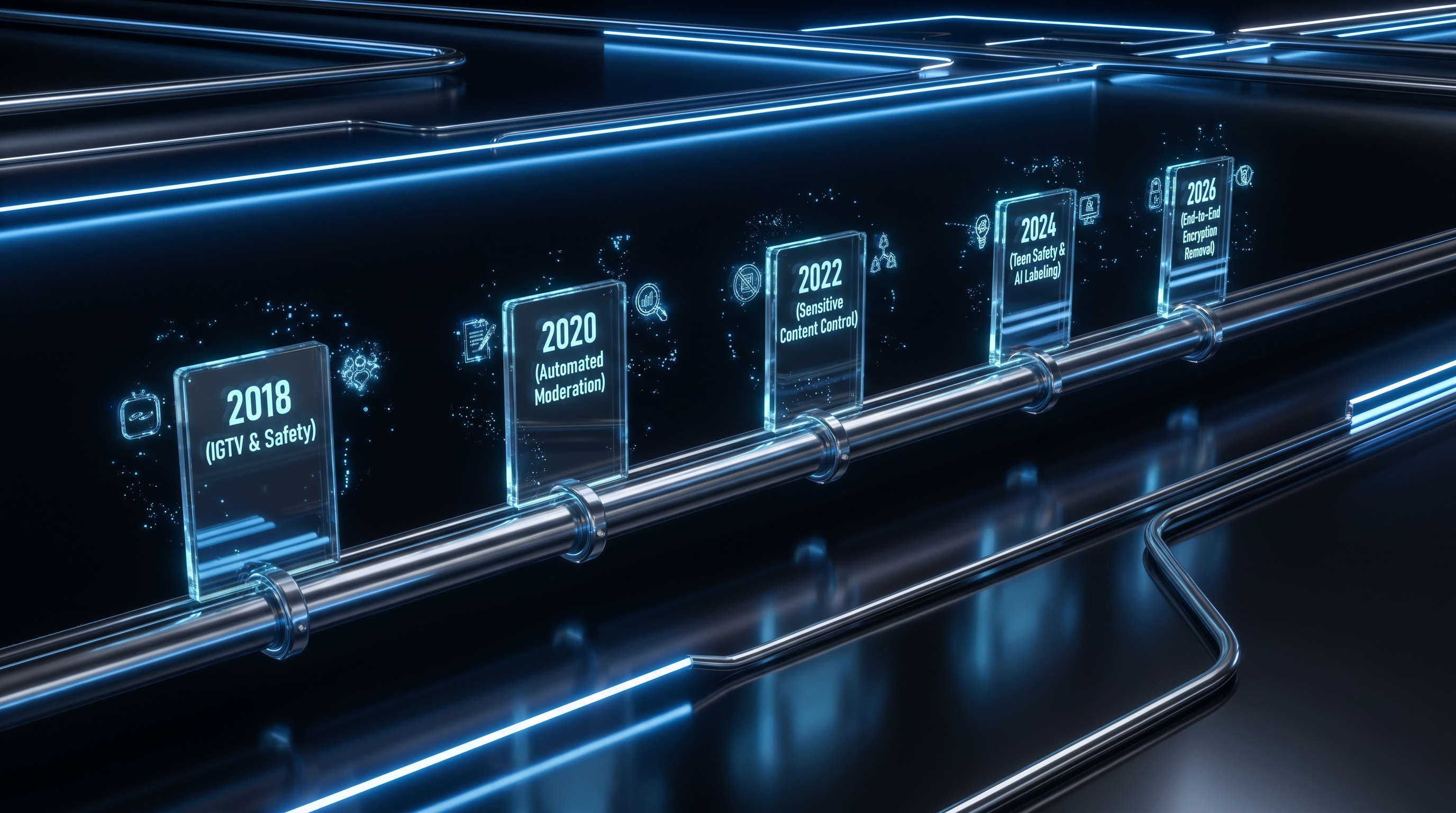
2018–2023 — PhotoDNA and the Early CSAM Framework
Instagram's enforcement infrastructure has its roots in PhotoDNA, the hash-matching technology developed by Microsoft and widely adopted by social platforms from around 2018 onward. PhotoDNA works by generating a unique digital fingerprint for known CSAM (Child Sexual Abuse Material) images and comparing every uploaded image against a database of those fingerprints maintained by NCMEC (the National Center for Missing and Exploited Children). During 2018–2023, Instagram's enforcement actions under this framework were largely confined to genuine CSAM cases — the technology was specific enough that false positives were rare, because it required near-exact matches to known images. The system was effective within its scope but limited: it could only catch content already catalogued in the NCMEC database, meaning novel content slipped through. This period established Meta's legal and procedural muscle for large-scale content enforcement, laying the infrastructure that would later be weaponised at far greater scale.
2024 — Teen Accounts and Stricter Default Privacy
In 2024, Meta introduced Instagram Teen Accounts — a parallel account type for users identified as under 16, with significantly restricted default privacy settings, no DM access from non-followers, and filtered content feeds. While the intent was protective, the implementation created new false-positive vectors. Instagram's age-detection AI began assessing the apparent age of users based on their profile behaviour, follower demographics, and content interaction patterns — and began applying Teen Account restrictions to users it classified as potentially under 16, even without explicit age verification. Businesses and creators serving youth audiences — EdTech platforms, sports coaching brands, youth fashion retailers — found their accounts subject to restrictions they hadn't consented to and couldn't easily challenge. This was the first large-scale deployment of age-inference AI on the platform, and it foreshadowed the 2025–2026 enforcement wave.
May–July 2025 — The First Major AI-Driven Ban Wave (635,000 Accounts)
The pivot to truly AI-driven enforcement happened in May 2025, when Meta quietly rolled out upgraded machine-learning filters trained not just on known-bad content hashes but on contextual signals — combinations of visual content, text, interaction patterns, and account behaviour that the AI associated with harmful use. The results were dramatic. By July 2025, Meta had removed approximately 135,000 accounts for sexualised comments or image requests involving children, plus over 500,000 linked accounts flagged as associated with predatory behaviour networks — totalling nearly 635,000 account removals in a single enforcement month [Source: social-me.co.uk/blog/42, verified April 7, 2026]. It was the first time the platform had removed accounts at this scale using primarily AI-generated evidence rather than human review. It was also the first time the false-positive rate became visible to the public, as legitimate accounts began appearing alongside genuine bad actors in the removal statistics.
October 2025 — PG-13 Filters Roll Out Globally
In October 2025, Meta extended its content filtering regime with what was internally described as PG-13 filters — an AI layer that assessed content for age-appropriateness and applied additional distribution restrictions to any content involving or targeting under-18 users. Unlike the Teen Account restrictions of 2024, the PG-13 filters applied to all accounts, not just those held by minors. Any account posting content that the AI assessed as potentially directed at or involving teenagers — regardless of whether those teenagers were the account holder's own children, students, clients, or simply members of the audience — could now face suppressed reach, action blocks, or account review triggers. This created a new wave of false-positive risk for the exactly the account categories least prepared for it: family content creators, fitness professionals, education brands, and children's product retailers [Source: medium.com/@ceo_46231/instagram-cse-bans-in-2026, verified April 2026].
January–April 2026 — False Positives Surge, $375M Court Ruling
The period from January to April 2026 saw the false-positive crisis reach mainstream visibility. Meta claimed a proactive detection rate of over 98% for policy-violating content — a figure that sounds reassuring until you consider what a 2% error rate means at billion-account scale. Thousands of legitimate accounts were being removed weekly. In March 2026, a landmark $375 million ruling by a New Mexico court found Meta liable for facilitating child exploitation on its platforms — paradoxically accelerating the company's already aggressive enforcement posture. Rather than slowing enforcement to reduce errors, Meta intensified AI-driven removal activity. The result: a feedback loop in which the legal and reputational pressure to act fast produced more collateral damage against the innocent accounts that were never the target. For DM automation users, this period marked the point at which any account with elevated engagement signals — even legitimate ones — became materially more likely to be swept up in enforcement actions.
Timeline at a Glance: Instagram Enforcement 2018–2026 | ||
Period | Key Development | Accounts Affected |
|---|---|---|
2018–2023 | PhotoDNA hash-matching; NCMEC reporting framework | CSAM cases only |
2024 | Instagram Teen Accounts launched; age-inference AI deployed | Under-16 users; youth-adjacent brands |
May–Jun 2025 | Upgraded ML contextual filters rolled out platform-wide | First large false-positive wave |
Jul 2025 | Peak enforcement — CSE + linked account sweeps | ~635,000 removed |
Oct 2025 | PG-13 filters applied globally to all accounts | Teen-adjacent content creators globally |
Jan–Mar 2026 | False positives surge; $375M New Mexico court ruling | Ongoing; non-English and family biz disproportionate |
Apr 2026 | Meta claims 98%+ proactive detection rate | 10M+ total removed; small businesses hit hardest |
Sources: Meta Transparency Reports; Social Media Experts Ltd analysis (April 7, 2026); unban.net citing official Meta data (2026).
How Meta's AI Detection System Actually Works in 2026

Hash-Matching — The PhotoDNA Layer
At the base of Meta's 2026 detection stack sits the original PhotoDNA hash-matching layer, now significantly expanded beyond its CSAM-only origins. PhotoDNA generates a perceptual hash — a fingerprint that captures the visual essence of an image while being robust to minor alterations like cropping, recolouring, or compression. Instagram compares every uploaded image against a database of known-bad image hashes maintained by NCMEC and expanded by Meta's own cataloguing of previously removed content. This layer is the most precise part of the system: a match against a known-bad hash is a high-confidence signal that requires little additional AI reasoning. However, it only catches content that has already been seen and catalogued. Novel content — new images, edited variants, or original material that shares visual characteristics with flagged content without being identical — passes through this layer to the next. For most legitimate accounts, the PhotoDNA layer is not the threat. The layers above it are.
Behavioural Analysis of DMs, Comments, and Interactions
Above the hash-matching layer sits a behavioural analysis engine that evaluates patterns of account activity rather than content alone. This system tracks DM send rates, comment frequency, interaction patterns with accounts of different demographics, follow/unfollow velocity, and the textual content of messages and comments. It is this layer that presents the most direct threat to DM automation users. When an account sends a high volume of DMs in a short window, uses templated or repetitive message text, or interacts with a large number of accounts in rapid succession, the behavioural AI registers a pattern consistent with automated bot activity and elevates the account's risk score. The practical implication: automation tools that send DMs at rates exceeding safe thresholds — or that use identical copy across every message without variation — are generating the exact behavioural fingerprint that this system is designed to detect. This is the core reason why the practices that keep DM accounts safe all revolve around humanised, rate-limited behaviour.
Cross-Platform Tracking (Instagram, Facebook, Threads, WhatsApp)
One of the most under-discussed aspects of Meta's 2026 detection system is its cross-platform scope. Instagram does not exist in isolation within Meta's infrastructure — it shares identity graphs, device identifiers, and behavioural data with Facebook, Threads, and WhatsApp. A user who has been flagged on Facebook for any reason carries that signal into Instagram's risk assessment for their account. More significantly for business users: if you manage a Facebook Business Page alongside your Instagram account and your page has received any policy warnings, that history affects your Instagram risk score. This cross-platform signal aggregation means that an Instagram account can be penalised for activity that never occurred on Instagram itself. For agencies managing multiple client accounts from the same devices or business accounts, the risk of cross-contamination between clients is real — one flagged account can elevate the risk profile of every account connected to the same Meta Business Manager. This is why the agency guide to Instagram automation in 2026 treats account isolation as a non-negotiable operating principle.
AI Context Models — Visual, Text, and Signal Fusion
The most sophisticated — and most error-prone — component of Meta's detection architecture is the context fusion model: an AI system that combines signals from visual analysis, natural language processing of text content, and behavioural data to make holistic assessments of account intent and content nature. This is the layer responsible for the majority of false positives in the 2026 wave. The model is trained to identify patterns associated with harmful behaviour, but those patterns are statistical correlations, not logical certainties. An account that posts family beach photos (visual signal: images of children in swimwear), uses comment-to-DM automation (behavioural signal: high-volume DM activity), and includes keywords like "kids" or "teen" in post captions (text signal: youth-adjacent language) may score highly on the model's harm probability output — despite being a completely legitimate family lifestyle account. The fusion of three innocuous individual signals produces a combined risk score that crosses the threshold for enforcement action. This is the mechanism behind the false positive crisis.
Why PG-13 Filters Increase False Positive Risk for Legitimate Accounts
The October 2025 PG-13 filter rollout added a content-quality assessment layer to Meta's detection stack that evaluates whether any element of a post — the image, the caption, the comments, the hashtags — is potentially inappropriate for minors, regardless of whether the account is targeting minors. This has created a new category of false positive: content that is entirely legal and appropriate for general audiences but contains visual or textual elements that the AI assesses as ambiguously age-appropriate. Fitness content showing physical exertion, fashion content featuring young-looking models, and educational content depicting children in learning environments all fall into this ambiguous zone. For accounts running DM automation campaigns in these niches, the combination of PG-13 content flags and elevated DM activity creates a compounded risk profile. The safest mitigation is to ensure your automation tool uses conservative rate limits — and to understand exactly why Instagram shadowbans and DM automation intersect the way they do.
The Three Types of Instagram Bans — And Which Triggers Each

Type 1 — CSE (Child Sexual Exploitation) Bans
CSE bans are Instagram's most severe account action — a zero-tolerance enforcement response to content or behaviour that Meta's AI associates with Child Sexual Exploitation. The consequences extend well beyond losing Instagram access: the CSE label carries reputational damage that persists even when the account is eventually reinstated, because the removal is reported to NCMEC and can appear in background checks run by employers or legal bodies. False CSE bans are documented disproportionately against family content creators, youth fitness professionals, children's clothing brands, paediatric health practitioners, and educators — all account types whose entirely legitimate content shares visual and contextual characteristics with content the AI is trained to flag. If your account operates in any of these niches, the risk is not theoretical. The mitigation strategy involves both content auditing (removing ambiguous images before they trigger a flag) and ensuring your automation tool's behaviour does not add a second risk signal on top of your content. Read more about shadowban versus real ban — how to tell the difference to understand where on the severity spectrum your situation sits.
Type 2 — Account Integrity Bans (Spam, Bots, Fake Engagement)
Account Integrity bans are the enforcement category most directly relevant to anyone using Instagram DM automation tools. These bans are triggered by behaviour patterns that Meta's AI identifies as characteristic of bot activity, spam operations, or coordinated inauthentic engagement: high DM send rates, repetitive message content, rapid follow/unfollow cycling, multi-tool stacking, and interaction patterns that don't match the natural rhythm of human account use. Unlike CSE bans, Account Integrity bans are more recoverable through the appeals process — they carry no NCMEC reporting and no external reputational damage beyond the platform itself. However, they are the single most common ban type for legitimate business accounts using automation, and they are entirely preventable with the right tool selection. An automation tool that caps DM sends at 20 per hour and uses humanised send patterns (randomised delays, varied message templates, no burst sending) produces a behavioural profile that looks indistinguishable from a manually active account. A tool that sends 100+ DMs per hour in rapid bursts produces the opposite. Understanding what triggers an Instagram action block is the first step toward avoiding one entirely.
Type 3 — Teen/Under-16 Policy Bans
The Teen/Under-16 ban category is the newest and in some ways the most insidious, because it can affect accounts that have no direct awareness of having interacted with minor users at all. Introduced as a policy enforcement mechanism alongside the Teen Accounts feature in 2024–2025, these bans are triggered when Instagram's AI determines that an account is interacting with users it has classified as under 16 in ways that violate the platform's teen protection policies — even if those interactions are entirely benign by any reasonable standard. An EdTech brand sending automated welcome DMs to new followers, some of whom Instagram has flagged as potential minors, can trigger this category of enforcement. A youth sports coaching account running a comment-to-DM campaign for a free training resource may face the same risk. The mitigation is particularly relevant for Indian accounts: children's education brands, youth fitness coaches, and family-focused D2C brands are all operating in a space where teenager users are a natural part of the audience, and the conservative DM rate limits offered by QuickDM's free plan (20 DMs/hour) significantly reduce the risk of Teen Account interaction flags accumulating to enforcement levels.
Shadowban vs. Action Block vs. Full Account Disable — Key Differences
Not every restrictive action Meta takes against an account constitutes a full ban. Understanding the spectrum of enforcement actions helps you calibrate your response correctly. A shadowban — technically called a content distribution restriction — suppresses your content's visibility in hashtag searches, the Explore feed, and recommendations without disabling your account or notifying you. You can still post, still DM, still interact; you just reach far fewer people. Shadowbans are typically triggered by spam signals (hashtag abuse, repetitive content, excessive posting frequency) and tend to self-resolve within one to two weeks with reduced activity. An action block is a more targeted restriction that prevents specific account actions — sending DMs, following users, liking posts — for a defined period, typically 24 to 72 hours. Action blocks are the typical first response to DM volume that approaches unsafe thresholds and are a strong warning signal that your automation tool's rate settings need immediate adjustment. A full account disable is the irreversible endpoint of both CSE and Account Integrity enforcement paths — your account is removed from the platform and all followers, content, and message history is inaccessible. For understanding the complete shadowban landscape for DM automation users, the key insight is that shadowbans and action blocks are warnings; full disables are the outcome you're engineering your entire workflow to prevent.
Ban Type Comparison: Severity, Triggers, and Automation Risk | ||||
Ban Type | Severity | Primary Trigger | Appeal Success Rate | Automation Risk? |
|---|---|---|---|---|
CSE Ban | Extreme | Child-related content flags, AI visual misread | Low without specialist help | Yes — tool + content combo risk |
Account Integrity | High | Bot behaviour, rate limits exceeded | Moderate | Yes — primary risk for tool users |
Teen/Under-16 | Moderate–High | Youth content, age-flagged interactions | Moderate | Low unless combined with other signals |
Shadowban | Low | Spam signals, hashtag abuse, repetitive content | Self-resolves in 1–2 weeks | Yes — early warning sign |
Action Block | Low–Moderate | Rapid unusual DM or follow activity | Self-resolves in 24–72 hours | Yes — triggered by DM volume bursts |
Most Common Triggers for False Bans — What Reddit Is Saying

Family and Children's Photos That Trip CSE Filters
The single most common trigger for false CSE bans in the 2026 wave is entirely ordinary family photography. Parents who post images of their children at beaches, pools, sports events, or family gatherings are finding that Meta's visual AI — trained to identify potential exploitation signals — is flagging content that any reasonable human reviewer would immediately dismiss. The AI's pattern-matching lacks the contextual understanding that distinguishes a family holiday photo from harmful material. Exacerbating the problem: many family content creators also use Instagram as a business tool, running comment-to-DM campaigns for brand partnerships or product promotions. The combination of child-adjacent visual content and high DM activity produces a multi-signal risk profile that accelerates enforcement action. If you run family content alongside any form of automation, an immediate audit of your content library — removing images that could be misread by an AI without full context — is a non-negotiable first step. Pair that with a tool that keeps your DM activity at safe levels, and you significantly reduce your exposure.
Fitness, Education, and Lifestyle Content With Teens
Youth fitness coaches, PE teachers, sports academies, dance studios, and EdTech brands are categorically over-represented in false-positive ban reports. Their content routinely features teenage clients, students, or participants in athletic or educational settings — imagery that is not only legal and appropriate but professionally required. Yet Meta's AI context models, trained primarily on English-language content and Western visual conventions, consistently misread this material. Instagram's own Community Guidelines explicitly permit this content — but the AI enforcement layer does not reliably implement the policy. The gap between stated policy and AI enforcement is the dangerous space these creators are occupying. Adding DM automation to this risk profile — even at low volumes — increases the likelihood that multiple signals combine to cross an enforcement threshold. The safest approach is content segmentation: maintain a clean separation between your youth-adjacent content and any accounts running automation campaigns. The complete Instagram automation setup guide covers exactly how to structure this separation in practice.
AI-Misread Comments and DMs
Meta's natural language processing layer is scanning the text of comments and DMs for signals associated with harmful behaviour — and its understanding of context, idiom, and cultural language variation is severely limited. A fitness coach who writes "killing it with these teens today 💪" in a workout post caption, or an EdTech brand whose automated DM welcome sequence mentions "under-18 discount available," can trigger the NLP layer without any intent that approaches policy violation. The problem is particularly acute for non-English content: Meta's AI models are trained disproportionately on English-language data, meaning that Hindi, Tamil, Telugu, and other Indian language content — which may use expressions, idioms, or cultural references that the AI cannot correctly parse — faces materially higher false-positive rates. This is a structural disadvantage for Indian creators that conservative DM rate limits partially mitigate, but that ultimately requires community pressure on Meta to resolve through better multilingual training data.
The "Same AI That Bans You Reviews Your Appeal" Problem
Perhaps the most demoralising aspect of the 2026 ban wave for affected users is the discovery that the appeals process offers far less recourse than it once did. Reddit threads from affected users consistently surface the same experience: an account receives an automated ban notification with no specific content cited; submits an appeal through the in-app form; receives a response within hours confirming the ban — from a system that appears to have reviewed the appeal using the same AI logic that made the original decision. Human review is now reserved for escalated cases only, and reaching a human reviewer requires either Meta Verified subscription (which provides priority support) or sufficiently persistent escalation through external channels. One frequently quoted user put it bluntly: "The same AI that banned me is also reviewing my appeal." For DM automation users, this reinforces a single strategic conclusion: prevention is vastly cheaper than recovery. A tool built to stay within safe thresholds eliminates the need to navigate an appeals process that is, by design, stacked against you.
Multi-Tool Use and Device/IP Tracking Risks
A specific and increasingly documented trigger for Account Integrity bans is the combination of multiple automation tools operating on the same Instagram account simultaneously. Each tool that connects to your account leaves an API access footprint that Meta can see. When two or more tools are accessing your account at the same time — or in rapid alternation — the combined API call pattern resembles the behaviour of a coordinated bot operation even when each individual tool is entirely within its own rate limits. Meta's systems also track device identifiers and IP addresses: if the same device or IP has been associated with previously banned accounts, any new account operating from that environment inherits elevated risk. For agencies managing multiple client accounts, this creates a contamination risk: one client's ban can elevate the risk score of every other client account accessed from the same infrastructure. The detailed framework for why using multiple automation tools gets accounts banned should be required reading for every agency team before onboarding any new client automation workflow.
Real user voices from Reddit (anonymised):
"The ban wave is getting ridiculous — can't even appeal without sending a video selfie."
"Same AI that banned me is also reviewing my appeal."
"Career and reputation ruined overnight by a false CSE ban."
"Meta's broken AI is coming for everyone."
Source: r/Instagram community threads, May 2026. Usernames anonymised.
Safe DM Automation — What the Numbers Actually Mean

What Meta's Graph API Rate Limits Actually Say
Meta's official Graph API documentation for the Instagram Messaging API specifies rate limits for DM sending — but the precise numeric thresholds are not published as simple public figures; they are documented as dynamic limits that vary by account age, follower count, engagement history, and account type. What is documented is a hard ceiling of approximately 200 DMs per hour for the highest-tier accounts using the official API [Source: developers.facebook.com/docs/instagram-api/rate-limiting — manual verification required before publish]. The 200/hour ceiling is the absolute maximum, reserved for large verified business accounts with established API access histories. For the vast majority of accounts — including growing businesses, influencers, and agencies — the effective safe ceiling is dramatically lower. The community consensus among Instagram API developers and automation tool builders places the practical safe threshold for mid-sized accounts at 20–50 DMs per hour, with 20 DMs/hour being the universally cited conservative safe standard. This is exactly the rate at which QuickDM's free plan is engineered to operate.
The Danger Zone — DM Volumes That Trigger Account Integrity Flags
The threshold at which Meta's behavioural AI begins flagging accounts for potential spam activity is not a published number, but the evidence from real-world account actions gives us a reasonably clear picture. Accounts sending more than 50 DMs per hour begin entering territory where Instagram's systems register elevated spam probability, particularly if the messages are identical or near-identical in content. Above 100 DMs per hour, the risk of receiving an action block within 24 hours is high for accounts without significant historical trust signals. Above 200 DMs per hour — or with any combination of high volume plus repetitive content plus new account age — permanent account integrity bans become likely. The tool that poses the most visible risk in this regard is InstantDM, whose paid tier permits up to 750 DMs per hour — more than three times Meta's published ceiling for even the highest-tier accounts. Operating at that volume is not automation; it is a near-certain trigger for enforcement action. Understanding exactly what triggers an Instagram action block is essential reading before you choose any automation tool.
The Safe Zone — Industry-Recommended Maximum Thresholds
The industry consensus for safe DM automation — drawn from the experiences of thousands of accounts, the documentation of automation tool builders, and the patterns visible in enforcement actions — converges on a clear safe zone: 1–20 DMs per hour, with randomised delays between sends and variation in message content. At this rate, your account's DM behaviour is statistically indistinguishable from a highly active human user who responds promptly to every comment and DM trigger. You generate no burst-send patterns, no API call signatures associated with automation tools, and no repetitive content flags. This is the rate at which QuickDM's free plan operates by design — not as a limitation, but as an engineering choice that reflects exactly this safety calculus. The Pro plan operates at up to 185 DMs per hour, which is appropriate for high-volume business accounts with established account histories and is still deliberately kept below Meta's 200/hour ceiling. For a detailed comparison of how every major DM automation tool handles rate limiting, see our full tool comparison below.
Why 20 DMs/Hour Is the Engineering Standard for Safety
The selection of 20 DMs per hour as QuickDM's free plan ceiling is not arbitrary — it reflects a deliberate engineering philosophy rooted in the principle that a DM automation tool should never be the reason a client's account gets flagged. At 20 DMs per hour, an account running continuous automation for 8 hours sends 160 DMs per day — a volume that matches or exceeds what any human SMM professional could realistically produce manually, while remaining within behavioural norms that Meta's AI does not flag as suspicious. The rate is also calibrated to be safe for new accounts, which face tighter informal thresholds than established accounts with years of API access history. For an Indian startup with a two-year-old Instagram account running their first DM campaign, 20 DMs per hour is not just safe — it is the responsible maximum. Tools that offer 750 DMs per hour are optimising for throughput at the cost of your account's safety. QuickDM optimises in the opposite direction.
Cooldowns, Delays, and Burst Prevention — How Safe Tools Are Built
Beyond raw DM volume, safe automation tools implement a suite of additional protective mechanisms that distinguish human-like DM behaviour from bot patterns. Randomised delays insert variable pauses between individual DM sends — instead of sending a DM every exactly 3 minutes, the tool sends one at 2 minutes 47 seconds, another at 3 minutes 14 seconds, creating the irregular timing rhythm that characterises human activity. Content variation uses dynamic templates that personalise messages with recipient usernames, post-specific references, or time-of-day variables, ensuring that no two DMs are identical even when they serve the same automation purpose. Burst prevention stops the tool from sending multiple DMs in rapid succession when a batch of comment triggers fires simultaneously — the messages are queued and released at the safe rate rather than sent all at once. Cooldown periods enforce rest windows after reaching a daily DM threshold, preventing the cumulative high-volume patterns that can trigger enforcement even when hourly rates are within safe limits. All of these mechanisms are part of QuickDM's core automation architecture.
DM Rate Thresholds: Safety Guide for Instagram Automation | ||
Volume (DMs/hour) | Risk Level | Notes |
|---|---|---|
1–20 DMs/hour | ✅ Safe | QuickDM Free tier; well under API thresholds; safe for all account ages |
21–50 DMs/hour | ⚠️ Caution | Approaching flag territory; use with randomised delays; established accounts only |
51–100 DMs/hour | 🔴 High Risk | Triggers account integrity checks for most account ages; action block likely |
100+ DMs/hour | 🚫 Danger | Near-certain action block or suspension; avoid entirely for normal accounts |
Note: Thresholds vary by account age, follower count, and engagement history. Always err toward the conservative end.
Tool-by-Tool Risk and Pricing Reality Check
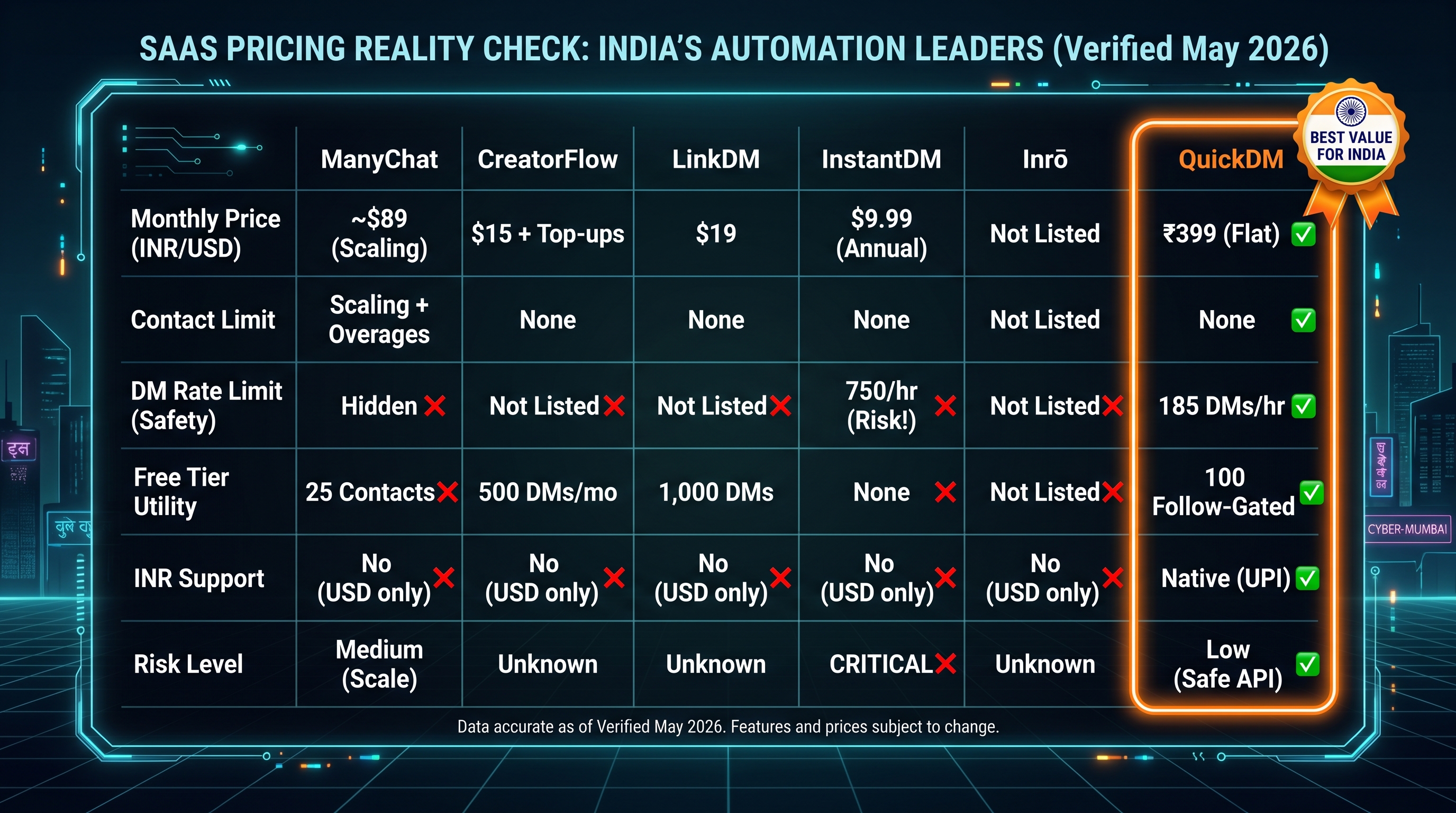
ManyChat — Powerful but Expensive and Risky at Scale
ManyChat is the market leader in Instagram DM automation by installed base and brand recognition, but its dominance comes with significant caveats in the 2026 context. Its per-contact billing model means that your monthly cost scales unpredictably with audience growth: a creator who starts on the Essential plan at $14/month and grows their contact list to 1,000 contacts faces overages of up to $75/month, bringing their real cost to $89/month or more [Source: manychat.com/pricing, verified May 2026]. For Indian creators converting to rupees, that translates to approximately ₹7,440/month — nearly 20 times the cost of QuickDM Pro. ManyChat's free tier limits automations to 4 and contacts to 25, making it effectively a trial with a very short shelf life. For a complete analysis of how QuickDM compares to ManyChat on every feature dimension, including rate limits, pricing, and safety architecture, our dedicated comparison page covers the full picture.
CreatorFlow — Good for Pure IG DM, Limited Safety Features
CreatorFlow is a focused Instagram DM automation tool with a cleaner pricing model than ManyChat — flat rate, no per-contact fees — but its free tier hard-caps DMs at 500 per month, which at peak usage translates to approximately 16 DMs per day. The Pro plan at $15/month [Source: creatorflow.so/pricing, verified May 2026] allows 5,000 DMs per month and the Growth plan at $30/month allows 10,000. CreatorFlow's DM cap model means that high-volume users will consistently need to pay for top-up packs, making the effective monthly cost less predictable than its headline pricing suggests. The tool has a 4.2/5 Trustpilot score, though from only 8 reviews — an insufficient sample for reliable quality assessment. Crucially, CreatorFlow does not publish its DM rate limit (per-hour send cap) in its documentation, which makes it impossible to independently verify whether it operates within safe API thresholds. For the detailed head-to-head, see QuickDM vs CreatorFlow full comparison.
LinkDM — Generous Free Tier, Watch the DM Volume
LinkDM offers the most generous free tier among QuickDM's competitors in absolute DM volume terms — 1,000 DMs per month on the free plan — but that headline figure requires context. The free plan is limited to a single Instagram account, requires LinkDM branding on all automated messages, and does not include follow-gating or email collection. The Pro plan at $19/month [Source: linkdm.com/pricing, verified May 2026] allows 25,000 DMs across three accounts. Like CreatorFlow, LinkDM does not publish per-hour send rate limits, which is a transparency gap that should concern safety-conscious users. The platform has a 3.5/5 Trustpilot score from just four reviews — not a meaningful quality signal. For Indian businesses evaluating LinkDM alternatives for India, the absence of INR pricing and the higher entry cost make it a difficult choice compared to QuickDM's ₹399/month Pro plan.
InstantDM — Budget Option, UI and Safety Mode Concerns
InstantDM positions itself as the budget option at $9.99/month (annual billing) [Source: instantdm.com/pricing, verified May 2026], and for users who don't read the documentation carefully, it appears comparable to QuickDM on price. However, a critical detail changes the risk calculus entirely: InstantDM's paid tier permits up to 750 DMs per hour — more than three times Meta's published maximum API ceiling of 200 DMs/hour for the highest-tier accounts. Operating an automation tool at 750 DMs per hour is not Instagram automation; it is a near-certain path to an Account Integrity ban for any account that is not a large enterprise with an established Meta Business API relationship. InstantDM's Trustpilot score of 4.4/5 is the best among the budget tools, but UI concerns are noted in reviews, and the safety implications of the 750/hour cap are absent from the tool's own marketing materials.
Inrō — Meta-Approved But Early-Stage; EUR-Only Pricing
Inrō is a newer entrant to the Instagram DM automation space that emphasises its Meta API compliance — a legitimate and important credential. However, its current feature set and market presence are both early-stage. The free plan allows only 100 active contacts per month and 3 automations — the most restrictive free tier in the comparison [Source: inro.social/pricing, verified May 2026]. The Pro plan at €12.99/month is priced in EUR only, with no USD or INR equivalent on the pricing page, making it an awkward choice for Indian and North American users dealing with conversion costs and uncertainty. With only 1 Trustpilot review, there is no meaningful community feedback to evaluate service quality. Inrō's Meta API compliance claim is credible but not unique — QuickDM also operates through the official Meta Graph API and adds the advantage of INR pricing and Mumbai-based support.
QuickDM — Built for Safety, Built for India
QuickDM is the only Instagram DM automation tool in this comparison that was built specifically with the Indian market's needs in mind — native INR pricing at ₹399/month for Pro, Mumbai headquarters, and a free plan designed to give Indian creators genuine utility without requiring a credit card or a USD payment method. On safety architecture, QuickDM's 20 DMs/hour cap on the free plan is the most conservative in the market and is explicitly engineered to keep accounts well within safe API thresholds. The Pro plan scales to 185 DMs/hour — close to Meta's 200/hour ceiling but maintaining a safety buffer — for high-volume business accounts with the follower count and account history to support it. Unlike ManyChat's per-contact billing model, QuickDM charges a flat monthly rate with no overages, making costs fully predictable. The free plan includes features — follow-gating for up to 100 followers, email collection for up to 100 contacts, unlimited comment-to-DM automation — that competing tools restrict to paid tiers. For a complete breakdown of the best Instagram DM automation tools in 2026, QuickDM's combination of safety architecture, India pricing, and free plan generosity consistently puts it at the top of the ranking for Indian and cost-conscious global users.
Full Competitor Comparison — Instagram DM Automation Tools 2026 (Data verified May 2026) | ||||||
Feature | QuickDM | ManyChat | CreatorFlow | LinkDM | InstantDM | Inrō |
|---|---|---|---|---|---|---|
Free plan | ✅ Yes | ✅ Yes | ✅ Yes | ✅ Yes | ✅ Yes | ✅ Yes |
Free DM limit | 20/hour (unlimited total*) | 25 contacts/mo | 500 DMs/mo | 1,000 DMs/mo | 500 automations/mo | 100 contacts/mo |
Paid plan starts at | ₹399/mo ($10) | $14/mo | $15/mo | $19/mo | $9.99/mo (annual) | €12.99/mo |
INR pricing | ✅ Yes | ❌ USD only | ❌ USD only | ❌ USD only | ❌ USD only | ❌ EUR only |
Follow-gating (free) | ✅ Up to 100 | ❌ Paid only | ❌ Paid only | ❌ Paid only | ❌ [unverified] | ❌ Paid only |
Email collection (free) | ✅ Up to 100 | ❌ Paid only | ❌ Paid only | ❌ Paid only | ❌ [unverified] | ❌ Paid only |
Safe DM rate cap | 20/hr (engineered safe cap) | Unspecified | Unspecified | Unspecified | 750/hr (paid) ⚠️ | Unspecified |
Per-contact billing | ❌ No overages | ✅ Yes (overage risk) | ❌ No | ❌ No | ❌ No | ✅ Yes |
Trustpilot rating | [pending] | 2.6/5 (265 reviews) | 4.2/5 (8 reviews) | 3.5/5 (4 reviews) | 4.4/5 (~20 reviews) | 3.5/5 (1 review) |
HQ / currency | Mumbai / INR | USA / USD | USA / USD | USA / USD | USA / USD | EU / EUR |
⚠️ Data verification: ManyChat pricing verified at manychat.com/pricing; CreatorFlow at creatorflow.so/pricing; LinkDM at linkdm.com/pricing; InstantDM at instantdm.com/pricing; Inrō at inro.social/pricing. All accessed May 2026. Review counts from Trustpilot/G2 snippets — partial data (some pages bot-blocked). Cells marked [unverified] require manual confirmation before publish.
Try QuickDM Free — 20 DMs/hour, zero credit card, forever free.
Start Free Today → quickdm.app/auth/signup
ManyChat Deep Dive — Why the World's Biggest Tool Has a 2.6 Trustpilot Score

ManyChat's Per-Contact Billing — The Hidden Cost Spiral
ManyChat's pricing model contains a structural trap that its headline numbers obscure: per-contact overage billing. The Essential plan appears accessible at $14/month — until you read the fine print that reveals the base plan covers only 250 contacts, with every additional contact costing $0.10/month. A growing creator with 1,000 contacts is paying $14 base + $75 in overages = $89/month. A brand with 5,000 contacts on the Pro plan ($29/month for 2,500 contacts) is paying $29 + $125 overage = $154/month. This billing model is fundamentally misaligned with the growth trajectory of any successful Instagram automation user: the better your automation performs, the more contacts you acquire, and the higher your bill spirals. For Indian creators, where INR margins and lower average revenue per follower make cost predictability essential, this model is particularly punishing. The cheapest ManyChat alternative in 2026 that avoids this billing trap entirely is QuickDM, which charges a flat ₹399/month with zero overages regardless of contact count. [Source: manychat.com/pricing, verified May 2026]
What ManyChat's 265 Trustpilot Reviews Actually Say
ManyChat's 2.6/5 Trustpilot rating from 265 reviews is one of the most striking data points in the Instagram automation tool market. For the world's most widely used DM automation platform, a sub-3.0 score on a major review platform is a significant trust signal — particularly given that Trustpilot ratings skew positive (unhappy users are more motivated to leave reviews, but so are advocates). Analysis of the review themes shows billing complaints — unexpected overages, difficulty cancelling subscriptions, and opaque pricing escalations — as the dominant negative category. A secondary cluster of complaints involves customer support responsiveness, with multiple reviewers citing multi-day response times for billing issues and account-level problems. Safety-related complaints (accounts facing action after using ManyChat) also appear, though they represent a smaller proportion of reviews. For a full examination of the best ManyChat alternatives for Instagram, including how each compares on support quality and billing transparency, our dedicated comparison covers every dimension. [Source: trustpilot.com/review/manychat.com, verified May 2026]
ManyChat Free Plan: 25 Contacts vs. QuickDM's Unlimited Automations
The contrast between ManyChat's free plan and QuickDM's free plan is stark and directly relevant to any creator or business evaluating both tools. ManyChat's free plan allows a maximum of 25 contacts and 4 automation flows — a threshold you can exhaust in the first few days of active use, after which every new contact requires a paid upgrade. The plan also mandates ManyChat branding on all automated messages, reducing the professional appearance of every interaction. QuickDM's free plan, by contrast, includes unlimited automation flows, unlimited comment-to-DM triggers, 20 DMs/hour (no monthly cap on automations), follow-gating for up to 100 followers, and email collection for up to 100 contacts — all with no credit card required and no ManyChat-style branding requirement. For an Indian D2C brand or creator starting out, this is not a marginal difference; it is the difference between a genuine working automation setup and a heavily constrained trial. For the complete ManyChat vs QuickDM pricing breakdown, including feature-by-feature analysis, see our dedicated comparison.
When ManyChat Makes Sense (And When It Doesn't)
ManyChat's market leadership is not without justification — for large enterprises running complex multi-platform automation across Instagram, Facebook Messenger, and WhatsApp simultaneously, ManyChat's feature depth and integrations are genuinely unmatched. If your automation needs span multiple Meta platforms, require deep CRM integrations (HubSpot, Salesforce), and involve complex multi-step flows with A/B testing at scale, ManyChat's Business tier ($69–$139/month) offers capabilities that no competitor currently matches. The calculus changes dramatically for Instagram-only or Instagram-primary use cases. For a creator or SMB whose automation needs are comment-to-DM flows, follow-gating, and email collection on Instagram — which covers 90% of the market — ManyChat's cost and complexity overhead is entirely unjustified. The right tool for Instagram-only use cases is one built for Instagram, not one that started with Messenger and expanded to Instagram as an afterthought.
QuickDM as the ManyChat Alternative for IG-Only Use Cases
QuickDM was built from the ground up for Instagram DM automation — not as a Messenger tool that added Instagram support, but as an Instagram-first product designed for the specific patterns, rate limits, and engagement dynamics of the platform. For the 90%+ of SMBs, creators, and agencies whose automation needs are Instagram-specific, QuickDM offers every core capability at a fraction of ManyChat's cost: comment-to-DM triggers, follow-gating, email collection, unlimited automation flows, and a conservative rate limit architecture that actively protects accounts from enforcement actions. At ₹399/month for Pro (vs. ManyChat's equivalent tier at ₹1,170–₹7,440/month depending on contact volume), the value differential for Indian users is overwhelming. For agencies comparing how QuickDM compares to ManyChat across client account management, multi-account support, and pricing at scale, the full comparison makes the case in detail.
The India Angle — Why Indian Creators and Businesses Need a Different Tool

ManyChat Costs ₹5,400+/mo — QuickDM Pro Is ₹399/mo
For Indian Instagram creators and businesses, the pricing gap between ManyChat and QuickDM is not a marginal difference — it is the difference between a tool that is financially viable and one that is not. ManyChat's Business tier, which is what a growing Indian D2C brand with a few thousand contacts would realistically need, costs $69/month at the base price. At current exchange rates, that translates to approximately ₹5,760/month before accounting for international transaction fees typically charged by Indian banks (1–3.5%), the GST complexity of USD billing, and the currency conversion risk that makes USD-priced subscriptions more expensive in rupees during periods of rupee depreciation. A brand that runs that subscription for 12 months faces a total tool cost of ₹69,000+ per year — before overages. QuickDM Pro costs ₹399/month flat, billed in INR with no conversion risk or overage fees, totalling ₹4,788/year. The annual saving — over ₹64,000 — is not a discount; it is capital that an Indian startup can deploy toward inventory, content creation, or advertising. This is the economic reality that makes DM automation for Indian creators a completely different conversation than the same topic in the US market. [Source: manychat.com/pricing, verified May 2026]
INR Pricing, GST Compliance, and the India-First Advantage
QuickDM is the only Instagram DM automation tool in the market offering native INR pricing — ₹399/month for Pro, charged in Indian rupees, invoiced for GST compliance, from a Mumbai-based company. This matters for several interconnected reasons. First, INR pricing eliminates currency conversion fees and exchange rate volatility from your tool budget — what you see is what you pay, every month, with no surprises. Second, a Mumbai-based company issues invoices under Indian GST regulations, which means the subscription can be claimed as a business expense with a valid GST credit — an important consideration for registered businesses and agencies whose USD-billed tool subscriptions currently sit in a compliance grey area. Third, an India-based team means support operates in Indian time zones, understands Indian business contexts (Diwali campaign rushes, IPL marketing windows, monsoon season D2C patterns), and builds features with Indian market use cases as first-class priorities. No other tool in this comparison offers all three of these advantages simultaneously.
Instagram DM Automation for Indian D2C Brands
India's D2C ecosystem has grown explosively on Instagram — fashion brands, skincare labels, food startups, home décor businesses, and artisan product sellers all rely on Instagram as their primary customer acquisition channel. For these brands, DM automation is not a luxury feature; it is an operational necessity. When a new collection drops and 500 comments arrive in an hour asking "How to order?", manual DM responses are impossible. A comment-to-DM flow that instantly delivers product links, size guides, or purchase instructions to every commenter — without exceeding safe rate limits — is the difference between converting those leads and losing them to competitors who responded faster. QuickDM's free plan provides exactly this capability with no upfront cost, making it the logical starting tool for any Indian D2C brand beginning its Instagram automation journey. For brands ready to scale, the Pro plan at ₹399/month adds higher DM volume capacity, extended email collection, and priority support — all for less than the monthly cost of a single Metro rail commuter pass in Mumbai. For a full guide to the best Instagram automation tools for Indian small businesses, the comparison consistently highlights QuickDM's price-to-feature ratio as unmatched in the Indian market.
Regional Use Cases: Fashion, EdTech, F&B, Fitness, Influencer Marketing
Indian Instagram use cases for DM automation span every major vertical, and QuickDM's feature set addresses each of them specifically. Fashion and lifestyle brands use comment-to-DM automation to deliver product links and catalogue PDFs instantly when followers comment keywords like "Price?" or "Link?" on new collection posts — a workflow that converts casual engagement into active purchase consideration. EdTech and coaching businesses use follow-gating to require followers to follow the account before receiving free resource downloads (study guides, course outlines, webinar links), building their follower base while qualifying leads. F&B brands and restaurant accounts use DM automation for menu inquiries, table reservation links, and offer notifications — converting Instagram followers into actual customers with zero manual response time. Fitness influencers use email collection to build subscriber lists for paid programme launches, creating a Meta-independent audience that survives any Instagram account action. And influencer marketing agencies use multi-account management to handle DM campaigns for multiple creator clients, with QuickDM's conservative rate limits ensuring no single client's campaign creates risk for the others. All of these use cases are covered in the practical Instagram DM automation guide for Indian creators.
How Indian Creators Are Using Follow-Gating and Email Collection on the Free Plan
Follow-gating and email collection — both available on QuickDM's free plan — are particularly high-value features for Indian creators building audiences from scratch. Follow-gating creates a simple value exchange: a follower comments on a post, the automation checks whether they follow the account, and if not, sends a DM requesting a follow in exchange for the promised free resource. This converts content reach into follower growth without requiring any advertising spend — critical for Indian creators operating on tight budgets. Email collection via DM automation works by extending the follow-gating flow: after the user follows and receives their free resource, a subsequent DM in the same flow asks for their email address to send additional content. The captured emails go into a list that the creator owns independently of Instagram — a platform-proof asset that retains its value regardless of any future algorithm changes or account actions. The free plan captures up to 100 emails, which is sufficient for a creator in early-stage growth to build a meaningful seed list before upgrading. For a detailed walkthrough of how to implement these flows, the step-by-step comment trigger setup guide covers the full technical process from start to finish. [CTA: Start collecting leads on Instagram for free — no credit card, no catch → https://quickdm.app/auth/signup]
Competitor INR Equivalent Pricing Table (May 2026) | |||
Tool | USD Price | INR Equivalent (approx) | INR Native? |
|---|---|---|---|
QuickDM Pro | $10/mo | ₹399/mo | ✅ Yes |
ManyChat Essential | $14/mo | ~₹1,170/mo | ❌ No |
ManyChat Pro | $29/mo | ~₹2,420/mo | ❌ No |
ManyChat Business | $69/mo | ~₹5,760/mo | ❌ No |
CreatorFlow Pro | $15/mo | ~₹1,250/mo | ❌ No |
LinkDM Pro | $19/mo | ~₹1,585/mo | ❌ No |
Inrō Pro | €12.99/mo | ~₹1,190/mo | ❌ No |
QuickDM Pro — ₹399/month. Made in Mumbai. Built for India.
Start Free, Upgrade When Ready → quickdm.app/auth/signup
Safe Automation Design — A Framework for Staying Off Meta's Radar
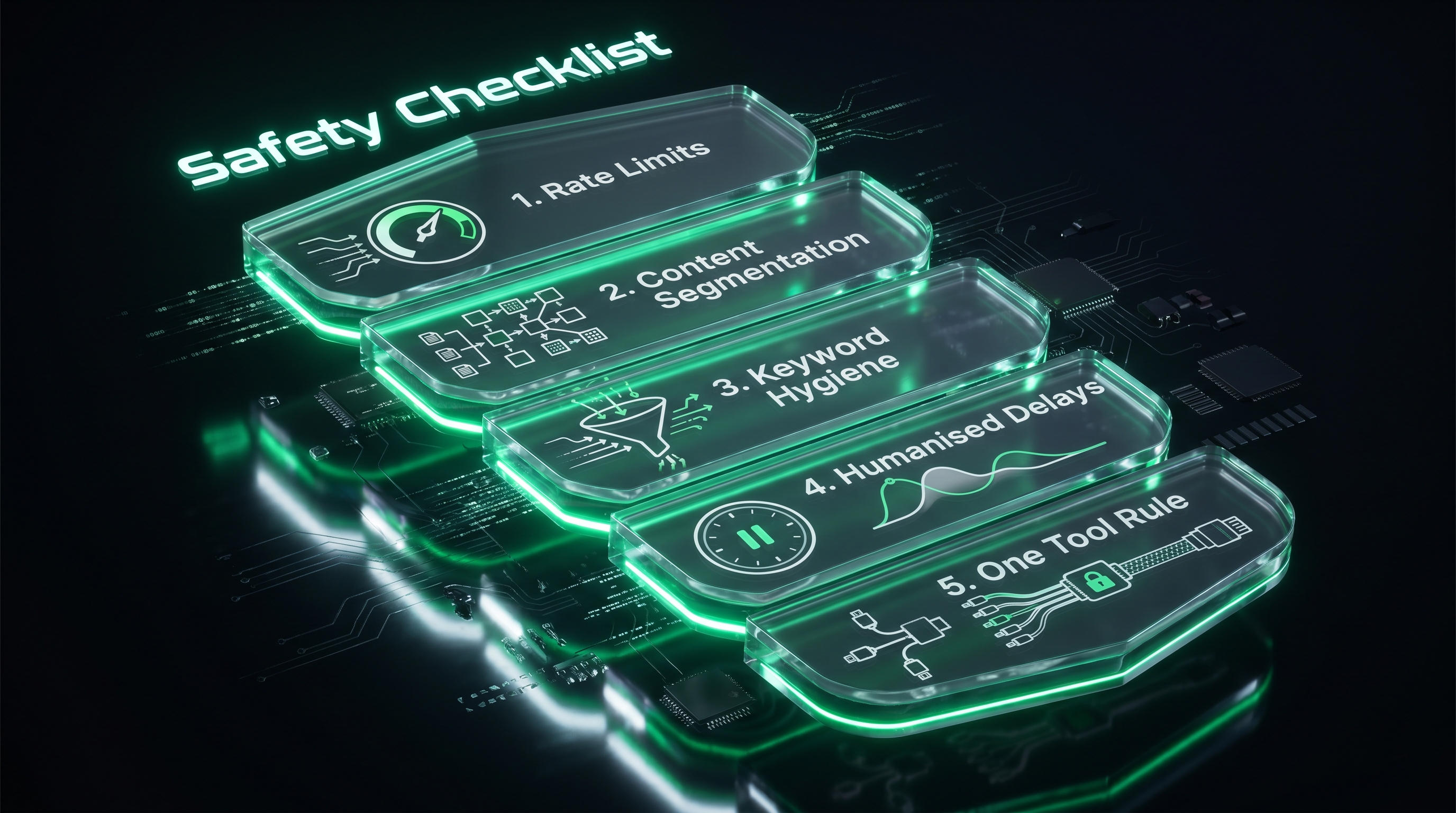
The Five-Layer Safety Stack for Instagram DM Automation
Building a safe Instagram DM automation workflow in 2026 requires thinking in layers — not just choosing a single safe tool and assuming the work is done. The five-layer safety stack is a framework for systematically eliminating every source of enforcement risk across your account. Layer one is rate limit compliance: your automation tool must cap DM sends at 20/hour or below for free accounts, with no burst-sending capability. Layer two is content segmentation: your automated DM campaigns must never be paired with content that includes youth-adjacent imagery, sensitive keywords, or ambiguous age signals. Layer three is keyword hygiene: your DM message templates and post captions must be reviewed against the keyword categories that Meta's NLP layer flags as potentially harmful. Layer four is humanised send patterns: your tool must implement randomised delays, message variation, and natural send timing rather than mechanical, perfectly-timed automation. Layer five is the one-tool rule: your account must connect to exactly one automation tool at any time — never multiple tools simultaneously. Each layer independently reduces your ban risk; all five together create an account safety profile that is, in practical terms, enforcement-resistant. For more on how to DM without sounding like a bot — which covers Layers 3 and 4 in detail — the dedicated guide includes templating examples and timing configuration.
Content Segmentation — Don't Mix Sensitive Content With High-Volume Funnels
Content segmentation is the practice of maintaining a clean operational boundary between the content categories your account posts and the DM automation campaigns you run. The risk you are managing is signal combination: a single risk signal from your content (an image of a child at a birthday party) plus a single risk signal from your automation behaviour (100 DMs triggered in an hour after the post goes viral) can combine to produce an enforcement-level risk score even though neither signal alone would trigger action. The segmentation solution is straightforward: if your content for a given week includes youth-adjacent imagery (family photos, school content, youth sports), reduce your DM automation activity during that period. If you're running a high-volume DM campaign for a product launch, avoid posting ambiguous content during that campaign window. This is not about suppressing your content variety — it's about ensuring that your two risk channels (content and behaviour) don't peak simultaneously. For agencies running campaigns across multiple client accounts, this segmentation logic extends to client-level risk isolation: one client's youth-adjacent content should not share automation infrastructure with another client's high-volume DM campaign.
Keyword Hygiene — Terms That Trigger CSE and Account Integrity Flags
Meta's NLP layer maintains a dynamic list of keyword patterns associated with harmful content categories — but the list is not public, and its scope extends well beyond obvious terms. In the context of the 2026 enforcement wave, two categories of keyword risk are particularly relevant for legitimate accounts. The first is youth-adjacent language: terms like "kids", "teens", "under 18", "young", "youth", "student", and related variants in DM templates or post captions can elevate an account's youth-interaction risk score when combined with high DM volume. The second is engagement urgency language: phrases like "act now", "limited time", "DM me immediately", and similar high-pressure terms are associated with spam and predatory behaviour patterns in Meta's training data, even when used in entirely legitimate marketing contexts. Cleaning your DM templates of both categories — replacing youth references with age-neutral language and urgency language with benefit-focused copy — is a simple, low-cost hygiene step that measurably reduces NLP-layer risk. The DM automation practices that keep accounts safe guide includes a full keyword hygiene checklist with replacement suggestions for each risk category.
Randomised Delays and Humanised Send Patterns
The technical fingerprint of bot behaviour is regularity — messages sent at perfectly consistent intervals, responses triggered within milliseconds of a comment, follow actions executed at machine precision. Meta's behavioural AI is trained specifically to detect this regularity as a spam signal. The counter-strategy is deliberate irregularity: introducing randomised delays between DM sends (varying send timing by ±30–90 seconds around a base interval), adding variable response timing for comment-to-DM triggers (some immediate, some delayed by 1–3 minutes), and rotating between 3–5 message template variants rather than sending identical copy to every recipient. These humanisation techniques are not merely cosmetic — they produce a behavioural API call pattern that is statistically indistinguishable from a manually active account, preventing the regularity signature that triggers enforcement flags. QuickDM's automation engine implements all of these techniques by default, which is one of the architectural reasons why accounts running QuickDM produce cleaner safety profiles than accounts running tools without these protections built in.
The "One Tool" Rule — Why Multi-Tool Stacking Gets Accounts Banned
The one-tool rule is simple to state and frequently violated by users who don't understand why it matters: never connect more than one automation tool to your Instagram account at the same time. The reason is not about feature redundancy — it's about API footprint. Every tool that connects to your Instagram account via the Meta Graph API leaves a distinct developer app fingerprint in your account's API access log. Meta's systems can see how many third-party apps are accessing your account, at what frequency, and with what permission scopes. When multiple automation tools are accessing the same account simultaneously, the combined API call pattern resembles the infrastructure of a bot operation — even if each individual tool is operating within its own rate limits. The combined signal crosses enforcement thresholds that no single tool would approach alone. For a detailed explanation of why using multiple automation tools gets accounts banned, including specific API signature patterns and how to safely migrate between tools without creating a multi-tool risk window, the dedicated guide covers the complete technical picture.
What Different Stakeholders Are Saying About the 2026 Ban Wave

Meta's Official Position — "Child Safety Is Our Top Priority"
Meta's official communications around the 2026 enforcement wave have been consistent in framing the crackdown as a child safety imperative. The company's Transparency Reports cite proactive detection rates of over 98% for CSE-related content violations — a figure Meta presents as evidence of the effectiveness of its AI systems. Meta has emphasised its investment in AI-powered content moderation, its NCMEC reporting obligations, and the scale of its child safety team as evidence of good-faith enforcement. What the official statements do not address is the false-positive crisis: the number of legitimate accounts being removed and the adequacy (or inadequacy) of the appeals process for affected users. Meta's position is that the false-positive rate is an acceptable cost of operating at the scale required to address genuine CSAM and CSE content. Critics argue that "acceptable" is a judgement that should involve the affected users, not be made unilaterally by the platform. The Meta Oversight Board has reviewed specific high-profile CSE-adjacent cases and published decisions that provide some transparency into the decision-making framework — but these decisions address individual cases rather than the systemic false-positive problem.
Brands and Advertisers — Quietly Reducing Instagram Budgets
The business community's response to the 2026 ban wave has been largely pragmatic and largely unpublicised. Marketing teams at large brands are not issuing press releases about Instagram risk; they are quietly diversifying their social media budget allocations, increasing investment in TikTok, YouTube, Pinterest, and owned channels (email, SMS, WhatsApp), and reducing their dependence on Instagram as the sole organic reach channel. The financial logic is clear: if a brand's Instagram account — representing years of follower growth, content library, and engagement history — can be removed by an AI system with limited human oversight and a degraded appeals process, concentration risk management requires treating Instagram as one channel in a portfolio rather than the portfolio itself. This institutional behaviour shift is happening below the surface of public marketing discourse, but it is visible in media budget reallocation data and in the growth trajectory of Instagram's competitors.
Influencers and SMM Professionals — "One Flag Wipes Out Months of Work"
For individual influencers and freelance social media managers, the 2026 ban wave represents an existential professional risk that the corporate PR framing of the crisis completely misses. A micro-influencer with 50,000 followers who has built their audience over three years — and whose entire income depends on that platform presence through brand partnerships, affiliate commissions, and course sales — faces a complete income disruption if their account is wrongly removed. Unlike a large brand that can absorb a temporary Instagram outage and redirect customers to other channels, an individual creator with no email list, no alternative platform presence, and no financial reserve cannot survive a multi-week account removal and appeal process. The community response has been a growing emphasis on audience diversification — building email lists, moving community engagement to owned platforms, and treating Instagram as a discovery layer rather than a destination. This is why using DM automation to collect emails and promote affiliate products has become an important strategic priority for creators who understand the risk landscape.
Digital Rights Lawyers — Calling for Human Oversight and Independent Audits
The legal and digital rights community has been more vocal than the business community in criticising the structure of Meta's 2026 enforcement regime. Digital rights organisations and academic researchers have highlighted several systemic concerns: the absence of meaningful human review in the ban and appeals process, the lack of transparency about the specific content or signals that triggered individual account removals, the disproportionate impact on non-English-language content (which faces higher false-positive rates due to AI training data imbalances), and the absence of independent audit mechanisms for Meta's AI enforcement systems. The March 2026 New Mexico $375 million court ruling — which found Meta liable for facilitating child exploitation on its platforms — has paradoxically reduced Meta's incentive to slow enforcement, creating a legal environment in which over-enforcement is treated as less risky than under-enforcement. Digital rights lawyers are now actively lobbying regulators in the EU, India (MEITY), and the UK (ICO) to require independent audits of AI content moderation systems and establish clear legal standards for false-positive compensation. [Source: social-me.co.uk/blog/42, verified April 7, 2026]
The New Mexico $375M Ruling and What It Means for Users
The $375 million ruling by a New Mexico court against Meta in March 2026 was the largest financial penalty Meta has faced in the child safety domain and has had a significant — if counterintuitive — effect on the enforcement landscape for regular users. The ruling found that Meta had failed to adequately prevent the use of its platforms for child exploitation, citing specific failures in content moderation, age verification, and predatory account detection. Meta's response was not to pause and recalibrate; it was to accelerate the AI-driven enforcement systems already in deployment, reasoning that demonstrating aggressive enforcement activity would provide some legal protection in future litigation. For individual users, the practical consequence is an enforcement regime that is now operating under heightened legal pressure to show action — which means error rates in the flagging and removal process have, if anything, increased rather than decreased in the months following the ruling. Understanding this dynamic is important context for anyone evaluating the risk environment for their account: enforcement is not becoming more careful; it is becoming more aggressive. [Source: social-me.co.uk/blog/42 and multiple journalism sources, verified March 2026]
Real Consequences of an Instagram Ban in 2026

Financial — Immediate Revenue, Sponsorship, and Sales Loss
The financial consequences of an Instagram account ban in 2026 arrive immediately and compound over time. For a D2C brand that uses Instagram as its primary customer acquisition channel, a single day of account unavailability can mean thousands of rupees in lost sales — from DMs that went unanswered, comment inquiries that converted nowhere, and link-in-bio traffic that stopped entirely. For influencers with active brand partnership agreements, a ban can trigger contract penalties or cancellation clauses, resulting in immediate revenue loss on top of the platform disruption. Long-term financial consequences include the loss of affiliate commission earnings during the recovery period, the need to rebuild follower count on a new or reinstated account if the appeal fails, and the advertising spend required to re-accelerate growth that was previously organic. For Indian creators and SMBs operating on tight margins, these financial impacts can be devastating — which makes the preventive investment of choosing a safe automation tool with conservative rate limits not just an abstract risk management choice, but a concrete financial protection decision.
Reputational — The CSE Label Stigma Even When Overturned
The reputational damage from a CSE ban is in a category entirely separate from the operational disruption of an Account Integrity ban. Even when a false CSE ban is eventually overturned through the appeals process, the removal event is typically reported to NCMEC, creating a record that can appear in due diligence searches conducted by employers, brand partners, and regulatory bodies. A fashion influencer whose account was temporarily removed for a false CSE flag after posting family holiday photos may find, months later, that a potential brand sponsor has declined to work with them based on a background report that shows an NCMEC-linked account removal. The stigma attaches to the label, not the outcome — "CSE ban reversed" is far less searchable than "Instagram CSE ban," and the reputational damage can outlast the platform disruption by years. This is why, for accounts operating in any youth-adjacent content niche, the prevention strategy — clean content, conservative automation, content segmentation — is the only acceptable approach.
Emotional — Stress, Community Loss, and Platform Dependency Risk
The emotional impact of an Instagram ban — which is often the least-discussed and most personally significant consequence for individual creators — involves the sudden loss of a community that may have been years in the building. Instagram accounts are not just marketing assets; for many creators, they represent their primary professional identity, their social community, and their daily creative practice. The abrupt removal of that presence, with no clear explanation, no human contact point, and no reliable timeline for resolution, produces a level of stress and grief that mental health professionals working with the creator economy are beginning to document as a distinct category of digital loss. The 2026 ban wave has made this risk visible to a category of users — small business owners, family content creators, fitness professionals — who previously had no reason to consider platform dependency as a life disruption risk. The strategic response — building an email list, diversifying to owned channels, treating Instagram as one touchpoint among many — is both a business decision and a psychological resilience measure.
Sectors at Highest Risk (Children's Clothing, EdTech, Youth Fitness, Family Brands)
Based on the documented false-positive patterns of the 2026 ban wave, four sectors face materially higher ban risk than the average Instagram account. Children's clothing and baby product brands post images of children wearing their products as a matter of course — visual content that Meta's AI contextualises as potentially exploitative without the human understanding that a child modelling clothing for their parents' brand is an entirely normal commercial activity. EdTech and education brands frequently feature student-age learners in their content, often in settings (classrooms, study groups, exam preparation) that their commercial captions contextualise in youth-adjacent language. Youth fitness and sports coaching accounts combine physical imagery of teenagers with high-engagement DM campaigns, creating the multi-signal risk profile that the AI is specifically trained to identify. Family lifestyle content creators post children as a central content element. All four sectors should treat the prevention framework above as mandatory operating procedure — not optional risk management.
Why Small Businesses and Solopreneurs Are Hit Hardest
Large enterprises have resources that small businesses and solopreneurs do not: dedicated legal teams to manage appeals, Meta Business Manager relationships that provide escalation access, alternative marketing channels already operational, and financial reserves to absorb platform disruption. A solopreneur whose Instagram account is their only business presence has none of these buffers. They cannot afford a specialist recovery service. They don't have a dedicated email list to communicate with their audience during the outage. They don't have a marketing team that can reroute campaign spend to an alternative platform while the appeal plays out. And they almost certainly do not have Meta Verified, which is the only reliable pathway to priority human review of their appeal. For small businesses and solopreneurs, the preventive investment in a safe automation tool — one that engineers its behaviour to stay well below enforcement thresholds — is the highest-return risk management decision available to them. It costs ₹399/month. The cost of a single ban, by contrast, can be measured in months of lost income.
How to Protect Your Account Before a Ban Happens

Audit Your Content — Remove Ambiguous Child-Adjacent Posts
The most immediately actionable protective step for any account operating in a youth-adjacent niche is a systematic content audit focused on identifying and removing images that could be misread by Meta's AI without full contextual understanding. This is not about removing content that violates policy — it doesn't. It's about acknowledging the reality that your content will be assessed by an AI system that lacks contextual intelligence and acting accordingly. The audit process involves reviewing your last 90 days of posts (the most actively indexed period) for images of minors in swimwear or sportswear, images that pair children with commercial messaging (product promotions, pricing, sale announcements), and captions that use youth-adjacent language in a commercial context. Archived or deleted posts do not appear in Instagram's active content index, so archiving (rather than permanently deleting) ambiguous content preserves your content history while removing it from active AI assessment. Conduct this audit before activating or scaling any DM automation campaign — you want to ensure your content risk profile is as clean as possible before adding behavioural signals.
Choose the Right Automation Tool With Safe Rate Limits
Tool selection is a protective decision, not just a feature decision. An automation tool that sends 750 DMs per hour is not just more powerful than one that sends 20 DMs per hour — it is categorically more dangerous to your account's continued existence. The right question to ask when evaluating any DM automation tool is not "how many DMs can this send?" but "what is the published hourly DM rate limit, and does it stay within safe API thresholds?" Tools that do not publish this number — including several major players in this comparison — should be treated with caution: the absence of a disclosed rate limit makes it impossible to assess the safety profile of the tool you're entrusting your account to. QuickDM publishes this number explicitly: 20 DMs/hour on free, 185 DMs/hour on Pro — both below Meta's effective safety thresholds for the relevant account tier. For the complete evaluation framework, the best Instagram DM automation tools comparison includes a dedicated safety architecture assessment for every tool in the market.
Back Up Your Followers, Emails, and Content Right Now
Account backup is not a contingency plan for a theoretical future — it is a maintenance task that should happen monthly, regardless of your current risk assessment. Instagram allows you to download your account data through the Settings > Your Activity > Download Your Information pathway, which produces an archive of your posts, followers list, following list, messages (within the storage window), and profile information. This data becomes invaluable if your account is removed: your follower list can be used to set up redirect notices on related platforms, your content archive prevents permanent content loss, and your message history can be reviewed for any interactions that might be cited in an appeal. Email list backup is separate and equally important: if you're collecting emails through DM automation (which QuickDM's free plan enables for up to 100 contacts), that list should be exported to your email marketing platform monthly. Emails are the one audience asset that Instagram cannot take from you, regardless of what happens to your account. For a full framework on building the email list that protects you from platform dependency, the guide on how to collect emails via Instagram DM covers the complete setup process.
Privacy and Comment Settings to Configure Today
Several Instagram privacy and comment management settings directly reduce enforcement risk and are configurable in minutes. First: enable hidden words filtering in your comment settings (Settings > Hidden Words), which prevents comments containing potentially flagged keywords from appearing on your posts — reducing the likelihood that your content is associated with harmful language by the NLP layer. Second: review your account's follower demographics and consider making your account private temporarily if you have a high ratio of under-18 followers, which increases Teen Account interaction risk. Third: disable DMs from people you don't follow (Settings > Privacy > Messages) if you're not running active automation campaigns — unsolicited inbound DMs from unknown accounts can create interaction patterns that elevate your risk profile. Fourth: for business accounts, ensure your contact information and business category are accurately filled out — accounts with complete, verified business profiles are treated differently by the enforcement system than anonymous personal accounts. These settings take less than 10 minutes to configure and collectively reduce your passive enforcement risk.
Consider Meta Verified — Does It Actually Help?
Meta Verified, Instagram's paid subscription tier (priced at approximately ₹699/month in India), offers several benefits that are directly relevant to ban risk management — though its value is more significant in the recovery pathway than in prevention. The subscription provides a verified blue badge (improving account trust signals in the enforcement AI's assessment), account impersonation protection, and — most importantly for ban risk management — priority access to human review for support issues including account actions. This last feature is the one that changes the calculus for accounts in high-risk content categories. When a false ban occurs, the difference between an AI-reviewed appeal (standard) and a human-reviewed appeal (Meta Verified priority queue) can be the difference between a multi-week ordeal and a 48-hour resolution. Whether Meta Verified is worth the cost depends on your account's risk profile: for accounts in youth-adjacent niches, running automation, with a follower count that represents significant business value, the ₹699/month cost of Meta Verified is a small insurance premium against the disruption cost of an unresolved false ban.
QuickDM Free — Automate safely from day one. No credit card, no risk.
Get Started Free → quickdm.app/auth/signup
How to Appeal and Recover a Banned Instagram Account in 2026
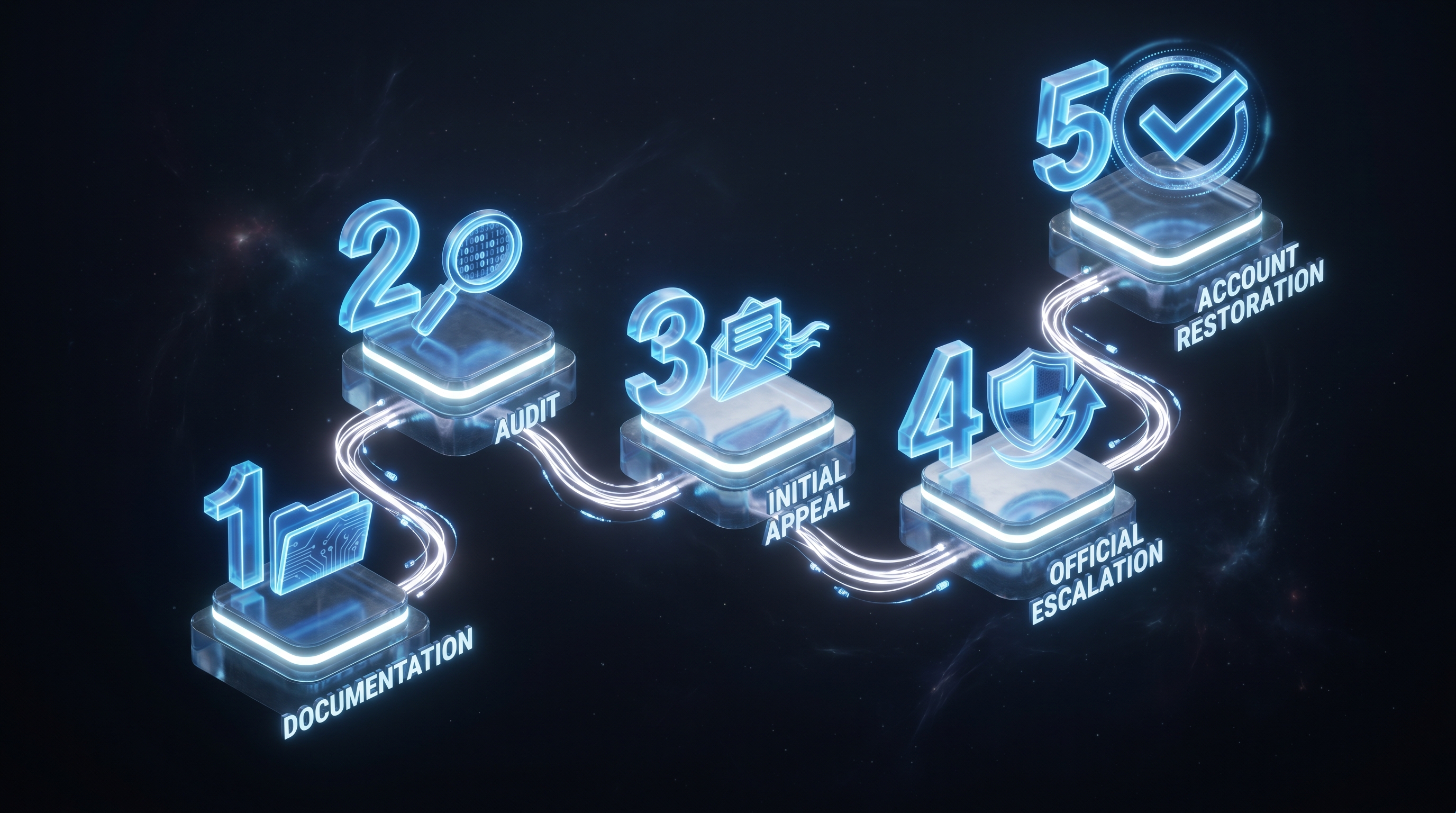
Step 1 — Document Everything Immediately (Screenshots, Notifications, History)
The moment you discover your Instagram account has been removed or restricted, your first action — before attempting any appeal, before contacting anyone — is to document everything you can access. Screenshot the ban notification email in full, including any account identifiers, policy references, and case numbers. Screenshot the in-app notification if the account is not yet fully disabled. Navigate to any connected Meta Business Manager and screenshot the account status, connected apps, and any policy warnings. Download whatever remains of your account data using Instagram's data download function if you can still access the account. Review and screenshot your last 30 days of DM automation activity — including which tool was connected, what flows were running, and what volumes were sent. This documentation forms the evidentiary foundation of your appeal and will be required by any specialist recovery service or legal representative you engage if the standard appeal fails. Time is critical: some account data becomes inaccessible within 30 days of removal.
Step 2 — Submit Through Every Available Channel Simultaneously
Once you have documented your situation, submit your appeal through every available channel at the same time rather than trying one channel, waiting for a response, and then trying the next. Available appeal channels include: the in-app appeal form (accessible even from a disabled account screen in many cases), the Meta Help Centre web form at help.instagram.com, the Meta Business Support portal if you have a connected Business Manager account, and — if you have Meta Verified — the priority support channel accessible through your subscription. Submitting through multiple channels simultaneously does not worsen your case (as some users believe); it creates multiple case records that can independently progress through the review system. Include the same core information in each submission: account username, account creation date, business category, a brief factual description of your account's purpose, and a specific denial that your account was used for the purpose cited in the ban notification. Keep the initial appeal brief and factual — do not include lengthy emotional appeals at this stage, as the initial review is likely AI-assessed and rewards structured factual information over personal narrative.
Step 3 — Build Your Evidence Package for Legitimate Activity
In parallel with submitting initial appeals, prepare a comprehensive evidence package demonstrating the legitimate nature of your account and its activities. For business accounts, this includes: your business registration documents (GST registration, MSME certificate, company incorporation documents for Indian businesses), your brand's physical or digital storefront evidence (website URL, product catalogue, e-commerce store screenshots), examples of brand partnership agreements, invoices, or press coverage, and screenshots of the content categories that represent your typical posts with explanatory annotations. If your account is in a youth-adjacent niche (EdTech, children's products, youth fitness), include documentation of your professional context: teaching credentials, business licences, safeguarding certifications, or professional association memberships. For creators without formal business documentation, a portfolio of your content work, engagement analytics exports, and evidence of commercial relationships (brand collaboration emails, affiliate programme membership confirmations) serves a similar purpose. This package is what you escalate with if the initial AI-reviewed appeals fail to produce a resolution.
Step 4 — Escalation Options (Meta Verified Priority, Regulators, Lawyers)
If standard appeals fail to restore your account within two weeks, the escalation pathway depends on the ban type and your resources. For Account Integrity bans, Meta Verified priority support is the most effective escalation — if you don't currently subscribe, the retrospective value of access to human review may justify the cost of subscribing even after the ban event. For CSE bans, where AI review of appeals is nearly universal and human review is rare, specialist social media account recovery services (several operate in India) that have established Meta business relationships may be the most effective route. For Indian users, filing a consumer complaint with the Ministry of Electronics and Information Technology (MEITY) regarding the removal of a legitimate business account creates a regulatory escalation that Meta is required to respond to under the IT Rules 2021 significant social media intermediary provisions. In cases involving reputational damage from false CSE labels, a legal letter from a technology law practitioner referencing the applicable defamation and data protection provisions under Indian law may produce a more rapid resolution than the appeals process alone.
Step 5 — Rebuilding If the Appeal Fails (New Account Strategy)
If all appeal pathways are exhausted and your account cannot be restored, the rebuilding strategy requires a clean-slate approach that avoids recreating the conditions that produced the original ban. Before creating a new account: disconnect all third-party apps from Meta on all your devices (Settings > Apps and Websites on any remaining Meta account), perform a full review of the content and automation practices that produced the original risk signals, and switch to a new automation tool (or reconfigure your existing tool with conservative rate limits) before connecting any automation to the new account. When creating the new account: use a device that has not been associated with the banned account if possible, verify your identity fully from the outset including business details if applicable, build at a conservative growth pace for the first 90 days before activating automation, and implement the full five-layer safety stack described above before starting your first DM campaign. Reconnecting with your existing audience via email (if you collected email addresses), through WhatsApp Business, or through other social platforms before your new account reaches sufficient scale helps bridge the community continuity gap. The getting unbanned after automation errors guide covers the new account strategy in full technical detail.
If You Were Banned for Automation-Related Reasons — A Specific Playbook

Identify Whether It Was CSE or Account Integrity (Different Appeals)
If your account was banned and you use DM automation, the first diagnostic question is whether the ban is classified as CSE or Account Integrity — because the appeal strategy, tone, evidence requirements, and escalation pathways differ substantially between the two. Instagram's ban notification email typically includes a policy reference: Community Guidelines violations related to "sexually exploiting minors" or similar language indicate CSE classification, while references to "spam", "fake engagement", "inauthentic behaviour", or "platform manipulation" indicate Account Integrity classification. If the notification is ambiguous, check your Meta Transparency Centre page (accessible at transparency.meta.com) for any account action records, which include policy categories. Account Integrity appeals should focus on demonstrating legitimate business activity, explaining the automation tool you used and its official API compliance, and showing that your DM volumes were within safe thresholds. CSE appeals require an entirely different posture: unambiguous documentation of the legitimate nature of any youth-adjacent content, professional context establishing your relationship to the content subjects, and — in clear false-positive cases — a calm, factual assertion that the classification is incorrect without speculating about why the AI made the error.
How to Remove Third-Party App Access Before Appealing
Before submitting any appeal for an automation-related ban, you must remove all third-party app connections from your Instagram account — including the tool that was running at the time of the ban. This step is critical because an active third-party app connection is visible to Meta's reviewers and will immediately raise the question of whether the app was complicit in the policy-violating behaviour. To remove app connections: navigate to instagram.com on a browser > Settings > Apps and Websites > Active apps > remove all automation tools. If you cannot access your account, remove the connections through the Facebook Settings > Apps and Websites page for any apps connected via the same Meta Business Manager. Document that you have removed the connections (screenshot the empty app access list) before submitting your appeal, and reference this action in your appeal submission as evidence that you are taking the enforcement concern seriously and have proactively addressed the technical factors that may have contributed to the flag.
Switching to a Safer Tool Before Reactivating Automation
Once your account is restored — either through appeal or through starting fresh — the single most important operational change you must make before reactivating any automation is switching to a tool that operates with fully transparent, conservative rate limits. An account that has previously received an Account Integrity action is flagged in Meta's enforcement system and faces a lower effective threshold for subsequent actions: the same DM volume that triggered a warning on your original account may trigger a permanent ban on the restored account. QuickDM's 20 DMs/hour free plan is specifically appropriate for this scenario: it is conservative enough to operate safely even on a risk-elevated account, and its official Meta API compliance means you are not re-introducing a third-party access pattern that the enforcement system will recognise as the same class of tool that caused the original issue. The agency guide to Instagram automation in 2026 covers the tool migration process — including how to transfer existing automation flows to a new tool without creating a multi-tool risk window — in full operational detail.
New Device, New IP, New Approach — When to Start Fresh
In cases where a full account ban cannot be overturned and rebuilding on a new account is the only path forward, the technical environment from which you access Instagram matters as much as the content and automation practices you adopt. Meta's enforcement AI uses device fingerprints and IP address history as risk signals: a new account created on the same device that housed the banned account, with the same IP address, will immediately inherit an elevated risk score from the association with the previous ban event. The practical mitigation is straightforward: create your new Instagram account from a new device if possible, access it through a fresh network connection (switching ISP, mobile data, or VPN — though sustained VPN use on Instagram has its own risk implications), and avoid connecting it to any Meta Business Manager or Facebook Page that was associated with the previous banned account during the first 90-day establishment period. These steps are not foolproof — Meta's cross-platform tracking is sophisticated — but they materially reduce the inherited risk signal that a rebuilt account carries from its predecessor.
How QuickDM's Conservative Defaults Prevent This From Happening Again
The simplest description of QuickDM's safety architecture is this: it is a tool engineered to ensure that the automation layer is never the reason your account gets banned. The 20 DMs/hour cap on the free plan, the humanised send patterns with randomised delays, the single-tool API footprint, the official Meta Graph API compliance (no unofficial or scraping-based access), and the conservative content guidelines built into the platform's DM template examples all work together to produce an account behaviour profile that Meta's enforcement AI does not flag. For an account recovering from an automation-related ban, this means the tool itself stops being a risk factor — leaving only the content and creative practices that you control as the variables requiring ongoing management. The combination of QuickDM's safety architecture with the content hygiene and behaviour practices described in this guide creates an enforcement-resistant operating model that is available starting at ₹0, with no credit card required. [CTA: Switch to the only DM tool engineered for your account's safety — start free today → https://quickdm.app/auth/signup]
Instagram Automation Dos and Don'ts in 2026
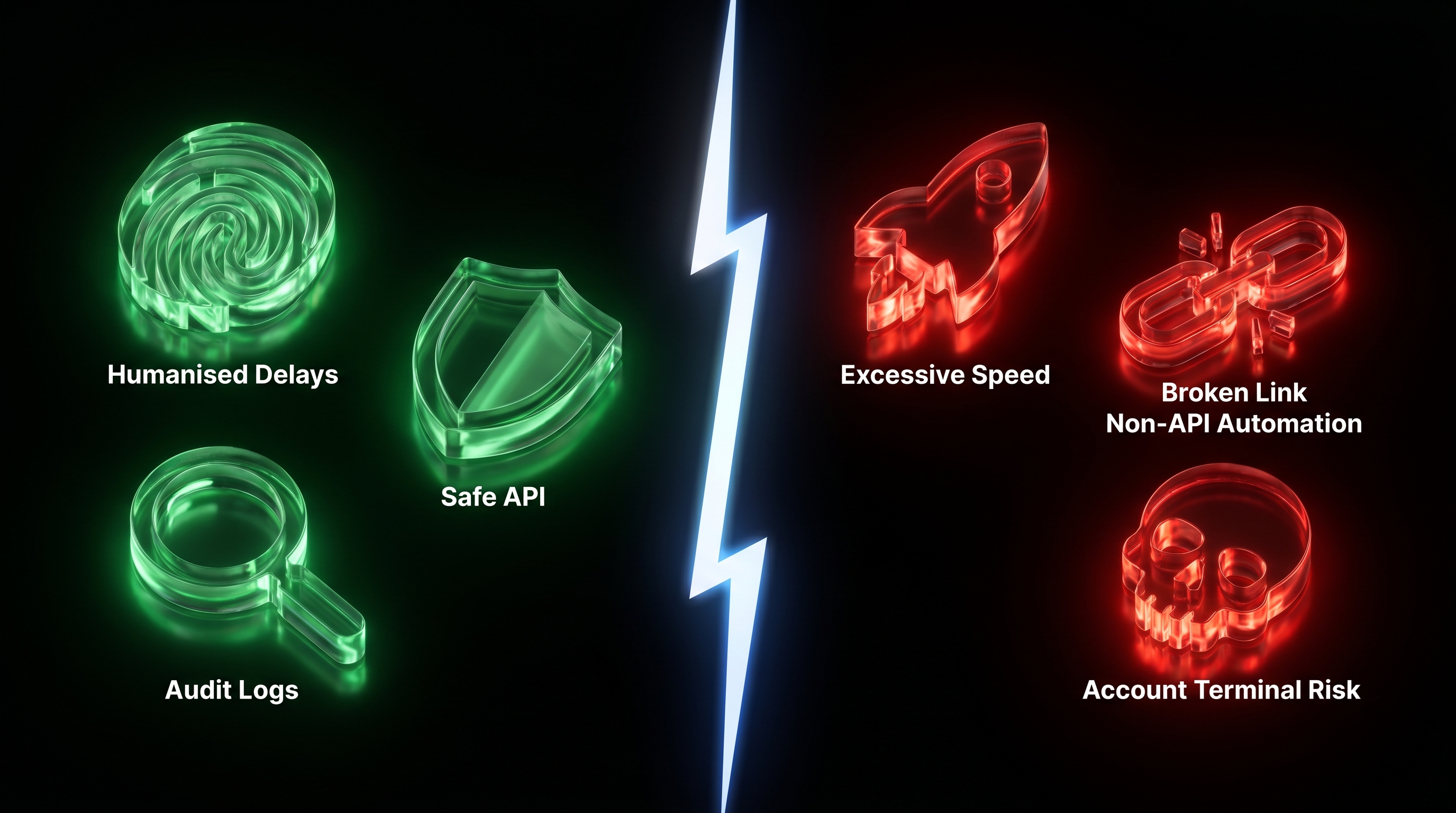
DOs — Safe Practices That Build Engagement Without Triggering Flags
The safe automation practices in 2026 share a common underlying principle: behave like a very efficient human, not like a machine. Use comment-to-DM triggers rather than cold outreach campaigns — triggered DMs sent in response to a real comment are explicitly lower risk than unsolicited mass DMs because they have a defined, legitimate initiation event. Use follow-gating to ensure your DM recipients have actively opted into a relationship with your account, which creates a consent signal that reduces spam classification risk. Back up your follower and email lists monthly, so that any account action does not result in permanent audience loss. Keep all your automation activity within one tool at a time. Review your DM template copy quarterly to ensure it remains free of risk-flag keyword categories. Monitor your account's action block and reach restriction history as early warning indicators that your automation settings need adjustment. And use QuickDM's free plan to establish a safe automation baseline before considering any higher-volume tool. For the complete framework, the DM automation practices that keep accounts safe guide covers every DO in operational detail with specific implementation examples.
DON'Ts — Actions That Increase Your Ban Risk Dramatically
The don'ts of safe Instagram automation in 2026 are, without exception, shortcuts that trade short-term convenience for long-term account risk. Never stack multiple automation tools on the same account simultaneously — the multi-tool API footprint is one of the clearest bot signals Meta's enforcement system can detect. Never send DMs in rapid identical bursts — the machine-regularity of burst sending is the behavioural fingerprint that triggers Account Integrity flags. Never use youth-related or urgency-pressure keywords in your DM templates without reviewing them against current risk-flag categories. Never run follow-unfollow loops at the same time as DM automation — the combined high-frequency follow and message activity produces a predatory behaviour profile. Never rely on Instagram as your only audience channel — without an email list or alternative platform presence, a single account action can be a catastrophic business event rather than a recoverable setback. And never ignore an action block as a minor inconvenience: an action block is a formal warning from Meta's enforcement system that your account's behaviour is approaching a threshold. What to do when Instagram blocks your automation should be your immediate next read after receiving any action block notification.
Content Types to Avoid Pairing With High-Volume Automation
Content risk and automation risk are additive in Meta's signal fusion model — pairing high-risk content categories with high-volume automation behaviour is the specific combination that produces enforcement-level risk scores from individually sub-threshold signals. The content types to isolate from any active automation campaign include: images of minors in any context (swimwear, sportswear, or simply as the primary subject of a commercial post), captions using youth-adjacent commercial language, posts with engagement instructions that include age-restricted qualifications ("only for 18+ followers" paradoxically creates a teen-interaction risk signal by highlighting age), and any content involving physical fitness demonstrations by young-looking subjects. During periods when any of these content types are active in your feed, reduce your automation to comment-to-DM responses only (which have a defined legitimate trigger) and pause any proactive DM campaigns until the content cycle moves on. This content-automation segmentation calendar approach adds minimal operational friction and significantly reduces the risk of signal combination triggering enforcement.
Hashtag and Keyword Hygiene for DM Campaigns
Hashtag strategy intersects with DM automation risk in a way that many creators don't anticipate. Instagram's NLP layer analyses not just DM content but the hashtag context of the posts triggering comment-to-DM flows: a DM automation campaign triggered by comments on a post using youth-adjacent hashtags (#teensfitness, #kidsactivities, #youthsports) will be contextualised against those hashtags in the AI's risk assessment. Using these hashtags on posts that are simultaneously driving high DM volumes creates an amplified risk signal. The practical solution is hashtag segmentation: maintain separate content pillars for youth-adjacent content (which uses relevant hashtags but has no automation running) and automation-active content (which uses professional, non-age-specific hashtags). Additionally, review your DM template text for any keyword patterns that resemble the language of grooming, deception, or exploitation — not because you're writing this content, but because common marketing phrases ("exclusive access", "just for you", "don't tell anyone") can pattern-match against training data categories in ways that create false-positive NLP flags.
The Right Way to Use Follow-Gating Without Triggering Spam Signals
Follow-gating — the practice of requiring a user to follow your account before receiving a promised resource via DM — is one of the most powerful features in the Instagram automation toolkit and, when implemented correctly, one of the safest. The key to safe follow-gating is the value exchange clarity: the promise in your post must clearly state what the user will receive when they follow and comment (a PDF, a link, a discount code, a resource), and the DM delivery must fulfil exactly that promise. Follow-gating that is deceptive (promising one thing, delivering another), that targets minors with inappropriate content, or that uses the follow requirement as a pretext for adding contacts to a cold outreach list violates both platform policy and best practice. QuickDM's follow-gating feature on the free plan (up to 100 followers) is designed specifically for transparent value-exchange follow-gating: the automation checks follower status, delivers the promised resource, and can extend the flow to include email collection — all within the 20 DMs/hour safe limit. For the complete technical setup, the comment-to-DM automation setup guide includes step-by-step follow-gating configuration instructions.
Instagram Automation Dos & Don'ts — 2026 Quick Reference | |
✅ DO | ❌ DON'T |
|---|---|
Use tools that cap at ≤20 DMs/hour | Stack multiple automation tools simultaneously |
Randomise send timing with human-like delays | Send DMs in rapid identical bursts |
Segment content — avoid kid-adjacent posts during DM campaigns | Use youth/child-related hashtags in mass DM campaigns |
Back up your follower and email lists monthly | Rely on Instagram as your only owned channel |
Keep all automation in one tool only | Run follow-unfollow loops with DM automation simultaneously |
Use comment-to-DM triggers with original content | Use reposts or unoriginal content in automated flows |
Appeal immediately with full documentation | Spam repeated appeals (can worsen your case) |
Agency and Creator Guide — Scaling Safely With Multiple Client Accounts
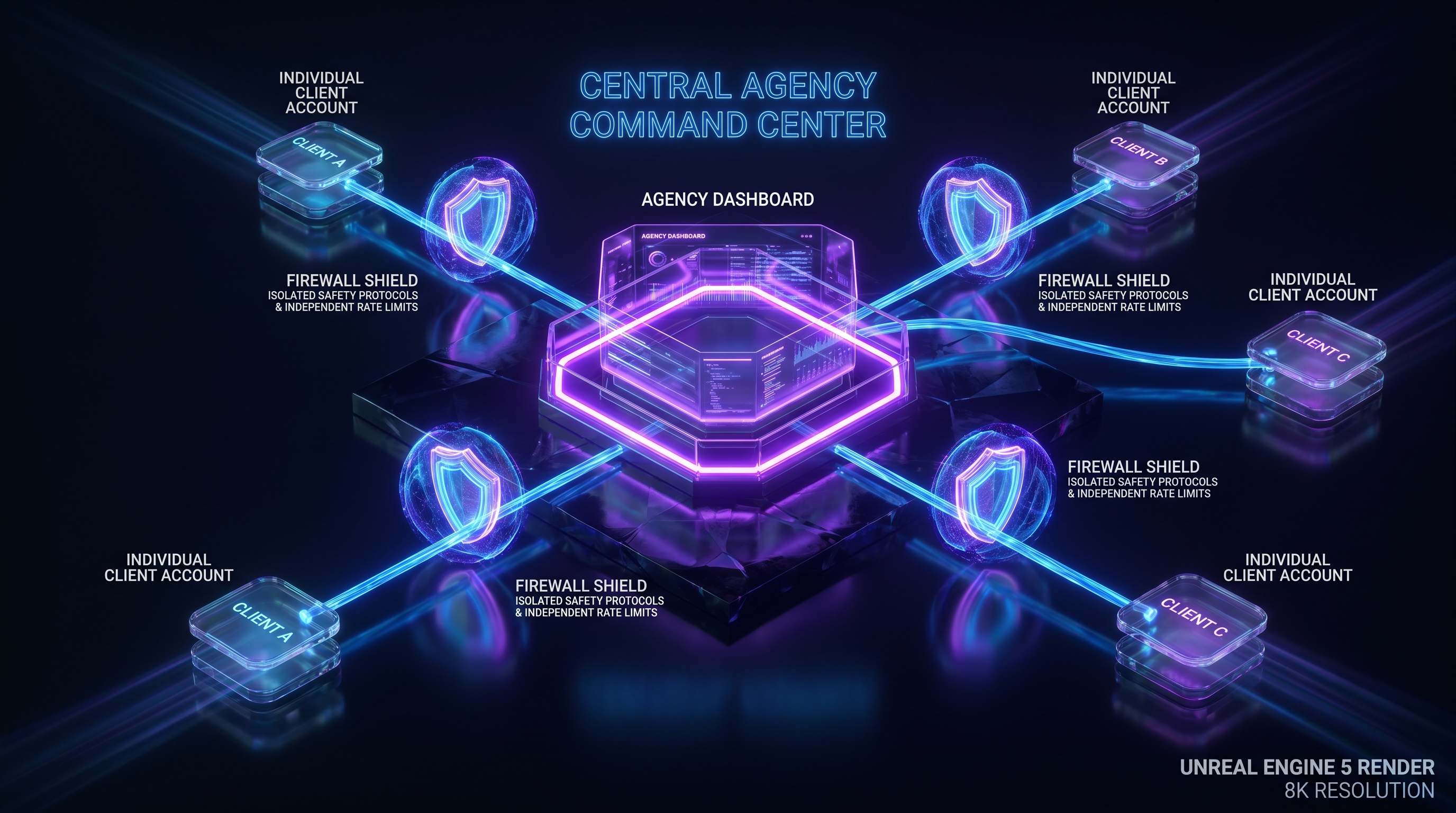
The Multi-Account Risk — What Happens When One Client Gets Banned
For agencies managing DM automation across multiple client Instagram accounts, the 2026 enforcement environment has introduced a specific operational risk that most agency workflows were not designed to manage: cross-account contamination. When one client account receives an Account Integrity ban, Meta's enforcement systems flag the third-party apps, device identifiers, and IP addresses associated with that account — which may also be associated with every other client account the agency manages from the same infrastructure. The contamination risk is not guaranteed — Meta's enforcement is probabilistic, not deterministic — but the elevated risk profile that a banned account creates for its infrastructure-sharing neighbours is real and documented. Agencies that use a single ManyChat account or a single automation tool credential to manage multiple client Instagram accounts through a centralised dashboard are particularly exposed: a single banned client account can create a tool-level flag that affects every account connected to the same tool credential. The isolation principle — separate tool credentials, separate device environments where possible, and conservative rate limits across all client accounts — is the agency-level equivalent of the one-tool rule for individual creators. For the full agency guide to Instagram automation in 2026, the operational framework covers multi-account risk management in comprehensive detail.
Agency-Safe Automation Practices in 2026
Safe automation at agency scale requires the same five-layer safety stack as individual accounts, with additional isolation protocols that prevent risk contamination between clients. The agency-specific additions to the safety stack are: client onboarding content audits (review every new client's existing content for risk flags before connecting any automation), separate tool credentials per client where feasible (avoiding a single shared automation account that touches multiple client APIs), conservative rate limit enforcement across all client accounts regardless of their individual account age or follower count (the weakest account in your portfolio sets the safety standard for the whole), a documented incident response protocol for when a client account receives an action block or ban (including the steps to immediately isolate that client's automation and assess contamination risk to adjacent accounts), and a quarterly safety review cycle that reassesses all client content categories and automation configurations against the latest enforcement patterns. Agencies that implement these protocols create a safety culture that becomes a competitive differentiator — as the 2026 ban wave continues, clients will increasingly seek agencies that can demonstrate they have not put their accounts at risk.
Managing Client DM Campaigns Without Shared Risk
The operational mechanics of managing multiple client DM campaigns without shared risk centres on tool and credential isolation. The ideal architecture for a safety-first agency is one tool connection per client account — each client's Instagram account connected to its own automation tool credential with its own API key, operating independently without sharing rate limit quotas with other clients. QuickDM's pricing model (₹399/month per connected account on Pro) makes this architecture financially viable for Indian agencies in a way that ManyChat's per-contact billing never could: managing 10 client accounts on QuickDM Pro costs ₹3,990/month, while managing the same accounts on ManyChat Pro would cost $290/month (≈₹24,200/month) plus overages. The cost differential directly enables the isolation architecture that makes the agency's client portfolio safer. For resolving the fragmented DM inbox problem that multi-account management creates, the dedicated guide covers the unified inbox approach that maintains isolation while giving agency managers visibility across all client accounts.
Tool Selection for Agencies — ManyChat vs. QuickDM at Scale
The agency tool selection decision in 2026 comes down to two competing priorities: feature depth vs. cost and safety architecture. ManyChat offers the most feature-complete multi-platform automation suite, but its per-contact billing creates scaling costs that become prohibitive for agencies managing high-contact-count client accounts, and its lack of published rate limits makes it impossible to independently verify the safety profile of its automation for each client. QuickDM offers a simpler feature set focused on Instagram, but with explicit rate limits, flat pricing, and a safety architecture designed specifically to prevent the Account Integrity bans that are the primary automation-related risk in the 2026 enforcement environment. For agencies whose clients operate primarily on Instagram — which describes the majority of Indian digital marketing agencies and most global creator economy agencies — QuickDM's focused Instagram-first architecture is a better fit than ManyChat's multi-platform complexity. For agencies managing clients across Facebook, WhatsApp, and Instagram simultaneously at enterprise scale, ManyChat's feature depth may still justify the cost despite its safety ambiguities. The comparing DM automation tools in 2026 guide includes an agency-specific evaluation framework for making this decision based on your specific client portfolio profile.
Building Client Reporting and Backup Workflows
Professional agency operations in the 2026 enforcement environment require a systematic client reporting and backup workflow that goes beyond standard campaign performance reporting to include safety metrics and data resilience measures. On a monthly cadence, agencies should: export all client follower lists and email collections from their automation tools, deliver clients a safety report that includes DM volumes sent, action blocks received (if any), and automation configuration changes made, review each client's content feed for new risk signals that should trigger automation adjustments, and confirm that each client's backup data (follower export, email list, content archive) has been updated. This reporting and backup practice protects the agency as much as it protects clients: documented monthly safety reviews create a paper trail demonstrating due diligence if a client account is banned and the client questions whether the agency's automation practices contributed to the outcome. For the practical process of implementing this workflow using Instagram automation for agencies, the dedicated guide includes template reporting formats and monthly safety review checklists.
Comment-to-DM Automation — The Safest Automation Format in 2026
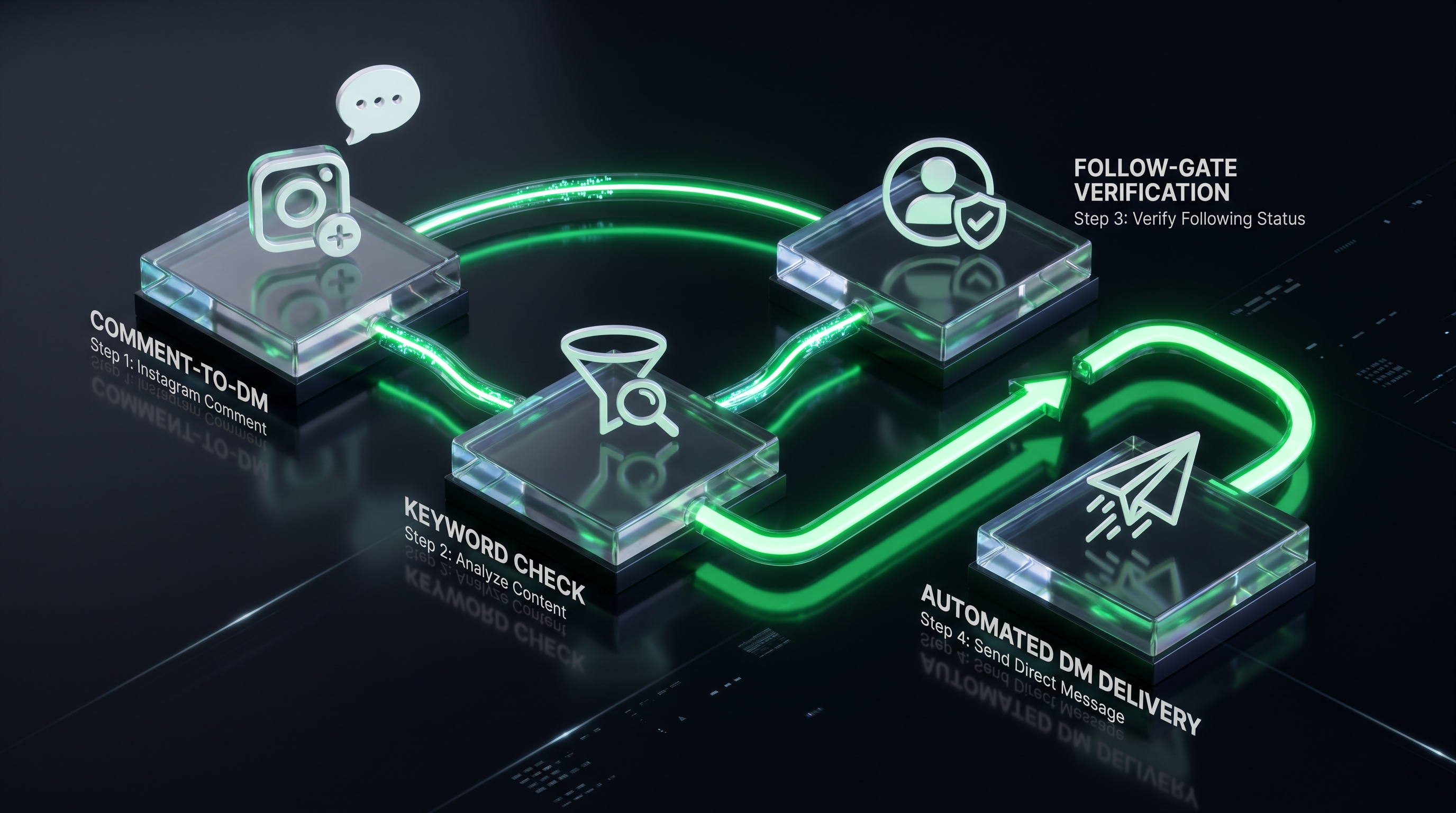
Why Comment Triggers Are Lower Risk Than Cold DM Campaigns
Comment-to-DM automation is structurally safer than cold DM outreach for a straightforward reason: the comment trigger creates a documented, legitimate initiation event that contextualises the subsequent DM as a response to user-generated interest rather than unsolicited contact. When Meta's enforcement AI assesses a DM, the presence of a recent comment by the DM recipient on the sender's post is a positive context signal — it indicates a bilateral interaction pattern characteristic of legitimate engagement rather than mass spam behaviour. Cold DM campaigns lack this contextual signal entirely: each DM appears as an unsolicited contact with no visible trigger event, which pattern-matches more closely to the spam and predatory outreach behaviour that the enforcement system is trained to detect. The practical implication: for any account concerned about ban risk in 2026, comment-to-DM triggers should be the default automation format, with cold DM campaigns reserved for high-value, low-volume use cases where the risk-reward calculation explicitly justifies the higher safety tradeoff. For the complete comment-to-DM automation setup guide, including trigger configuration, message template best practices, and safety settings, the dedicated walkthrough covers every step.
Setting Up Comment-to-DM Automation Without Tripping Spam Filters
A comment-to-DM automation setup that avoids spam filter triggers requires attention to four specific configuration details. First, set a keyword trigger that is specific enough to exclude accidental activations: "Price" or "Send link" is better than "yes" or a single emoji, because high-volume emoji triggers can create burst-send patterns when popular posts go viral. Second, configure a minimum comment length requirement if your platform supports it — filtering out one-character or emoji-only comments reduces the trigger volume and improves the intent signal quality of your DM recipients. Third, use message personalisation in your DM template: include the recipient's username and a specific reference to the post or product they commented on rather than a generic message. Fourth, set a rate limit cap explicitly in your tool's settings even if the tool has a default — QuickDM's 20 DMs/hour cap on the free plan means this is handled automatically, but on tools with higher default caps, manually reducing the limit to 20/hour is an important safety configuration step. The complete Instagram automation setup guide includes screenshots of these configuration settings across the major tool platforms.
Post, Reel, and Story — Which Works Best for Comment Triggers
Comment-to-DM automation can be triggered from standard posts, Reels, and — through some platforms — Story replies, each with different engagement characteristics and risk profiles. Standard posts and Reels support public comments, which means anyone who discovers the post organically through hashtags or the Explore feed can trigger the automation — creating exposure to users you have no prior relationship with, including potential minor-age accounts. This is manageable with keyword specificity (requiring a deliberate keyword trigger rather than any comment) and follow-gating (requiring the commenter to follow your account before receiving the DM). Story replies are a lower-public-exposure format because only your existing followers can view and reply to your Stories — reducing the risk of unknown users triggering your automation. Note that Story reply automation is a "coming soon" feature on QuickDM — currently the platform's most effective comment trigger format is standard post and Reel comments. For accounts in high-risk content niches, Reels tend to produce higher-quality comment triggers because the short-form video format generates more intentional, context-aware engagement than static posts.
Combining Comment Automation With Follow-Gating Safely
The combination of comment-to-DM automation with follow-gating is one of the most powerful and safe automation flows available on Instagram in 2026. The flow works as follows: a user comments on your post with the trigger keyword → the automation checks whether they follow your account → if they do, they receive the promised resource immediately → if they don't, they receive a DM explaining that the resource is available when they follow the account → upon following, the automation detects the new follow and delivers the resource. This flow simultaneously drives follower growth (from the follow-gating incentive), DM engagement (from the resource delivery), and email collection (if the flow includes a follow-up DM asking for email address) — all at the controlled 20 DMs/hour rate that keeps the account well within safe thresholds. The consent architecture of this flow — the user initiates with a comment, accepts the follow request explicitly, and receives the resource they asked for — creates a positive interaction pattern that Meta's enforcement AI contextualises as legitimate engagement rather than spam. QuickDM's free plan supports this exact flow for up to 100 follow-gating completions, making it immediately available to every user without any upfront investment.
QuickDM's Comment-to-DM Setup in Under 5 Minutes
Setting up a comment-to-DM automation flow in QuickDM takes under five minutes from account connection to first live automation. The process: connect your Instagram Business account to QuickDM through the official Meta OAuth flow (no password sharing, no unofficial API access), create a new automation flow from the dashboard, select "Comment Trigger" as the flow type, enter your keyword trigger (e.g., "SEND" or "GUIDE" or any specific word you include in your post caption), write your DM template with recipient name personalisation, optionally enable follow-gating and email collection, and publish the flow. The automation is live immediately — the next comment containing your trigger keyword on any of your posts will fire the first DM. The 20 DMs/hour rate cap operates automatically in the background; you don't need to configure it manually. The entire setup process is covered step-by-step in the comment-to-DM automation setup guide, with screenshots of each configuration screen. [CTA: Set up your first comment-to-DM automation in 5 minutes — free forever, no credit card → https://quickdm.app/auth/signup]
Using DM Automation for Lead Generation and Email Collection

Why Email Is Your Insurance Policy Against Instagram Bans
The 2026 Instagram ban wave has delivered a lesson that every creator and business relying on Instagram as their primary audience channel needed to hear: platform-owned audiences are borrowed, not owned. The followers you have built on Instagram exist in Meta's infrastructure, are accessible only while your account remains active, and can be made inaccessible without warning by an automated enforcement decision that has no guaranteed resolution timeline. An email list, by contrast, is an audience you own unconditionally — it lives in your email platform, is accessible regardless of what happens to any social media account, and can be communicated with at any time, at any volume, with no algorithm between you and your audience. Building an email list through Instagram DM automation is the most efficient path from a borrowed platform audience to an owned, durable one — and it's a strategy that every Indian creator and business should be implementing before they need it, not as a recovery measure after a ban event. The relationship between DM automation and affiliate product promotion via email also illustrates the revenue dimension of email list building: an email list converts at higher rates than Instagram DMs for commercial offers, making it both a resilience asset and a revenue multiplier.
Collecting Emails Through DM Automation — How It Works
Email collection via DM automation is a multi-step flow that converts a social media interaction into a owned contact record. The mechanics: a user comments on your post with the trigger keyword → they receive a DM with the promised free resource → a follow-up message in the same flow asks "Would you like me to send this to your email too? Just reply with your email address." → the user replies with their email → the automation captures the reply and stores it as a contact record. The opt-in nature of this flow — the user actively provides their email address in response to an explicit question — creates a GDPR and Indian PDPB-compliant consent record for each email contact, which is increasingly important for Indian businesses that fall under the Personal Data Protection Bill compliance framework. The email capture rate for well-designed flows (where the free resource has genuine value and the email request is positioned as additional convenience rather than a data capture demand) typically ranges from 30–60% of DM recipients — meaning a 100-DM campaign generating 30–60 email addresses, each representing a platform-independent audience contact.
QuickDM's Email Collection Feature on the Free Plan (Up to 100 Emails)
QuickDM's email collection feature is included in the free plan and captures up to 100 email addresses — a meaningful starter audience for any creator or business beginning to build their owned contact list. The feature is integrated directly into the comment-to-DM flow builder: when creating an automation, you can enable an "Email Capture" step that automatically extracts email addresses from user DM replies and stores them in your QuickDM contacts dashboard, with a CSV export option for transferring the list to your email marketing platform (Mailchimp, Klaviyo, ConvertKit, or any other). On the Pro plan at ₹399/month, the email collection cap is removed entirely — you can collect unlimited email addresses as part of your automation flows. For Indian D2C brands using Instagram as a primary acquisition channel, this feature alone — available free, requiring no credit card, on an Indian-priced platform — represents a significant competitive advantage: every product launch DM campaign is simultaneously building an email retargeting audience that can be used for WhatsApp Business broadcasts, email newsletters, and future product launches, independent of any Instagram account status.
Integrating Email Collection With Your CRM or Email Platform
The email contacts captured by QuickDM's automation flows can be exported as a CSV and imported into any major email marketing or CRM platform, creating a seamless pipeline from Instagram comment to managed email contact. For Indian businesses, the most commonly used integration targets include: Mailchimp (the most popular free-tier email platform globally), Klaviyo (the industry standard for D2C e-commerce email automation), ConvertKit (popular with creators and course businesses), and WhatsApp Business API platforms for businesses that use WhatsApp as their primary communication channel. The CSV export format is compatible with all of these platforms without any custom integration work — download from QuickDM, upload to your email platform, and your Instagram-captured contacts are immediately available for email and WhatsApp campaigns. For businesses ready to automate the import process, QuickDM's roadmap includes native integration with major email platforms — check the QuickDM website for the current integration status. The how to collect emails via Instagram DM guide covers the full CRM integration workflow with platform-specific import instructions.
Building an Audience You Actually Own
The strategic framing for email collection through Instagram DM automation is not "getting more leads" — it is "de-risking your business from platform dependency." Every email address you collect through Instagram automation is a contact that Instagram cannot take from you. Every follower who remains only a follower — never converted into an email subscriber — is an audience member that a single enforcement action can make permanently inaccessible. The goal of a mature Instagram DM automation strategy is to systematically convert your Instagram audience into owned channels: email lists, WhatsApp Business contacts, SMS subscribers, and community members on platforms you control. QuickDM's free plan gives you the tools to begin this conversion process with zero upfront cost — 20 DMs/hour, email collection for up to 100 contacts, follow-gating for up to 100 followers — and the Pro plan at ₹399/month removes the caps entirely. The insurance value of a 1,000-person email list, built through six months of consistent Instagram automation, is incalculable in the context of the 2026 ban wave. Start building it today, before you need it.
Collect up to 100 emails free with QuickDM — your backup if Instagram bans hit.
Start Building Your Email List Free → quickdm.app/auth/signup
Future-Proofing Your Instagram Strategy Beyond 2026

The Platform Diversification Imperative — Threads, TikTok, and Owned Channels
The 2026 ban wave is not the last time Instagram's enforcement AI will produce false positives at scale — it is the first widely visible iteration of a structural pattern that will recur as Meta's AI systems continue to evolve. Future-proofing your social media strategy requires treating Instagram as one channel in a diversified portfolio rather than the sole channel in your presence. The most valuable diversification moves in 2026 are: building a presence on Threads (Meta's own text-based platform, which currently benefits from the same audience graph as Instagram but faces lower enforcement scrutiny); establishing a content footprint on YouTube (where content is indexed permanently and generates long-term SEO value rather than disappearing from feeds within 48 hours); and creating at minimum a basic presence on TikTok (which, despite its own regulatory uncertainties, provides an alternative short-form video reach channel that can be activated quickly if Instagram access is disrupted). None of these alternatives replaces Instagram's current dominance for visual brand-building and DM-based conversion — but each one provides a continuity option that ensures a single platform action cannot destroy your audience outreach capability.
Building an Email List as Your Platform-Proof Asset
Among all the diversification options available to creators and businesses in 2026, email list building remains the highest-priority investment for a simple reason: it is the only audience format that is genuinely platform-independent. A YouTube channel can be demonetised. A TikTok account can be banned in a regulatory sweep. A Threads following disappears if Meta restricts that platform. An email list — maintained in your own email platform, exportable to a CSV, importable to any future platform — survives every platform action that has ever occurred and will ever occur. The integration of email collection into QuickDM's DM automation flow makes this investment essentially costless for Indian creators: instead of running Instagram DM campaigns that build only Instagram engagement (which helps Meta's metrics but leaves you with no owned asset), you run campaigns that simultaneously build engagement and collect email addresses, converting your Instagram visibility into a durable asset with every automation cycle. For creators operating at scale, a 10,000-email list built over 18 months of Instagram automation represents a communication asset worth tens of thousands of rupees in annual revenue potential — and it costs nothing beyond the ₹399/month Pro plan that powers the automation collecting those addresses.
What Meta's AI Evolution Means for 2027 and Beyond
Meta's investment in AI-powered content moderation is increasing, not decreasing — the 2026 enforcement wave is an early product of that investment, not its peak. By 2027 and beyond, we should anticipate: more sophisticated multimodal AI models capable of understanding cultural and linguistic context more accurately (which may reduce false positives for non-English content, though this is not guaranteed), faster enforcement turnaround times (which benefits genuine policy violation detection but reduces the window for proactive self-correction before an action is taken), more granular penalty structures (action blocks and content restrictions as intermediate measures before full account removal), and potentially improved appeals infrastructure with more explicit grounds for human review escalation. For automation tool users, the trajectory suggests that the safe DM rate thresholds of 2026 will remain relevant in 2027 — Meta's API rate limits are a structural ceiling, not an annual-revision policy — but that the content and keyword risk landscape will continue to evolve. Staying informed through Meta's official Policy Blog, the Meta Transparency Centre, and community resources like the QuickDM Blog's ongoing enforcement coverage is the practical way to track these changes as they occur.
Staying Ahead of Policy Changes — Resources to Monitor
The Instagram policy landscape changes faster than any single article can track — which means building a personal monitoring infrastructure is more valuable than relying on periodic guides. The authoritative sources to monitor for Instagram policy changes are: Meta's official Newsroom (newsroom.fb.com) for platform-wide policy announcements, the Meta Transparency Centre (transparency.meta.com) for enforcement data and Oversight Board decisions, the Instagram Help Centre (help.instagram.com) for direct policy documentation updates, the Meta for Developers blog (developers.facebook.com/blog) for API rate limit and Graph API changes, and community sources like the QuickDM Blog, which translates technical policy changes into practical automation guidance for Indian creators and agencies. For Indian businesses specifically, MEITY's IT Rules updates (particularly for significant social media intermediary obligations) and the TRAI (Telecom Regulatory Authority of India) digital communications guidelines are additional regulatory layers that affect how Meta must operate in the Indian market and can create policy changes that have downstream implications for account management practices.
Why Choosing a Conservative, Compliance-First Automation Tool Matters Long-Term
The long-term argument for choosing a conservative, compliance-first automation tool like QuickDM over a higher-throughput alternative is not just about avoiding bans in the current enforcement cycle — it's about building a sustainable automation practice that remains viable through whatever enforcement cycles Meta introduces next. Tools that stay within official API rate limits, use official Graph API access (not scraping or unofficial methods), and implement humanised send patterns are working with Meta's infrastructure rather than against it. If Meta adjusts its rate limits in 2027, a tool built at the conservative end of the current range is more likely to remain compliant with the new limits than a tool that was already operating close to the ceiling. If Meta introduces new content context requirements for automated DMs, a tool with a transparent architecture and a compliance-first development culture is more likely to implement those requirements proactively than one that has historically prioritised throughput over safety. The investment in a conservative tool is an investment in automation infrastructure that will still be working for you in 2028 — not one that will be the cause of your account's removal in 2027.
Frequently Asked Questions
Which is the cheapest Instagram DM automation tool?
QuickDM is the cheapest Instagram DM automation tool in 2026, with a free plan that includes 20 DMs/hour and unlimited automations — no credit card required. The paid Pro plan is $10/month globally and ₹399/month in India, making it significantly cheaper than ManyChat ($14–$139/month) [Source: manychat.com/pricing, verified May 2026] and CreatorFlow ($15/month) [Source: creatorflow.so/pricing, verified May 2026]. No per-contact overage fees apply on QuickDM. For a full breakdown, see our best Instagram DM automation tools comparison.
Is there a truly free Instagram DM automation tool?
Yes — QuickDM offers a free-forever plan with no credit card required. The free plan includes 20 DMs/hour, unlimited automation flows, follow-gating for up to 100 followers, and email collection for up to 100 contacts. Most competitors either hard-cap free DMs at 500/month (CreatorFlow, InstantDM) or restrict contacts to just 25 (ManyChat), making QuickDM the most generous free tier available.
Which Instagram automation tool is best for India?
QuickDM is the best Instagram DM automation tool for India. It is the only tool in the market with native INR pricing (₹399/month for Pro), is headquartered in Mumbai, and does not require a credit card for the free plan. ManyChat's equivalent tier costs ~₹1,170–₹5,760/month depending on contact volume, with additional international transaction fees. QuickDM's free plan also includes follow-gating and email collection — features that cost extra on all US-priced competitors. See our best Instagram automation tools for Indian small businesses guide.
Why is Instagram banning so many accounts in 2026?
Meta launched one of its largest enforcement sweeps in 2026, removing over 10 million accounts targeting bots, fake engagement, and CSE (Child Sexual Exploitation) violations [Source: unban.net, citing official Meta reports, 2026]. However, upgraded AI moderation has significantly increased false positives, with legitimate family brands, fitness coaches, educators, and small businesses getting caught in the crackdown. The AI system handles both ban decisions and appeal reviews with minimal human oversight.
What is a CSE ban on Instagram and can innocent accounts get one?
A CSE (Child Sexual Exploitation) ban is Instagram's most severe account action, triggered when Meta's AI detects content or behaviour it associates with child exploitation. Yes, innocent accounts can and do receive false CSE bans — documented cases include family photographers, youth fitness coaches, children's clothing brands, and teachers. The CSE label carries severe reputational damage even when overturned. Minimising automation risk factors (high DM volume, multi-tool use) reduces your exposure.
Can using a DM automation tool get your Instagram account banned?
Yes, if the tool sends DMs too aggressively. Meta's AI flags patterns that resemble bot behaviour — high DM volume per hour, rapid identical messages, and multiple-tool stacking are the most common triggers. Tools that cap send rates at 20 DMs/hour (like QuickDM) stay well within safe thresholds. Tools with higher throughput caps (e.g. 750/hour) significantly increase account integrity ban risk. See our guide on why multi-tool stacking gets accounts banned.
How many DMs per hour is safe on Instagram?
Based on Meta's Graph API rate limit patterns and community consensus among Instagram automation specialists, 20 DMs/hour is the widely cited safe ceiling for accounts of all sizes. QuickDM's free plan is engineered exactly at this limit. Exceeding 50 DMs/hour risks action blocks; exceeding 100/hour risks account suspension. Always add randomised delays between sends to further reduce bot-signal detection.
What should I do if my Instagram account is banned in 2026?
Act immediately: (1) screenshot all ban notifications and your account history, (2) submit appeals through the in-app form and Meta's Help Centre simultaneously, (3) compile evidence of legitimate business activity, (4) if Meta Verified, use priority support, (5) for persistent cases, contact MEITY in India or specialist recovery services. Do not spam multiple appeals. For the full process, see our Instagram ban recovery guide.
Does ManyChat cause Instagram bans?
ManyChat itself does not inherently cause bans, but its higher-tier plans allow send volumes that can approach or exceed safe thresholds if not carefully configured. ManyChat users who combine it with other automation tools risk multi-tool ban triggers. ManyChat's Trustpilot score of 2.6/5 reflects significant user frustration, with some complaints related to account actions following automation use [Source: trustpilot.com/review/manychat.com, verified May 2026]. See our ManyChat vs QuickDM comparison.
What is the difference between a shadowban and a real Instagram ban?
A shadowban suppresses your content's reach without disabling your account — you can still post and DM, but your posts won't appear in hashtag searches or the Explore feed. A real ban (account integrity or CSE) disables your account entirely, preventing login. Shadowbans are typically temporary (1–2 weeks) and self-resolve with reduced posting frequency. Full bans require formal appeals. Read our full guide on shadowban vs real ban — how to tell the difference.
Can I use Instagram DM automation for my Indian D2C brand without risking a ban?
Yes, with the right tool and conservative send rates. Indian D2C brands should choose tools like QuickDM that cap DMs at 20/hour, use comment-to-DM triggers rather than cold outreach, and avoid pairing automation with sensitive content categories. QuickDM's ₹399/month Pro plan and free tier are designed for Indian market economics and include email collection to build an owned audience as a backup to any Instagram account action. See the Instagram DM automation guide for Indian creators.
What happened to Instagram in July 2025?
July 2025 was the peak of Meta's 2025–2026 enforcement wave. Meta removed approximately 135,000 Instagram accounts for sexualised comments or image requests involving children, plus over 500,000 linked accounts associated with predatory behaviour — a total of nearly 635,000 account removals in a single month [Source: social-me.co.uk/blog/42, verified April 7, 2026]. This was driven by upgraded machine-learning filters that significantly increased both true positive and false positive detection rates.
Why is ManyChat so expensive compared to alternatives?
ManyChat's pricing model uses per-contact billing, meaning your monthly cost scales with your audience size. A creator with 1,000 contacts on the Essential plan ($14/month base) pays an additional $75/month in overages, bringing the real cost to ~$89/month. Alternatives like QuickDM ($10/month globally, ₹399/month in India) and CreatorFlow ($15/month) use flat pricing without per-contact fees, making costs fully predictable. See the cheapest ManyChat alternative guide. [Source: manychat.com/pricing, verified May 2026]
How do I collect emails through Instagram DM automation?
Email collection via DM automation works through a triggered flow: a user comments on your post → your automation sends them a DM with the promised resource → a follow-up message asks for their email address → the tool captures and stores the reply. QuickDM includes this feature on its free plan for up to 100 email captures, and the Pro plan removes this cap. This turns your Instagram audience into an owned list that survives platform bans and algorithm changes. Full walkthrough: how to collect emails via Instagram DM.
Is Instagram DM automation legal and against Meta's Terms of Service?
Instagram DM automation is permitted by Meta when done through officially approved API integrations. Tools that operate through Meta's official Graph API — including QuickDM — are compliant with Meta's Terms of Service. The risk of bans comes not from automation itself but from automation that mimics bot behaviour (excessive speed, identical messages, multi-tool stacking). Always use tools that operate within official API rate limits and avoid any tool that claims to bypass Meta's systems.